. 2019 Sep 25;286(1911):20191472.
doi: 10.1098/rspb.2019.1472. Epub 2019 Sep 25.

The importance of migratory connectivity for global ocean policy

Daniel C Dunn  1   2 Autumn-Lynn Harrison  3 Corrie Curtice  1 Sarah DeLand  1 Ben Donnelly  1 Ei Fujioka  1 Eleanor Heywood  1 Connie Y Kot  1 Sarah Poulin  1 Meredith Whitten  1 Susanne Åkesson  4 Amalia Alberini  1 Ward Appeltans  5 José Manuel Arcos  6 Helen Bailey  7 Lisa T Ballance  8   9   10 Barbara Block  11 Hannah Blondin  1   11 Andre M Boustany  12 Jorge Brenner  13 Paulo Catry  14 Daniel Cejudo  15 Jesse Cleary  1 Peter Corkeron  16 Daniel P Costa  17 Michael Coyne  18 Guillermo Ortuño Crespo  1 Tammy E Davies  19 Maria P Dias  19 Fanny Douvere  20 Francesco Ferretti  11   21 Angela Formia  22 David Freestone  23 Ari S Friedlaender  17 Heidrun Frisch-Nwakanma  24 Christopher Barrio Froján  25 Kristina M Gjerde  26 Lyle Glowka  24 Brendan J Godley  27 Jacob Gonzalez-Solis  28 José Pedro Granadeiro  29 Vikki Gunn  25 Yuriko Hashimoto  30 Lucy M Hawkes  27 Graeme C Hays  31 Carolina Hazin  19 Jorge Jimenez  32 David E Johnson  25 Paolo Luschi  33 Sara M Maxwell  34 Catherine McClellan  1 Michelle Modest  17 Giuseppe Notarbartolo di Sciara  35 Alejandro Herrero Palacio  1 Daniel M Palacios  10 Andrea Pauly  24 Matt Rayner  36 Alan F Rees  27 Erick Ross Salazar  22 David Secor  7 Ana M M Sequeira  37 Mark Spalding  38 Fernando Spina  39 Sofie Van Parijs  16 Bryan Wallace  1   40 Nuria Varo-Cruz  15 Melanie Virtue  24 Henri Weimerskirch  41 Laurie Wilson  30 Bill Woodward  42 Patrick N Halpin  1
Affiliations

The importance of migratory connectivity for global ocean policy

Daniel C Dunn et al. Proc Biol Sci. .

Abstract

The distributions of migratory species in the ocean span local, national and international jurisdictions. Across these ecologically interconnected regions, migratory marine species interact with anthropogenic stressors throughout their lives. Migratory connectivity, the geographical linking of individuals and populations throughout their migratory cycles, influences how spatial and temporal dynamics of stressors affect migratory animals and scale up to influence population abundance, distribution and species persistence. Population declines of many migratory marine species have led to calls for connectivity knowledge, especially insights from animal tracking studies, to be more systematically and synthetically incorporated into decision-making. Inclusion of migratory connectivity in the design of conservation and management measures is critical to ensure they are appropriate for the level of risk associated with various degrees of connectivity. Three mechanisms exist to incorporate migratory connectivity into international marine policy which guides conservation implementation: site-selection criteria, network design criteria and policy recommendations. Here, we review the concept of migratory connectivity and its use in international policy, and describe the Migratory Connectivity in the Ocean system, a migratory connectivity evidence-base for the ocean. We propose that without such collaboration focused on migratory connectivity, efforts to effectively conserve these critical species across jurisdictions will have limited effect.

Keywords: area-based management; areas beyond national jurisdiction; marine spatial planning; migratory species.


Conflict of interest statement

We declare we have no competing interests.

Figures
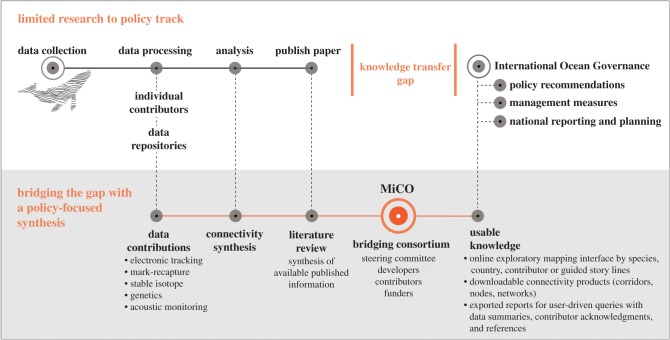
Figure 1.
Figure 1.
MiCO bridges a knowledge communications gap between researchers and policy fora. The typical flow of knowledge from data collection to scientific publication limits access to that knowledge and is dependent on participation by each individual researcher in all relevant policy processes. Bridging consortia like MiCO provide mechanisms to increase access to knowledge, ensure that it is provided in a usable format, and allow contributors to track the impact of their work.

References

    1. Hussey NE, et al. 2015. Aquatic animal telemetry: a panoramic window into the underwater world. Science 348, 1255642 (10.1126/science.1255642) - DOI - PubMed
    1. Webster MS, Marra PP, Haig SM, Bensch S, Holmes RT. 2002. Links between worlds: unraveling migratory connectivity. Trends Ecol. Evol. 17, 76–83. (10.1016/S0169-5347(01)02380-1) - DOI
    1. Block BA, et al. 2011. Tracking apex marine predator movements in a dynamic ocean. Nature 475, 86–90. (10.1038/nature10082) - DOI - PubMed
    1. Weimerskirch H, Delord K, Guitteaud A, Phillips RA, Pinet P. 2015. Extreme variation in migration strategies between and within wandering albatross populations during their sabbatical year, and their fitness consequences. Sci. Rep. 5, 1–7. (10.1038/srep08853) - DOI - PMC - PubMed
    1. Egevang C, Stenhouse IJ, Phillips RA, Petersen A, Fox JW, Silk JRD. 2010. Tracking of Arctic terns Sterna paradisaea reveals longest animal migration. Proc. Natl Acad. Sci. USA 107, 2078–2081. (10.1073/pnas.0909493107) - DOI - PMC - PubMed

Publication types