Healthy Dietary Patterns and Incidence of CKD: A Meta-Analysis of Cohort Studies
- PMID: 31551237
- PMCID: PMC6777603
- DOI: 10.2215/CJN.00530119
Healthy Dietary Patterns and Incidence of CKD: A Meta-Analysis of Cohort Studies
Abstract
Background and objectives: Whether a healthy dietary pattern may prevent the incidence of developing CKD is unknown. This study evaluated the associations between dietary patterns and the incidence of CKD in adults and children.
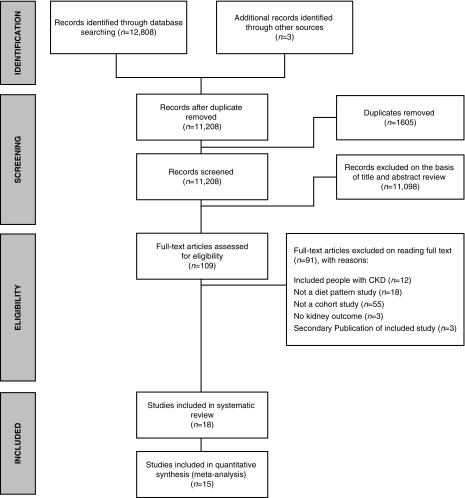
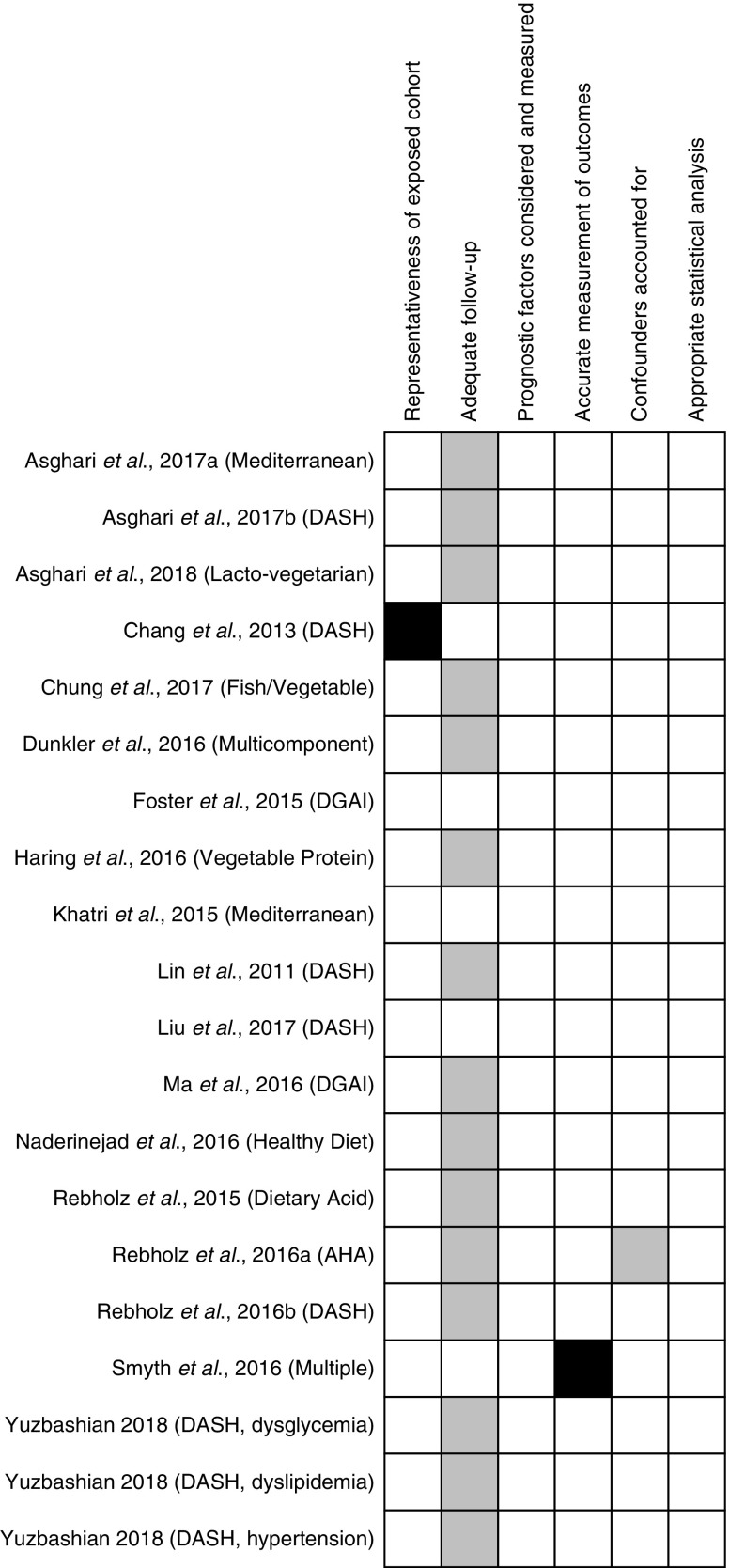
Design, setting, participants, & measurements: This systematic review and meta-analysis identified potential studies through a systematic search of MEDLINE, Embase and references from eligible studies from database inception to February 2019. Eligible studies were prospective and retrospective cohort studies including adults and children without CKD, where the primary exposure was dietary patterns. To be eligible, studies had to report on the primary outcome, incidence of CKD (eGFR<60 ml/min per 1.73 m2). Two authors independently extracted data, assessed risk of bias and evidence certainty using the Newcastle-Ottawa scale and GRADE.
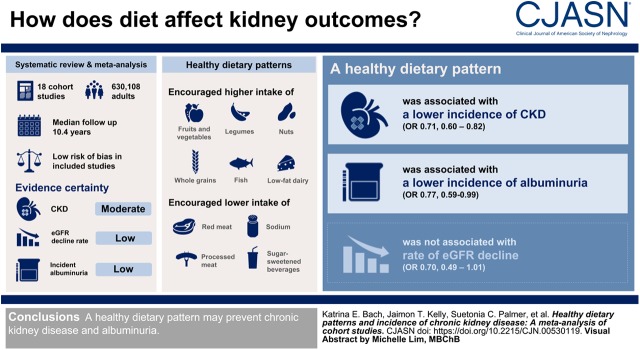
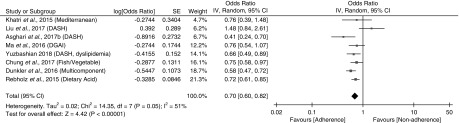
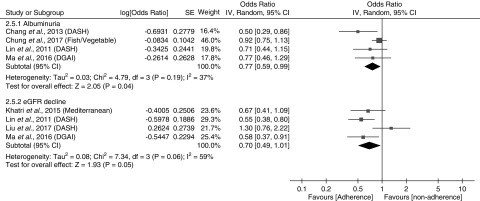
Results: Eighteen prospective cohort studies involving 630,108 adults (no children) with a mean follow-up of 10.4±7.4 years were eligible for analysis. Included studies had an overall low risk of bias. The evidence certainty was moderate for CKD incidence and low for eGFR decline (percentage drop from baseline or reduced by at least 3 ml/min per 1.73 m2 per year) and incident albuminuria. Healthy dietary patterns typically encouraged higher intakes of vegetables, fruit, legumes, nuts, whole grains, fish and low-fat dairy, and lower intakes of red and processed meats, sodium, and sugar-sweetened beverages. A healthy dietary pattern was associated with a lower incidence of CKD (odds ratio [OR] 0.70 (95% confidence interval [95% CI], 0.60 to 0.82); I2=51%; eight studies), and incidence of albuminuria (OR 0.77, [95% CI, 0.59 to 0.99]; I2=37%); four studies). There appeared to be no significant association between healthy dietary patterns and eGFR decline (OR 0.70 [95% CI, 0.49 to 1.01], I2=49%; four studies).
Conclusions: A healthy dietary pattern may prevent CKD and albuminuria.
Keywords: DASH; Diet; Mediterranean; adult; albuminuria; child; chronic kidney disease; chronic renal insufficiency; diet; dietary patterns; fabaceae; fat-restricted; follow-up studies; fruit; glomerular filtration rate; human; incidence; nuts; prospective studies; retrospective studies; sodium; sugars; sweetening agents; systematic review; vegetables; whole grains.
Copyright © 2019 by the American Society of Nephrology.
Figures
Comment in
-
Diet Patterns and Kidney Disease.Clin J Am Soc Nephrol. 2019 Oct 7;14(10):1417-1418. doi: 10.2215/CJN.09660819. Epub 2019 Sep 24. Clin J Am Soc Nephrol. 2019. PMID: 31551238 Free PMC article. No abstract available.
-
Can Dietary Patterns Modify Risk for CKD?Clin J Am Soc Nephrol. 2019 Oct 7;14(10):1419-1420. doi: 10.2215/CJN.09440819. Epub 2019 Sep 24. Clin J Am Soc Nephrol. 2019. PMID: 31591254 Free PMC article. No abstract available.
References
-
- Eknoyan G, Lameire N, Barsoum R, Eckardt KU, Levin A, Levin N, Locatelli F, MacLeod A, Vanholder R, Walker R, Wang H: The burden of kidney disease: Improving global outcomes. Kidney Int 66: 1310–1314, 2004 - PubMed
-
- Go AS, Chertow GM, Fan D, McCulloch CE, Hsu CY: Chronic kidney disease and the risks of death, cardiovascular events, and hospitalization. N Engl J Med 351: 1296–1305, 2004 - PubMed
-
- Kelly JT, Rossi M, Johnson DW, Campbell KL: Beyond sodium, phosphate and potassium: Potential dietary interventions in kidney disease. Semin Dial 30: 197–202, 2017 - PubMed
Publication types
MeSH terms
LinkOut - more resources
Full Text Sources
Medical
Research Materials
Miscellaneous