


Detailed 3-dimensional body shape features predict body composition, blood metabolites, and functional strength: the Shape Up! studies
- PMID: 31553429
- PMCID: PMC6885475
- DOI: 10.1093/ajcn/nqz218
Detailed 3-dimensional body shape features predict body composition, blood metabolites, and functional strength: the Shape Up! studies
Abstract
Background: Three-dimensional optical (3DO) body scanning has been proposed for automatic anthropometry. However, conventional measurements fail to capture detailed body shape. More sophisticated shape features could better indicate health status.
Objectives: The objectives were to predict DXA total and regional body composition, serum lipid and diabetes markers, and functional strength from 3DO body scans using statistical shape modeling.
Methods: Healthy adults underwent whole-body 3DO and DXA scans, blood tests, and strength assessments in the Shape Up! Adults cross-sectional observational study. Principal component analysis was performed on registered 3DO scans. Stepwise linear regressions were performed to estimate body composition, serum biomarkers, and strength using 3DO principal components (PCs). 3DO model accuracy was compared with simple anthropometric models and precision was compared with DXA.
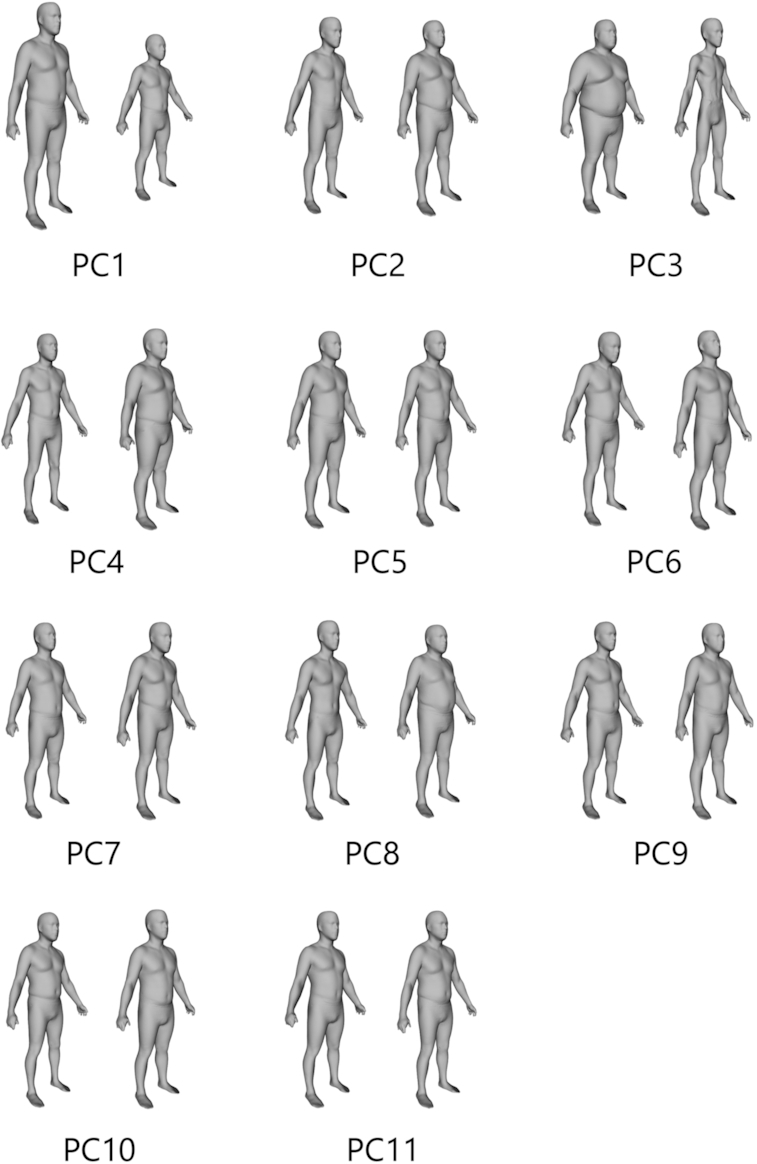
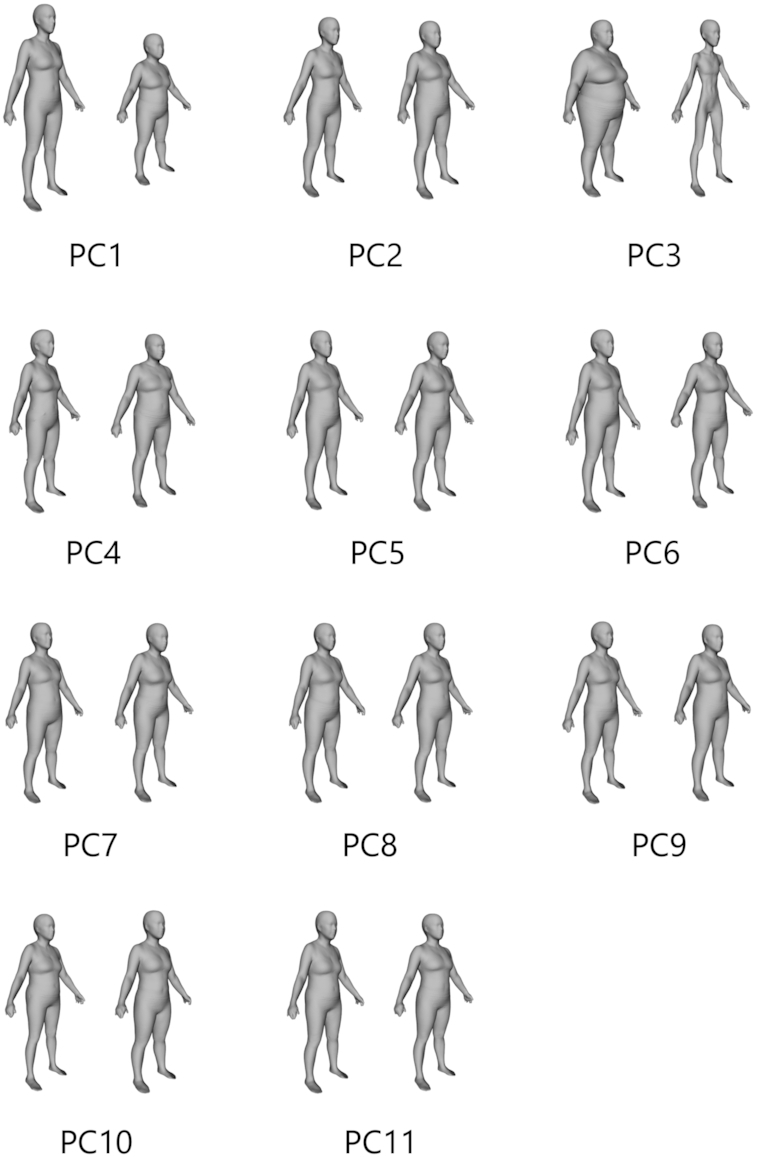
Results: This analysis included 407 subjects. Eleven PCs for each sex captured 95% of body shape variance. 3DO body composition accuracy to DXA was: fat mass R2 = 0.88 male, 0.93 female; visceral fat mass R2 = 0.67 male, 0.75 female. 3DO body fat test-retest precision was: root mean squared error = 0.81 kg male, 0.66 kg female. 3DO visceral fat was as precise (%CV = 7.4 for males, 6.8 for females) as DXA (%CV = 6.8 for males, 7.4 for females). Multiple 3DO PCs were significantly correlated with serum HDL cholesterol, triglycerides, glucose, insulin, and HOMA-IR, independent of simple anthropometrics. 3DO PCs improved prediction of isometric knee strength (combined model R2 = 0.67 male, 0.59 female; anthropometrics-only model R2 = 0.34 male, 0.24 female).
Conclusions: 3DO body shape PCs predict body composition with good accuracy and precision comparable to existing methods. 3DO PCs improve prediction of serum lipid and diabetes markers, and functional strength measurements. The safety and accessibility of 3DO scanning make it appropriate for monitoring individual body composition, and metabolic health and functional strength in epidemiological settings.This trial was registered at clinicaltrials.gov as NCT03637855.
Keywords: body composition; diabetes; imaging; obesity; principal component analysis; strength.
Copyright © American Society for Nutrition 2019.
Figures
Comment in
-
Three-dimensional optical scanning for clinical body shape assessment comes of age.Am J Clin Nutr. 2019 Dec 1;110(6):1272-1274. doi: 10.1093/ajcn/nqz258. Am J Clin Nutr. 2019. PMID: 31622453 No abstract available.
References
-
- Zhang C, Rexrode KM, van Dam RM, Li TY, Hu FB. Abdominal obesity and the risk of all-cause, cardiovascular, and cancer mortality. Circulation. 2008;117(13):1658–67. - PubMed
-
- Calle EE, Kaaks R. Overweight, obesity and cancer: epidemiological evidence and proposed mechanisms. Nat Rev Cancer. 2004;4(8):579–91. - PubMed
-
- Price GM, Uauy R, Breeze E, Bulpitt CJ, Fletcher AE. Weight, shape, and mortality risk in older persons: elevated waist-hip ratio, not high body mass index, is associated with a greater risk of death. Am J Clin Nutr. 2006;84(2):449–60. - PubMed
-
- Kuk JL, Katzmarzyk PT, Nichaman MZ, Church TS, Blair SN, Ross R. Visceral fat is an independent predictor of all‐cause mortality in men. Obesity. 2012;14(2):336–41. - PubMed
Publication types
MeSH terms
Substances
Associated data
Grants and funding
LinkOut - more resources
Full Text Sources
Other Literature Sources
Medical
