Review
. 2019 Sep 24;8(10):1136.
doi: 10.3390/cells8101136.

New Frontiers: ARID3a in SLE

Affiliations
Review

New Frontiers: ARID3a in SLE

Joshua Garton et al. Cells. .

Abstract

Systemic lupus erythematosus (SLE) is a devastating and heterogeneous autoimmune disease that affects multiple organs, and for which the underlying causes are unknown. The majority of SLE patients produce autoantibodies, have increased levels of type-I inflammatory cytokines, and can develop glomerulonephritis. Recent studies indicate an unexpected but strong association between increased disease activity in SLE patients and the expression of the DNA-binding protein ARID3a (A + T rich interaction domain protein 3a) in a number of peripheral blood cell types. ARID3a expression was first associated with autoantibody production in B cells; however, more recent findings also indicate associations with expression of the inflammatory cytokine interferon alpha in SLE plasmacytoid dendritic cells and low-density neutrophils. In addition, ARID3a is expressed in hematopoietic stem cells and some adult kidney progenitor cells. SLE cells expressing enhanced ARID3a levels show differential gene expression patterns compared with homologous healthy control cells, identifying new pathways potentially regulated by ARID3a. The associations of ARID3a expression with increased disease severity in SLE, suggest that it, or its downstream targets, may provide new therapeutic targets for SLE.

Keywords: ARID3a; B lymphocytes; interferon alpha; low-density neutrophils; plasmacytoid dendritic cells; systemic lupus erythematosus.


Conflict of interest statement

The authors declare no conflict of interests.

Figures
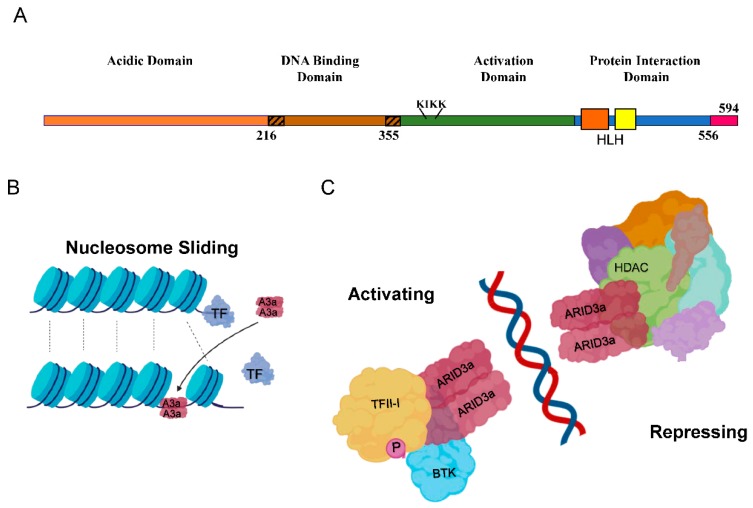
Figure 1
Figure 1
Schematic diagrams of ARID3a (A + T rich interaction domain protein 3a) domains and functions. (A) The four protein domains of ARID3a are shown, including the extended DNA-binding domain (hashed ends), the nuclear localization motif (KIKK), the helix-loop-helix regions (orange and yellow boxes), and amino acid numbers. The short carboxyl terminus has not been given a name or function. (B). ARID3a is proposed to induce nucleosome sliding, potentially disrupting the binding of other transcription factors, and potentially recruiting new transcription factors. (C). ARID3a DNA-interacting protein complexes can have either activating or repressing functions. Some of the known interacting proteins are shown. A3a—ARID3a; TF—transcription factor; HDAC—histone deacetylase; TFII-I—transcription factor II-I; P—phosphorylation; BTK—Bruton’s tyrosine kinase.
Figure 2
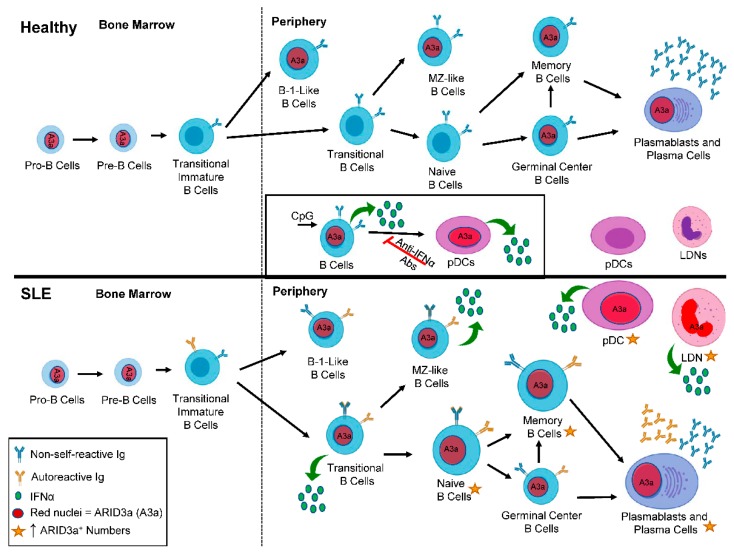
Figure 2
ARID3a expression is enhanced in systemic lupus erythematosus (SLE) B cell subsets compared to healthy controls. A diagram depicts B lineage development in healthy (top panel) and SLE patients (bottom panel) from the bone marrow to the periphery. Red nuclei denote cell subsets that express ARID3a. The inset shows the induction of ARID3a and interferon alpha (IFNα; green circles), and the effect of those ARID3a-expressing B cells on healthy pDCs. In SLE patients, larger cells and gold stars indicate those cell subsets with increased numbers of ARID3a+ cells and associated IFNα production. Blue immunoglobulin (Ig) indicates non-self-reactive Ig, while gold Ig indicates the subsets of cells that can also produce autoreactive Ig. pDCs—plasmacytoid dendritic cells; LDN—low density neutrophils; A3a—ARID3a.
Figure 3
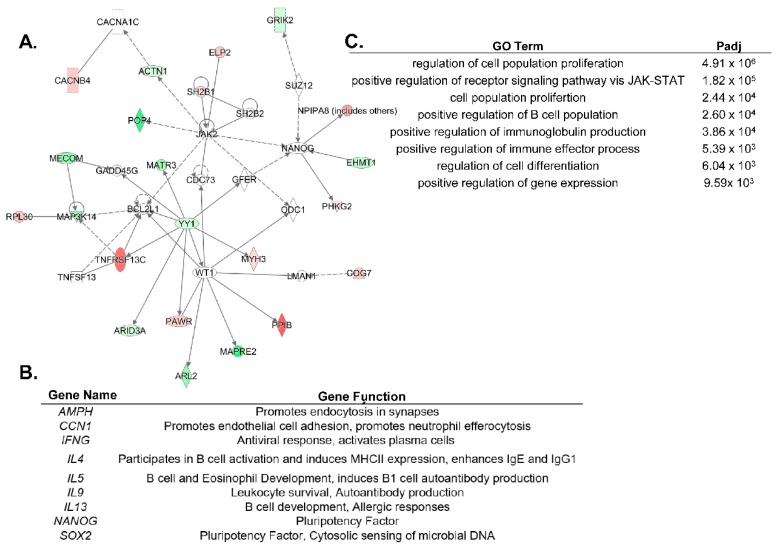
Figure 3
ARID3a expression is associated with diverse genes in distinct cell types. (A). An ingenuity pathway analysis (IPA) network was generated using genes differentially expressed in single cell RNAseq of naïve SLE B cells with a differential ARID3a expression. Green indicates upregulation and red indicates downregulation, while the genes associated with these pathways, but not differentially regulated in the B cells, are colorless. (B). SLE LDNs and pDCs shared nine differentially expressed genes associated with the ARID3a expression and listed here. (C). GO analyses of the nine ARID3a-associated genes differentially regulated in both pDCs and LDNs indicate the most significant pathways associated with their expression.
Figure 4
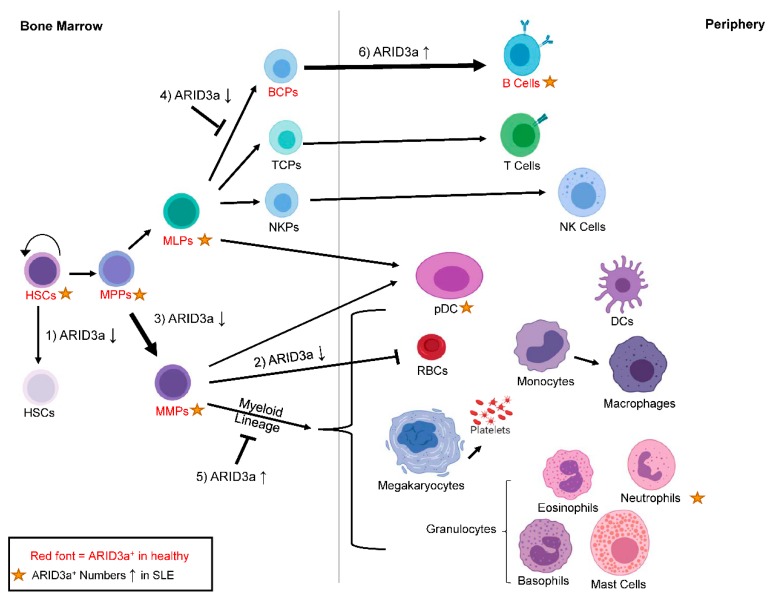
Figure 4
ARID3a is expressed in healthy and SLE hematopoietic progenitors, and the levels of ARID3a affect lineage decisions. Cell subsets with ARID3a expression in healthy individuals are indicated with the red font, while gold stars indicate populations with increased numbers of ARID3a-expressing cells in SLE patients. The effects of increased or inhibited levels of ARID3a (arrows up or down) on HSCs (1), RBCs (2) early myeloid lineage development (3), early B lymphoid development (4), late myeloid lineage development (5), and late B lineage development (6) are shown by thicker arrows for increases, or with a symbol showing that development is blocked. HSCs—hematopoietic stem cells; MPPs—multipotent progenitors; MMPs—multi-myeloid progenitors; MLPs—multi-lymphoid progenitors; TCPs—T cell progenitors; NKPs—natural killer cell progenitors; pDCs—plasmacytoid dendritic cells; RBCs—red blood cells.

References

    1. Carter E.E., Barr S.G., Clarke A.E. The global burden of SLE: Prevalence, health disparities and socioeconomic impact. Nat. Rev. Rheumatol. 2016;12:605–620. doi: 10.1038/nrrheum.2016.137. - DOI - PubMed
    1. Bombardier C., Gladman D.D., Urowitz M.B., Caron D., Chang C.H. Derivation of the SLEDAI. A disease activity index for lupus patients. The Committee on Prognosis Studies in SLE. Arthritis Rheum. 1992;35:630–640. doi: 10.1002/art.1780350606. - DOI - PubMed
    1. Gladman D.D., Ibanez D., Urowitz M.B. Systemic lupus erythematosus disease activity index 2000. J. Rheumatol. 2002;29:288–291. - PubMed
    1. Golbus J., McCune W.J. Lupus nephritis. Classification, prognosis, immunopathogenesis, and treatment. Rheum. Dis. Clin. N. Am. 1994;20:213–242. - PubMed
    1. Contreras G., Lenz O., Pardo V., Borja E., Cely C., Iqbal K., Nahar N., de La Cuesta C., Hurtado A., Fornoni A., et al. Outcomes in African Americans and Hispanics with lupus nephritis. Kidney Int. 2006;69:1846–1851. doi: 10.1038/sj.ki.5000243. - DOI - PubMed

Publication types

MeSH terms