Review
. 2019 Sep 24;8(4):163.
doi: 10.3390/antibiotics8040163.

Countering Gram-Negative Antibiotic Resistance: Recent Progress in Disrupting the Outer Membrane with Novel Therapeutics

Affiliations
Review

Countering Gram-Negative Antibiotic Resistance: Recent Progress in Disrupting the Outer Membrane with Novel Therapeutics

Kelly M Lehman et al. Antibiotics (Basel). .

Abstract

Gram-negative bacteria shield themselves from antibiotics by producing an outer membrane (OM) that forms a formidable permeability barrier. Multidrug resistance among these organisms is a particularly acute problem that is exacerbated by the OM. The poor penetrance of many available antibiotics prevents their clinical use, and efforts to discover novel classes of antibiotics against Gram-negative bacteria have been unsuccessful for almost 50 years. Recent insights into how the OM is built offer new hope. Several essential multiprotein molecular machines (Bam, Lpt, and Lol) work in concert to assemble the barrier and offer a swathe of new targets for novel therapeutic development. Murepavadin has been at the vanguard of these efforts, but its recently reported phase III clinical trial toxicity has tempered the anticipation of imminent new clinical options. Nonetheless, the many concerted efforts aimed at breaking down the OM barrier provide a source of ongoing optimism for what may soon come through the development pipeline. We will review the current state of drug development against the OM assembly targets, highlighting insightful new discovery approaches and strategies.

Keywords: Bam; BamA; Lol; Lpt; LptD; arylomycin; globomycin; outer membrane.


Conflict of interest statement

The authors declare no conflicts of interest.

Figures
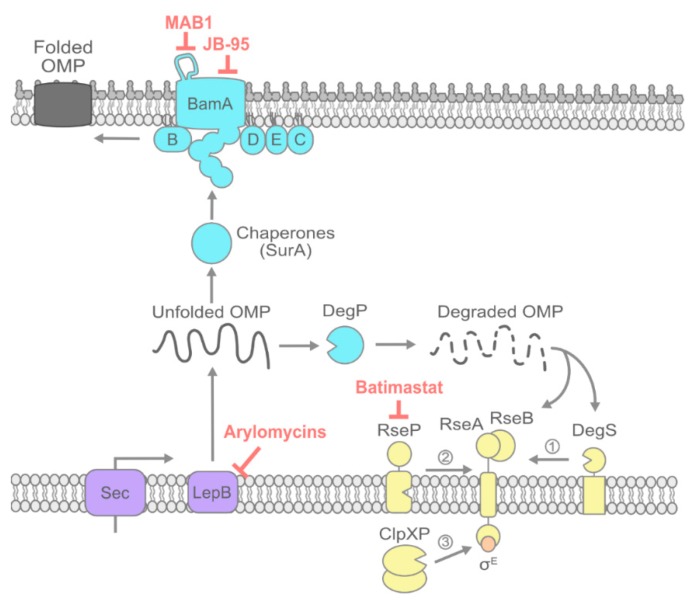
Figure 1
Figure 1
Outer membrane protein (OMP) biogenesis and its inhibitors. Targeted by an N-terminal signal peptide, OMPs are translocated to the inner membrane (IM) via the SecYEG translocon. After translocation, the signal peptide is cleaved by peptidases, such as LepB. Cleavage releases unfolded OMPs (uOMPs) into the periplasm, where they are transported to the outer membrane (OM) by chaperones. The BamABCDE complex receives, folds, and inserts OMPs at the OM. The periplasmic protease DegP degrades uOMPs in the periplasm if they accumulate or misfold. The σE stress response monitors OMP folding. Degraded uOMPs displace RseB from the anti-σ factor RseA, freeing RseA for cleavage by the protease DegS. Subsequent proteolysis by RseP and ClpXP releases σE into the cytosol to induce the transcription of stress regulon members. Red labels indicate compounds recently found to be active against steps of OMP biogenesis.
Figure 2
Figure 2
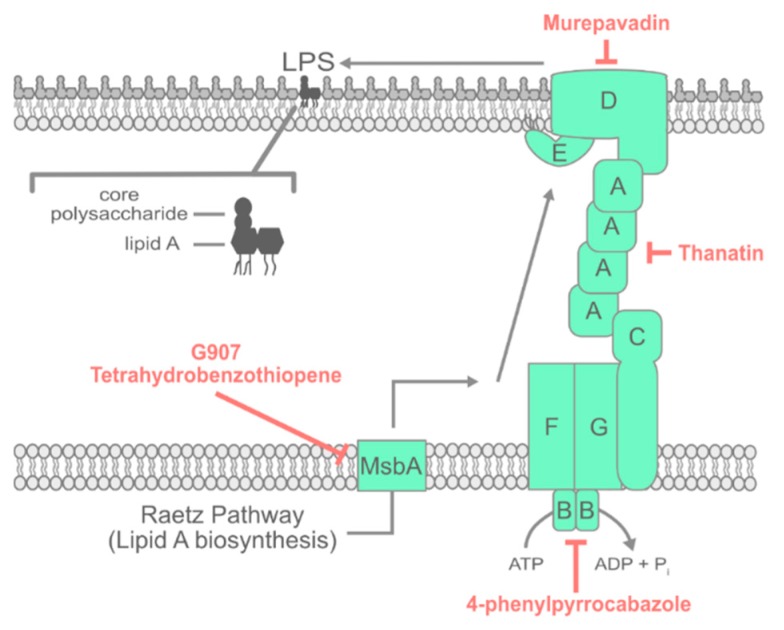
Lipopolysaccharide (LPS) biogenesis and its inhibitors. LPS is composed of lipid A, core polysaccharides, and the O antigen (not pictured). In the cytoplasm, lipid A is synthesized via the Raetz pathway. The flippase MsbA translocates LPS across the IM bilayer. The ATP-binding cassette (ABC) transporter LptB2FG extracts LPS molecules from the periplasmic leaflet of the IM. LPS travels from LptC, across an LptA bridge, and is received by LptD at the OM. LptDE facilitates the insertion of LPS into the OM. Red labels indicate compounds that are active against steps of LPS biogenesis and transport.
Figure 3
Figure 3
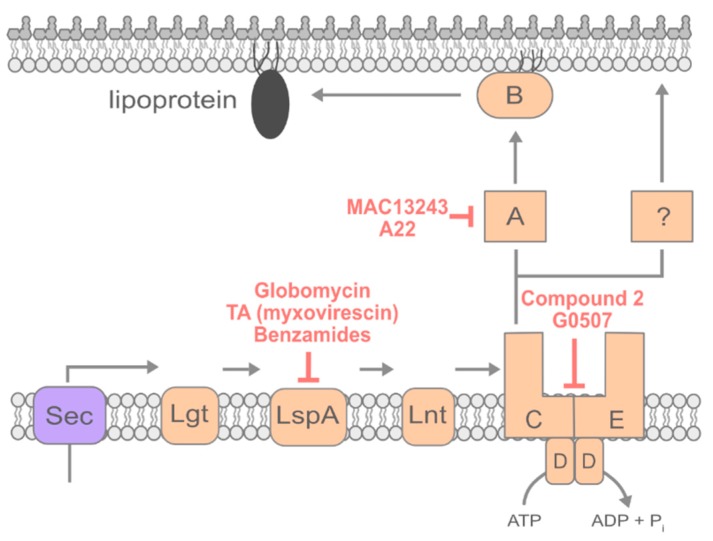
Lipoprotein trafficking and its inhibitors. Lipoproteins are synthesized in the cytoplasm and secreted by SecYEG. In the IM, lipoproteins undergo a series of modifications by Lgt, LspA, and Lnt to become mature triacylated species. The ATP-binding cassette (ABC) transporter LolCDE then extracts mature lipoproteins from the IM. LolA receives lipoproteins from LolC and traffics lipoproteins across the periplasm to the OM. At the OM, LolB receives and inserts lipoproteins. Recent work has indicated that an alternate route of lipoprotein trafficking must exist that does not require LolA or LolB. Red labels indicate compounds targeting lipoprotein maturation and trafficking. Lol: localization of lipoproteins.
Figure 4
Figure 4
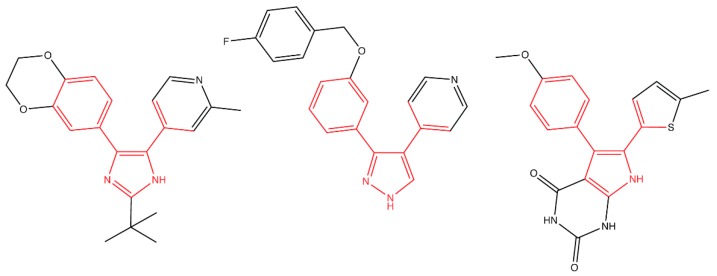
Inhibitors of the LolCDE complex show structural similarities. Nayar’s compound 2 (left), McLeod’s compound 2 (center), and Nickerson’s G0507 (right) all inhibit the LolCDE complex. Structural similarity between the three compounds is highlighted in red.

References

    1. O’Neill J. Review on Antimicrobial Resistance: Tackling a Crisis for the Health and Wealth of Nations. HM Government; London, UK: 2014.
    1. CDC . Antibiotic Resistance Threats in the United States, 2013. Centers of Disease Control and Prevention; Atlanta, Georgia: 2013.
    1. Nikaido H. Molecular Basis of Bacterial Outer Membrane Permeability Revisited. Microbiol. Mol. Biol. Rev. 2003;67:593–656. doi: 10.1128/MMBR.67.4.593-656.2003. - DOI - PMC - PubMed
    1. Kamio Y., Nikaido H. Outer membrane of Salmonella typhimurium: Accessibility of phospholipid head groups to phospholipase C and cyanogen bromide activated dextran in the external medium. Biochemistry. 1976;15:2561–2570. doi: 10.1021/bi00657a012. - DOI - PubMed
    1. Tokuda H. Biogenesis of Outer Membranes in Gram-Negative Bacteria. Biosci. Biotechnol. Biochem. 2009;73:465–473. doi: 10.1271/bbb.80778. - DOI - PubMed

LinkOut - more resources