Review
. 2019 Sep 6:9:833.
doi: 10.3389/fonc.2019.00833. eCollection 2019.

Monitoring Chronic Myeloid Leukemia: How Molecular Tools May Drive Therapeutic Approaches

Affiliations
Review

Monitoring Chronic Myeloid Leukemia: How Molecular Tools May Drive Therapeutic Approaches

Barbara Izzo et al. Front Oncol. .

Abstract

More than 15 years ago, imatinib entered into the clinical practice as a "magic bullet"; from that point on, the prognosis of patients affected by chronic myeloid leukemia (CML) became comparable to that of aged-matched healthy subjects. The aims of treatment with tyrosine kinase inhibitors (TKIs) are for complete hematological response after 3 months of treatment, complete cytogenetic response after 6 months, and a reduction of the molecular disease of at least 3 logs after 12 months. Patients who do not reach their goal can switch to another TKI. Thus, the molecular monitoring of response is the main consideration of management of CML patients. Moreover, cases in deep and persistent molecular response can tempt the physician to interrupt treatment, and this "dream" is possible due to the quantitative PCR. After great international effort, today the BCR-ABL1 expression obtained in each laboratory is standardized and expressed as "international scale." This aim has been reached after the establishment of the EUTOS program (in Europe) and the LabNet network (in Italy), the platforms where biologists meet clinicians. In the field of quantitative PCR, the digital PCR is now a new and promising, sensitive and accurate tool. Some authors reported that digital PCR is able to better classify patients in precise "molecular classes," which could lead to a better identification of those cases that will benefit from the interruption of therapy. In addition, digital PCR can be used to identify a point mutation in the ABL1 domain, mutations that are often responsible for the TKI resistance. In the field of resistance, a prominent role is played by the NGS that enables identification of any mutation in ABL1 domain, even at sub-clonal levels. This manuscript reviews how the molecular tools can lead the management of CML patients, focusing on the more recent technical advances.

Keywords: ABL1; BCR-ABL1; CML; NGS; chronic myeloid leukemia; digital PCR; mutations; real-time PCR.


Figures
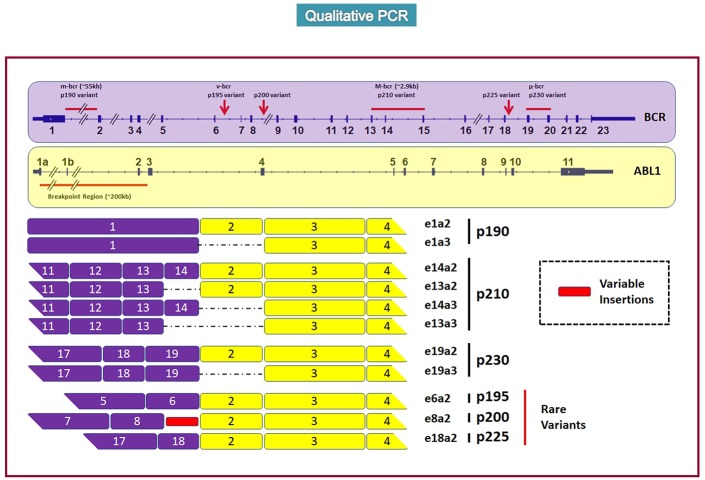
Figure 1
Figure 1
The figure represents the most frequent loci of rupture of the BCR and ABL1 genes (up part) and the consequently origined proteins (P190, P210, P230, rare rearrangements) taken from Weerkamp et al. (7).
Figure 2
Figure 2
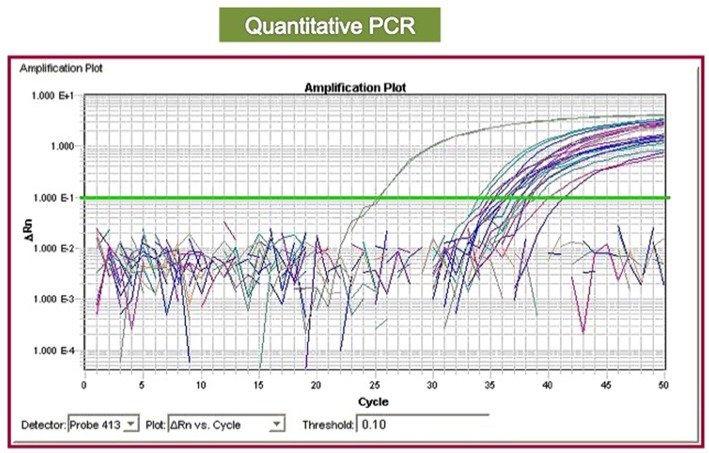
Quantitative PCR plot (RQ-PCR): the real-time amplification allows to measure the quantity of BCR-ABL1 transcript by using a reference curve. By the measure of the threshold cycle (the cycle corresponding to the point where the amplification signal overcomes the background) is possible to calculate the concentration of each sample.
Figure 3
Figure 3
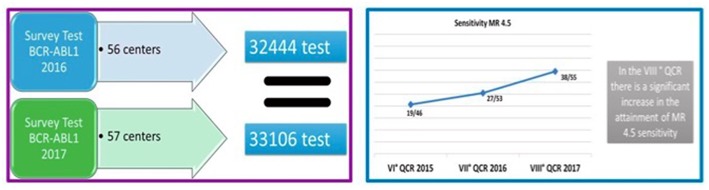
Increasing number of laboratories of the Italian LabNet network being able to attain a sensitivity level of MR 4.5 (BCR-ABL1/ABL1 ratio = 0.0032%).
Figure 4
Figure 4
Digital PCR (dPCR) overview. The fundamental phases of the process are represented: (1) partitioning of the sample in thousand of drops; (2) amplification; (3) output and digital analysis.
Figure 5
Figure 5
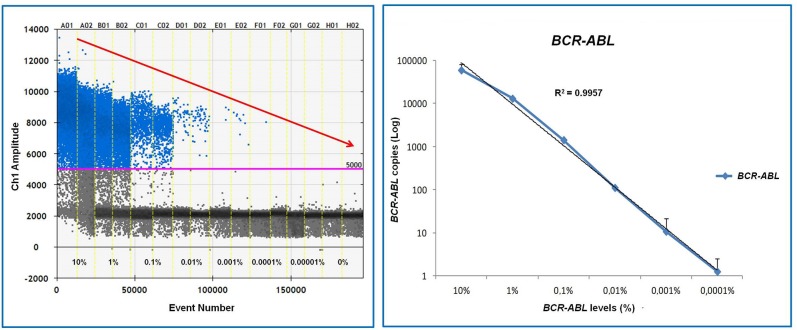
Assessment of detection performance of dPCR system in RNA samples obtained from serial dilutions of Ph'+ cells in Ph'-cells. As shown, dPCR is able to detect BCR-ABL1 mRNA up to 0.001% (MR5).
Figure 6
Figure 6
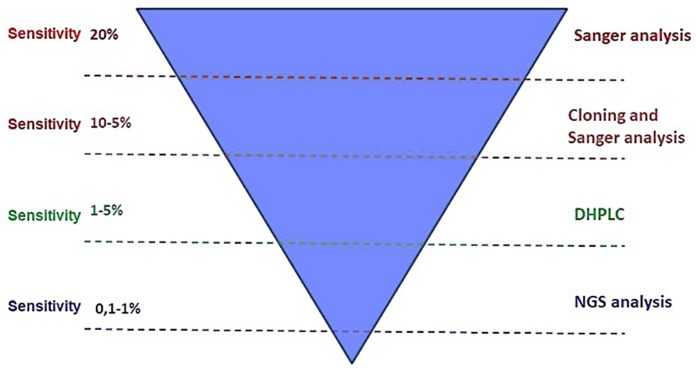
Sensitivity of different molecular biology methods for ABL1 kinase domain mutations detection: the deepest sensitivity is reached by Next Generation Sequencing (NGS) tools.

References

    1. Sandberg AA, Gemmill RM, Hecht BK, Hecht F. The Philadelphia chromosome: a model of cancer and molecular cytogenetics. Cancer Genet Cytogenet. (1986) 21:129–46. 10.1016/0165-4608(86)90039-7 - DOI - PubMed
    1. Bartram CR, Kleihauer E, de Klein A, Grosveld G, Teyssier JR, Heisterkamp N, et al. . C-abl and bcr are rearranged in a Ph1-negative CML patient. EMBO J. (1985) 4:683–6. 10.1002/j.1460-2075.1985.tb03683.x - DOI - PMC - PubMed
    1. Heisterkamp N, Stam K, Groffen J, de Klein A, Grosveld G. Structural organization of the bcr gene and its role in the Ph' translocation. Nature. (1985) 315:758–61. 10.1038/315758a0 - DOI - PubMed
    1. Ben-Neriah Y, Daley GQ, Mes-Masson AM, Witte ON, Baltimore D. The chronic myelogenous leukemia-specific P210 protein is the product of the bcr/abl hybrid gene. Science. (1986) 233:212–4. 10.1126/science.3460176 - DOI - PubMed
    1. Chan LC, Karhi KK, Rayter SI, Heisterkamp N, Eridani S, Powles R, et al. . A novel abl protein expressed in Philadelphia chromosome positive acute lymphoblastic leukaemia. Nature. (1987) 325:635–7. 10.1038/325635a0 - DOI - PubMed