Review
. 2019 Sep 4:6:78.
doi: 10.3389/fmolb.2019.00078. eCollection 2019.

Nucleosome Remodeling by Fun30SMARCAD1 in the DNA Damage Response

Affiliations
Review

Nucleosome Remodeling by Fun30SMARCAD1 in the DNA Damage Response

Susanne C S Bantele et al. Front Mol Biosci. .

Abstract

Many cellular pathways are dedicated to maintain the integrity of the genome. In eukaryotes, the underlying DNA transactions occur in the context of chromatin. Cells utilize chromatin and its dynamic nature to regulate those genome integrity pathways. Accordingly, chromatin becomes restructured and modified around DNA damage sites. Here, we review the current knowledge of a chromatin remodeler Fun30SMARCAD1, which plays a key role in genome maintenance. Fun30SMARCAD1 promotes DNA end resection and the repair of DNA double-stranded breaks (DSBs). Notably, however, Fun30SMARCAD1 plays additional roles in maintaining heterochromatin and promoting transcription. Overall, Fun30SMARCAD1 is involved in distinct processes and the specific roles of Fun30SMARCAD1 at DSBs, replication forks and sites of transcription appear discordant at first view. Nonetheless, a picture emerges in which commonalities within these context-dependent roles of Fun30SMARCAD1 exist, which may help to gain a more global understanding of chromatin alterations induced by Fun30SMARCAD1.

Keywords: DNA double-stranded break; DNA end resection; Fun30/SMARCAD1; cell cycle; genome stability; nucleosome remodeling; post-translational modification.


Figures
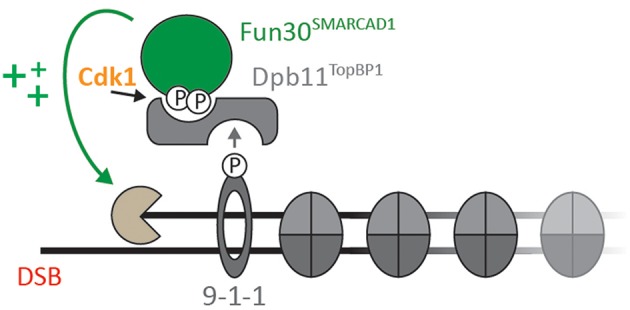
Figure 1
Figure 1
Cell cycle- and DNA damage-activated kinases lead to formation of a ternary complex formed by Fun30SMARCAD1, Dpb11TOPBP1, and the 9-1-1 complex (adapted from Bantele et al., ; Bantele, 2018). Upon CDK-dependent phosphorylation of Fun30 S20/S28 or SMARCAD1 T71, respectively, Fun30 and SMARCAD1 associate with BRCT1+2 of Dpb11 or BRCT0/1/2 of TOPBP1. In yeast, binding to the 9-1-1 complex (in a DNA damage-induced manner) contributes to localization of Fun30-Dpb11 to sites of DNA end resection, where it stimulates long-range resection (Chen et al., ; Costelloe et al., ; Eapen et al., ; Bantele et al., 2017).
Figure 2
Figure 2
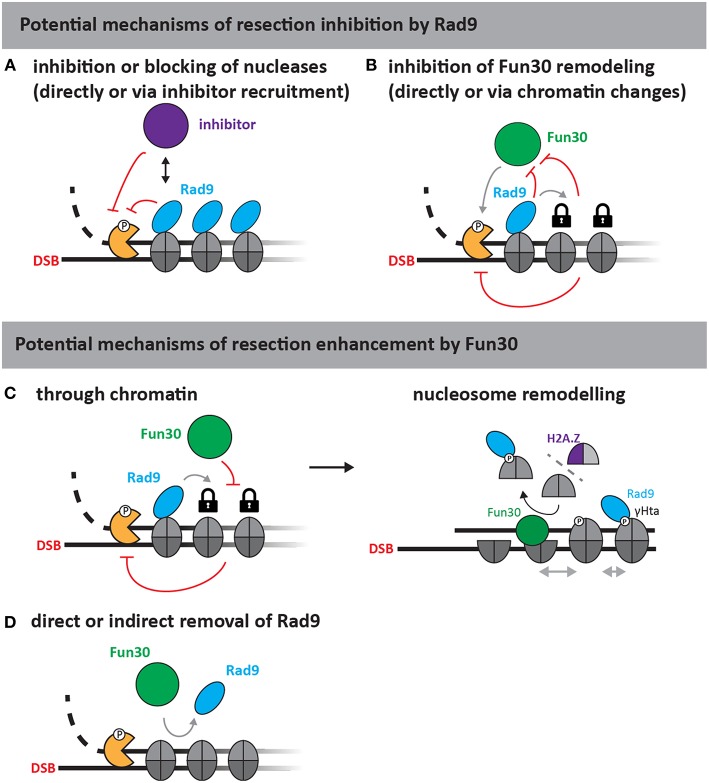
Putative mechanisms of resection regulation by Fun30 and Rad9 (adapted from Bantele, 2018). As Rad9 is a chromatin-binding protein without apparent catalytic activity, at least two mechanisms of resection inhibition can be envisioned (upper part). First, Rad9 could directly block or slow down the progression of nucleases either by inhibiting the nucleases (A) or by stabilizing chromatin in a configuration that is non-permissive to resection (B) for example by inhibiting Fun30, if the latter was required to help overcome resection-inhibition by nucleosomes. Fun30 could also promote resection by several different mechanisms (lower part). As a nucleosome remodeler, Fun30 could either act through chromatin (C), or by removing Rad9 from chromatin (D). The action through chromatin could involve its putative remodeling activities and potentially H2A/H2B dimer exchange, which might affect γH2A and H2A.Z dynamics or repositioning of nucleosomes by nucleosome sliding (C, right side).

References

    1. Adkins N. L., Niu H., Sung P., Peterson C. L. (2013). Nucleosome dynamics regulates DNA processing. Nat. Struct. Mol. Biol. 20, 836–842. 10.1038/nsmb.2585 - DOI - PMC - PubMed
    1. Adkins N. L., Swygert S. G., Kaur P., Niu H., Grigoryev S. A., Sung P., et al. . (2017). Nucleosome-like, single-stranded DNA (ssDNA)-histone octamer complexes and the implication for DNA double strand break repair. J. Biol. Chem. 292, 5271–5281. 10.1074/jbc.M117.776369 - DOI - PMC - PubMed
    1. Arafat K., Al Kubaisy E., Sulaiman S., Karam S. M., Al Natour Z., Hassan A. H., et al. . (2018). SMARCAD1 in breast cancer progression. Cell. Physiol. Biochem. 50, 489–500. 10.1159/000494163 - DOI - PubMed
    1. Awad S., Ryan D., Prochasson P., Owen-Hughes T., Hassan A. H. (2010). The Snf2 homolog Fun30 acts as a homodimeric ATP-dependent chromatin-remodeling enzyme. J. Biol. Chem. 285, 9477–9484. 10.1074/jbc.M109.082149 - DOI - PMC - PubMed
    1. Baldeyron C., Soria G., Roche D., Cook A. J. L., Almouzni G. (2011). HP1alpha recruitment to DNA damage by p150CAF-1 promotes homologous recombination repair. J. Cell Biol. 193, 81–95. 10.1083/jcb.201101030 - DOI - PMC - PubMed

LinkOut - more resources