


Long noncoding RNA SMAD5-AS1 acts as a microRNA-106a-5p sponge to promote epithelial mesenchymal transition in nasopharyngeal carcinoma
- PMID: 31557058
- PMCID: PMC6902713
- DOI: 10.1096/fj.201900803R
Long noncoding RNA SMAD5-AS1 acts as a microRNA-106a-5p sponge to promote epithelial mesenchymal transition in nasopharyngeal carcinoma
Abstract
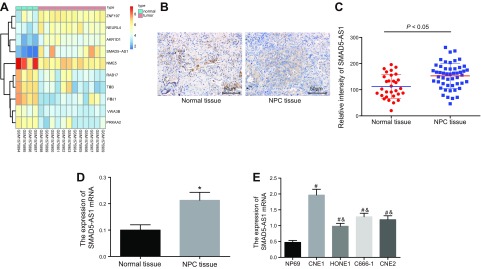
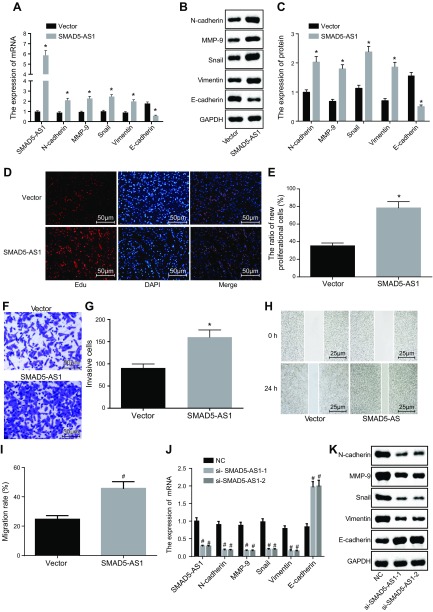
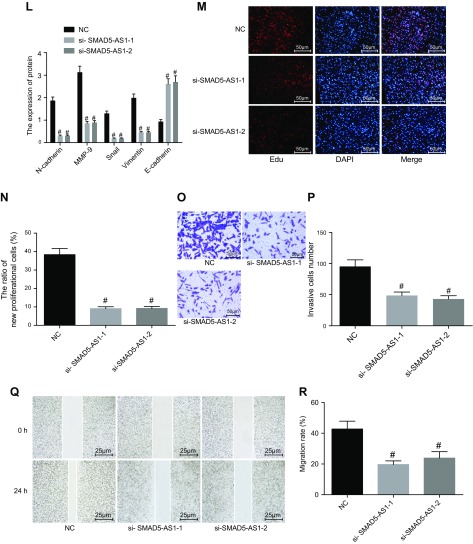
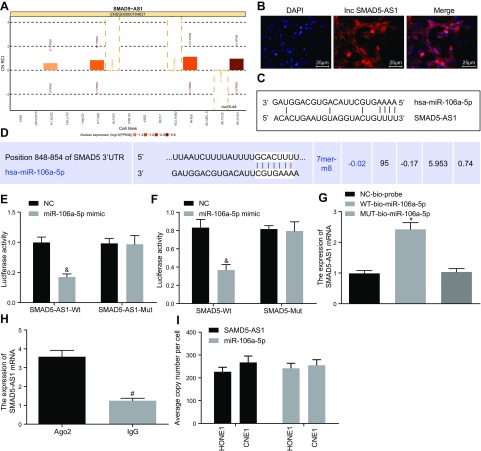
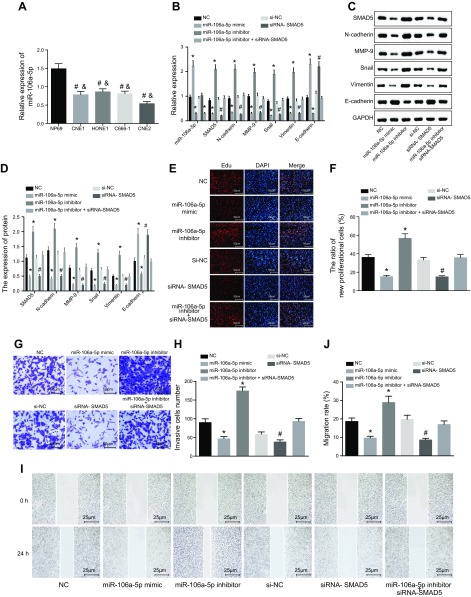
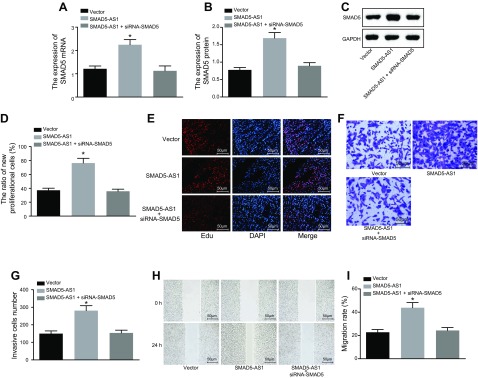
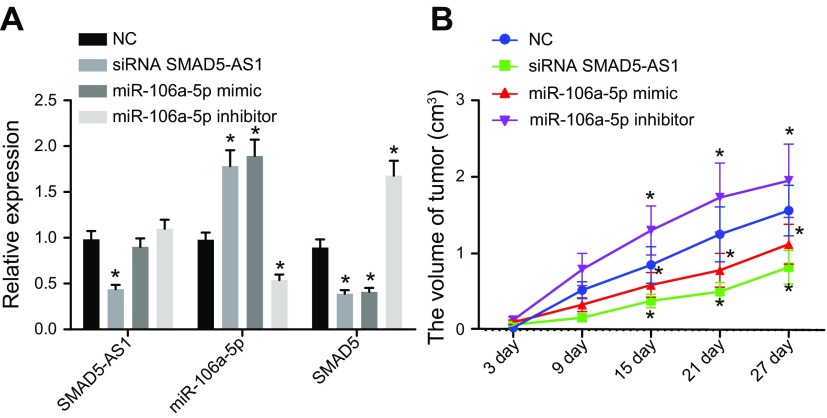
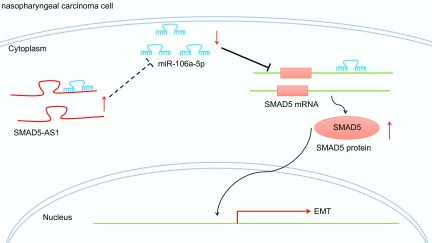
Nasopharyngeal carcinoma (NPC) is a malignant epithelial cancer of the head and neck with high prevalence in southern China, which is accompanied by notable invasiveness and metastasis. Long noncoding RNAs (lncRNAs) participate in the progression of various cancers including NPC. Microarray-based analysis identified highly expressed lncRNA mothers against decapentaplegic homolog 5 (SMAD5)-antisense RNA 1 (AS1) related to NPC. Interestingly, it is found that SMAD5-AS1 competitively bound to microRNA (miR)-106a-5p to regulate SMAD5. Herein, the study aimed to clarify the role of SMAD5-AS1/miR-106a-5p/SMAD5 axis in the process of epithelial mesenchymal transition (EMT) in NPC. SMAD5-AS1 was highly expressed and miR-106a-5p was poorly expressed in NPC tissues and cell lines. The NPC cells were treated with a series of small interfering RNAs, mimics, or inhibitors to explore the effects of SMAD5-AS1, SMAD5, and miR-106a-5p on EMT, cell proliferation, migration, and invasion in NPC. Of note, SMAD5-AS1 silencing or miR-106a-5p overexpression reduced expression of N-cadherin, matrix metallopeptidase 9, Snail, and Vimentin while elevating E-cadherin expression, thus inhibiting EMT, cell proliferation, migration, and invasion in NPC by down-regulation of SMAD5. Moreover, SMAD5 silencing could reduce the ability of EMT induced by SMAD5-AS1 up-regulation. SMAD5-AS1 silencing or miR-106a-5p elevation inhibited tumorigenesis in nude mice. Taken together, SMAD5-AS1 silencing suppressed EMT, cell proliferation, migration, and invasion in NPC by elevating miR-106a-5p to down-regulate SMAD5, which provided a novel therapeutic target for NPC treatment.-Zheng, Y.-J., Zhao, J.-Y., Liang, T.-S., Wang, P., Wang, J., Yang, D.-K., Liu, Z.-S. Long noncoding RNA SMAD5-AS1 acts as a microRNA-106a-5p sponge to promote epithelial mesenchymal transition in nasopharyngeal carcinoma.
Keywords: SMAD5; ceRNA; invasion; migration; proliferation.
Conflict of interest statement
Y.-J.Z. and J.-Y.Z. are regarded as co-first authors. The authors declare no conflicts of interest.
Figures
References
-
- Li T., Chen J. X., Fu X. P., Yang S., Zhang Z., Chen KhH., Li Y. (2011) microRNA expression profiling of nasopharyngeal carcinoma. Oncol. Rep. 25, 1353–1363 - PubMed
-
- Qi G., Chen J., Shi C., Wang Y., Mi S., Shao W., Yu X., Ma Y., Ling J., Huang J. (2016) Cinnamic acid (CINN) induces apoptosis and proliferation in human nasopharyngeal carcinoma cells. Cell. Physiol. Biochem. 40, 589–596 - PubMed
-
- Lee A. W., Tung S. Y., Ngan R. K., Chappell R., Chua D. T., Lu T. X., Siu L., Tan T., Chan L. K., Ng W. T., Leung T. W., Fu Y. T., Au G. K., Zhao C., O’Sullivan B., Tan E. H., Lau W. H. (2011) Factors contributing to the efficacy of concurrent-adjuvant chemotherapy for locoregionally advanced nasopharyngeal carcinoma: combined analyses of NPC-9901 and NPC-9902 Trials. Eur. J. Cancer 47, 656–666 - PubMed
-
- Li X. J., Peng L. X., Shao J. Y., Lu W. H., Zhang J. X., Chen S., Chen Z. Y., Xiang Y. Q., Bao Y. N., Zheng F. J., Zeng M. S., Kang T. B., Zeng Y. X., Teh B. T., Qian C. N. (2012) As an independent unfavorable prognostic factor, IL-8 promotes metastasis of nasopharyngeal carcinoma through induction of epithelial-mesenchymal transition and activation of AKT signaling. Carcinogenesis 33, 1302–1309 - PMC - PubMed
MeSH terms
Substances
LinkOut - more resources
Full Text Sources
Research Materials
