Benefit and Risks of Aspirin in Addition to Ticagrelor in Acute Coronary Syndromes: A Post Hoc Analysis of the Randomized GLOBAL LEADERS Trial
- PMID: 31557763
- PMCID: PMC6764000
- DOI: 10.1001/jamacardio.2019.3355
Benefit and Risks of Aspirin in Addition to Ticagrelor in Acute Coronary Syndromes: A Post Hoc Analysis of the Randomized GLOBAL LEADERS Trial
Abstract
Importance: The role of aspirin as part of antiplatelet regimens in acute coronary syndromes (ACS) needs to be clarified in the context of newer potent P2Y12 antagonists.
Objective: To evaluate the benefit and risks of aspirin in addition to ticagrelor among patients with ACS beyond 1 month after percutaneous coronary intervention (PCI).
Design, setting, and participants: This is a nonprespecified, post hoc analysis of GLOBAL LEADERS, a randomized, open-label superiority trial comparing 2 antiplatelet treatment strategies after PCI. The trial included 130 secondary/tertiary care hospitals in different countries, with 15 991 unselected patients with stable coronary artery disease or ACS undergoing PCI. Patients had outpatient visits at 1, 3, 6, 12, 18, and 24 months after index procedure.
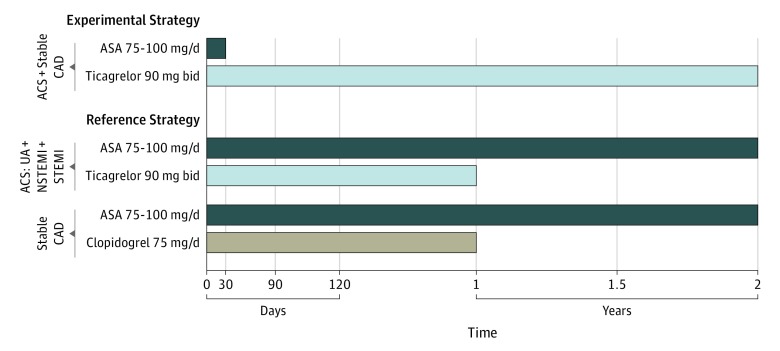
Interventions: The experimental group received aspirin plus ticagrelor for 1 month followed by 23-month ticagrelor monotherapy; the reference group received aspirin plus either clopidogrel (stable coronary artery disease) or ticagrelor (ACS) for 12 months, followed by 12-month aspirin monotherapy. In this analysis, we examined the clinical outcomes occurring between 31 days and 365 days after randomization, specifically in patients with ACS who, within this time frame, were assigned to receive either ticagrelor alone or ticagrelor and aspirin.
Main outcomes and measures: The primary outcome was the composite of all-cause death or new Q-wave myocardial infarction.
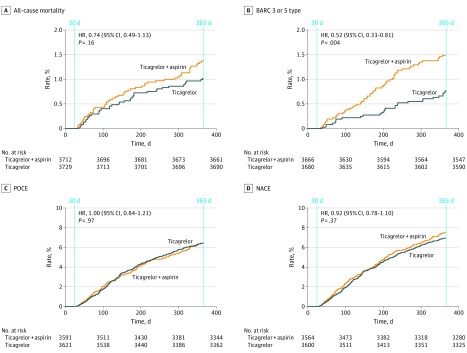
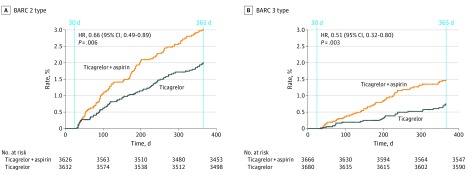
Results: Of 15 968 participants, there were 7487 patients with ACS enrolled; 3750 patients were assigned to the experimental group and 3737 patients to the reference group. Between 31 and 365 days after randomization, the primary outcome occurred in 55 patients (1.5%) in the experimental group and in 75 patients (2.0%) in the reference group (hazard ratio [HR], 0.73; 95% CI, 0.51-1.03; P = .07); investigator-reported Bleeding Academic Research Consortium-defined bleeding type 3 or 5 occurred in 28 patients (0.8%) in the experimental group and in 54 patients (1.5%) in the reference arm (HR, 0.52; 95% CI, 0.33-0.81; P = .004).
Conclusions and relevance: Between 1 month and 12 months after PCI in ACS, aspirin was associated with increased bleeding risk and appeared not to add to the benefit of ticagrelor on ischemic events. These findings should be interpreted as exploratory and hypothesis generating; however, they pave the way for further trials evaluating aspirin-free antiplatelet strategies after PCI.
Trial registration: ClinicalTrials.gov identifier: NCT01813435.
Conflict of interest statement
Figures
References
-
- Cannon CP, Harrington RA, James S, et al. ; PLATelet inhibition and patient Outcomes Investigators . Comparison of ticagrelor with clopidogrel in patients with a planned invasive strategy for acute coronary syndromes (PLATO): a randomised double-blind study. Lancet. 2010;375(9711):283-293. doi: 10.1016/S0140-6736(09)62191-7 - DOI - PubMed
-
- Vranckx P, Valgimigli M, Jüni P, et al. ; GLOBAL LEADERS Investigators . Ticagrelor plus aspirin for 1 month, followed by ticagrelor monotherapy for 23 months vs aspirin plus clopidogrel or ticagrelor for 12 months, followed by aspirin monotherapy for 12 months after implantation of a drug-eluting stent: a multicentre, open-label, randomised superiority trial. Lancet. 2018;392(10151):940-949. doi: 10.1016/S0140-6736(18)31858-0 - DOI - PubMed
Publication types
MeSH terms
Substances
Associated data
LinkOut - more resources
Full Text Sources
Medical
Miscellaneous