. 2019 Nov;50(11):3004-3012.
doi: 10.1161/STROKEAHA.119.026545. Epub 2019 Sep 27.

Leveraging Human Genetics to Estimate Clinical Risk Reductions Achievable by Inhibiting Factor XI

Affiliations

Leveraging Human Genetics to Estimate Clinical Risk Reductions Achievable by Inhibiting Factor XI

Benjamin Georgi et al. Stroke. 2019 Nov.

Abstract

Background and Purpose- Coagulation factor XI (FXI) is a novel target for antithrombotic therapy addressed by various therapeutic modalities currently in clinical development. The expected magnitude of thrombotic event reduction mediated by targeting FXI is unclear. Methods- We analyzed the association of 2 common genetic variants, which alter levels of FXI, with a range of human phenotypes. We combined variants into a genetic score standardized to a 30% increase in relative activated partial thromboplastin time, equivalent to what can be achieved with pharmacological FXI reduction. Using data from 371 695 participants in the United Kingdom Biobank and 2 large-scale genome-wide association studies, we examined the effect of this FXI score on thrombotic and bleeding end points. Results- Genetic disposition to lower FXI levels was associated with reduced risks of venous thrombosis (odds ratio, 95% CI; P value; odds ratio=0.1, 0.07-0.14; P=3×10-43) and ischemic stroke (odds ratio=0.47, 0.36-0.61; P=2×10⁻⁸) but not with major bleeding (odds ratio=0.7, 0.45-1.04; P=0.0739). The observed relative risk reductions were consistent within a range of subgroups that were at high risk for thrombosis. Consistently, we observed higher absolute risk reductions conferred by genetically lower FXI levels in high-risk subgroups, such as patients with atrial fibrillation. Conclusions- Human genetic data suggest that pharmacological inhibition of FXI may achieve considerable reductions in ischemic stroke risk without clear evidence for an associated risk of major bleeding. The quantitative framework developed can be used to support the estimation of achievable risk reductions with pharmacological modulation of FXI.

Keywords: blood coagulation factor inhibitors; enoxaparin; mendelian randomization analysis; odds ratio; risk; thrombosis.


Figures
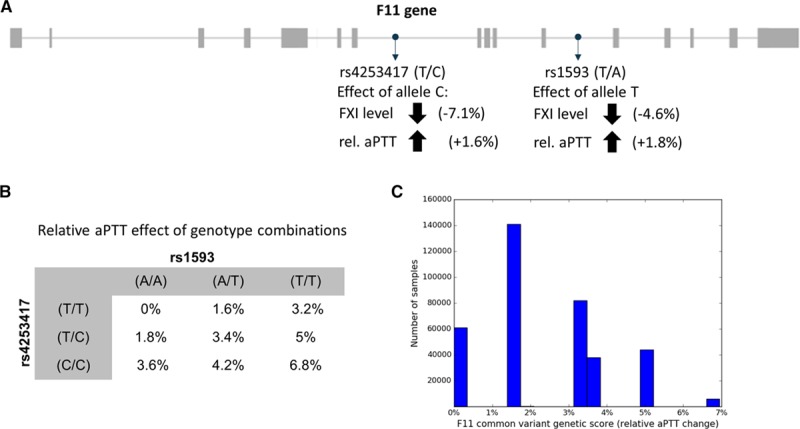
Figure 1.
Figure 1.
Derivation of a common variant genetic factor XI (FXI) score. A, The genetic FXI score was derived based on 2 common, intronic variants (rs4253417 and rs1593) with previously described effects on FXI levels and aPTT. B, Possible combinations of genotypes for the 2 variants showed a range from 0% to 6.8% genetically determined relative activated partial thromboplastin time (aPTT) increase. C, Distribution of score values in the UK Biobank.
Figure 2.
Figure 2.
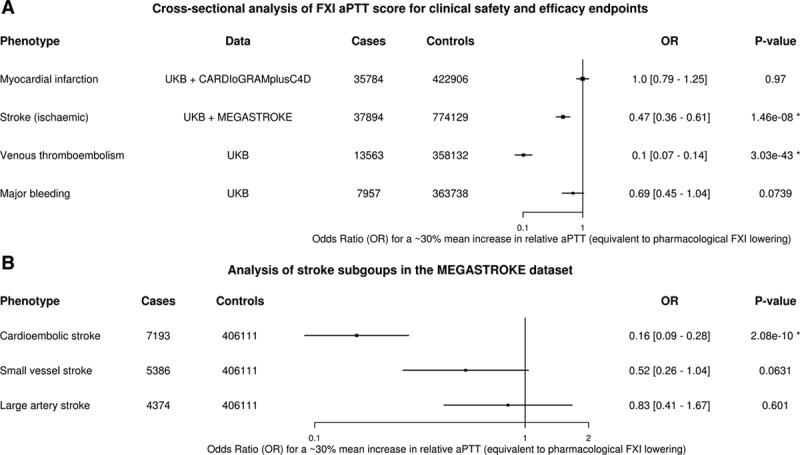
Cross-sectional analyses of the genetic factor XI (FXI) score for clinical end points and ischemic stroke subtypes. A, Association of the FXI genetic score with 4 primary safety and efficacy outcomes (United Kingdom Biobank [UKB], external genetics consortia). After correcting for testing 4 primary outcomes (Bonferroni threshold=0.05/4=0.01), we observe significant associations of the FXI genetic score, expressed as a 30% relative increase in activated partial thromboplastin time (aPTT), with venous thromboembolism (odds ratio [OR]=0.1 [0.07–0.14], P=3.03×10−43) and ischemic stroke (OR=0.47 [0.36–0.61]; P=1.5×10⁻⁸) and (B) cross-sectional analysis of CCS ischemic stroke subgroups from the MEGASTROKE dataset. Integration of MEGASTROKE effect sizes for 2 common FXI SNPs (rs4253417, rs1593) by fixed-effect meta-analysis showed significant risk reduction for the cardioembolic stroke subtype (OR=0.16 [0.09–0.28]; P=2.08×10⁻¹⁰).
Figure 3.
Figure 3.
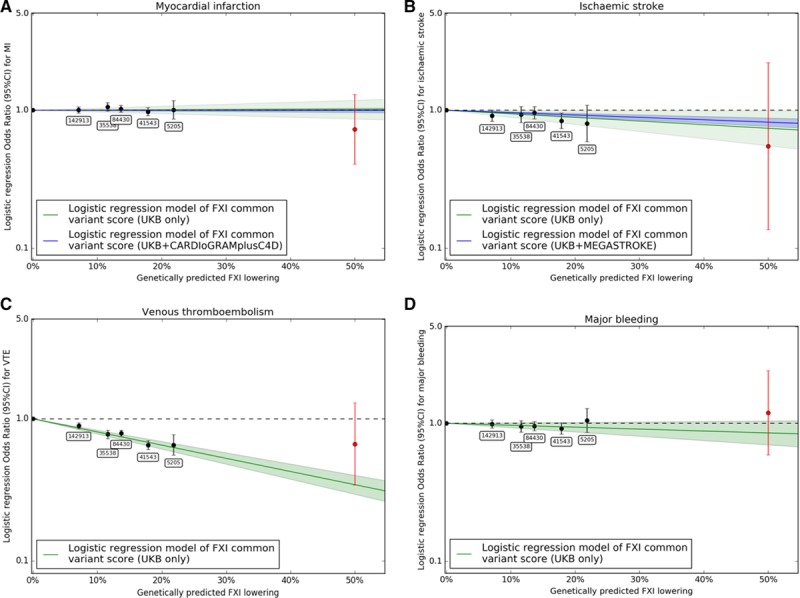
Analysis of fit of effect estimates of individual genotype groups to the log-linear model. Effects for (A) myocardial infarction, (B) ischemic stroke, (C) venous thromboembolism, and (D) major bleeding. Effect estimates for the categorical version of the factor XI (FXI) score where each level corresponds to a specific combination of genotypes of rs4253417 and rs1593 (black) show good fit to the log-linear model (green). Effects of FXI loss-of-function variants in 50k whole-exome sequences (red) were broadly consistent with the linear model, although CIs were wide because of the limited sample size of 477 FXI LOF variant carriers.
Figure 4.
Figure 4.
Effects of genetically lower factor XI (FXI) levels in high-risk subgroups in the UK Biobank. Hazard ratios (HR) of subgroup analyses of relevant risk factors for (A) ischemic stroke and (B) venous thromboembolism and the FXI genetic score. We observed no significant interactions between any risk factors and the FXI genetic score. C, Survival analysis of differences in ischemic stroke rate for participants with the strongest observed genetic effect on FXI (red) and participants with no genetic effect (black) stratified by atrial fibrillation (AF) presence. While we observed similar relative risk reduction conferred by genetically lower FXI in the presence (dashed) and absence (solid) of AF, it can be seen that the absolute risk reduction in the AF subgroup is markedly higher.

References

    1. LaPointe NM, Chen AY, Alexander KP, Roe MT, Pollack CV, Jr, Lytle BL, et al. Enoxaparin dosing and associated risk of in-hospital bleeding and death in patients with non ST-segment elevation acute coronary syndromes. Arch Intern Med. 2007;167:1539–1544. doi: 10.1001/archinte.167.14.1539. - PubMed
    1. McDonald SB, Renna M, Spitznagel EL, Avidan M, Hogue CW, Jr, Moon MR, et al. Preoperative use of enoxaparin increases the risk of postoperative bleeding and re-exploration in cardiac surgery patients. J Cardiothorac Vasc Anesth. 2005;19:4–10. doi: 10.1053/j.jvca.2004.11.002. - PubMed
    1. Wheeler AP, Gailani D. The intrinsic pathway of coagulation as a target for antithrombotic therapy. Hematol Oncol Clin North Am. 2016;30:1099–1114. doi: 10.1016/j.hoc.2016.05.007. - PMC - PubMed
    1. Büller HR, Bethune C, Bhanot S, Gailani D, Monia BP, Raskob GE, et al. FXI-ASO TKA Investigators. Factor XI antisense oligonucleotide for prevention of venous thrombosis. N Engl J Med. 2015;372:232–240. doi: 10.1056/NEJMoa1405760. - PMC - PubMed
    1. Plenge RM, Scolnick EM, Altshuler D. Validating therapeutic targets through human genetics. Nat Rev Drug Discov. 2013;12:581–594. doi: 10.1038/nrd4051. - PubMed

Publication types

MeSH terms