. 2019 Oct 24;123(42):8910-8915.
doi: 10.1021/acs.jpcb.9b07593. Epub 2019 Oct 14.

Exploring the Effectiveness of Binding Free Energy Calculations

Affiliations

Exploring the Effectiveness of Binding Free Energy Calculations

Dibyendu Mondal et al. J Phys Chem B. .

Abstract

Increasing the accuracy of the evaluation of ligand-binding energies is one of the most important tasks of current computational biology. Here we explore the accuracy of free energy perturbation (FEP) approaches by comparing the performance of a "regular" FEP method to the one using replica exchange to enhance the sampling on a well-defined benchmark. The examination was limited to the so-called alchemical perturbations which are restricted to a fragment of the drug, and therefore, the calculation is a relative one rather than the absolute binding energy of the drug. Overall, our calculations reach the 1 kcal/mol accuracy limit. It is also shown that the accurate prediction of the position of water molecules around the binding pocket is important for FEP calculations. Interestingly, the replica exchange method does not significantly improve the accuracy of binding energies, suggesting that we reach the limit where the force field quality is a critical factor for accurate calculations.


Conflict of interest statement

The authors declare no competing financial interest.

Figures
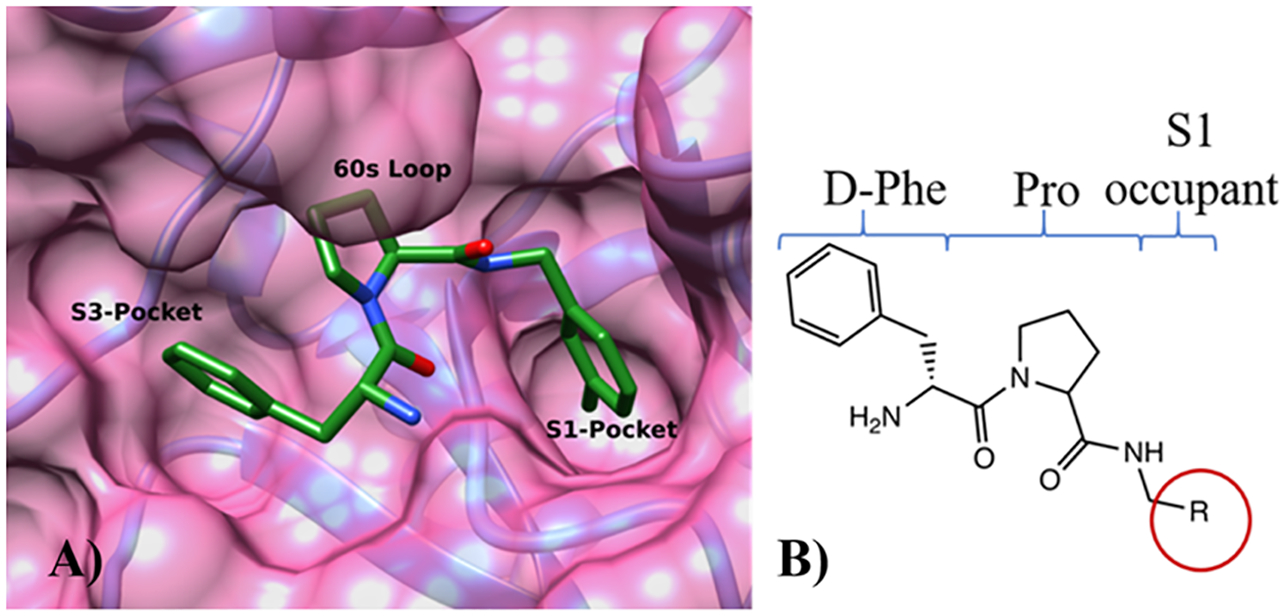
Figure 1.
Figure 1.
(A) The binding pocket of thrombin, where the ligand is represented in stick (atom-based colorings are used) and protein as blue ribbons. The vdw surface (pink) is calculated using Chimera., Different parts of the ligand binding pocket are clearly shown. (B) A generic ligand (d-Phe-Pro-based thrombin inhibitor), where the chemical groups in the ligand are marked according to the portion of the binding pocket where it binds.
Figure 2.
Figure 2.
A thermodynamic cycle for relative binding free energy calculations using the alchemical FEP method.
Figure 3.
Figure 3.
Schematic of the alchemical free energy change pathway. The part of a ligand containing a methyl group is shown to be replaced to a ligand with the Cl group. At the first step the partial charges of the depicted region are converted to zero. In the second step the atom types are changed (C → Cl; H → dummy) and in the last step the partial charges of the Cl-containing ligand are regenerated. The color in the boxes represents different steps and the color gradient is the representation of the percentage of the initial state on the corresponding FEP window. λdecharge, λvdw, and λrecharge are the mapping constants for the decharging, atom type conversion, and recharging steps, respectively.
Figure 4.
Figure 4.
Schematic representation of the Hamiltonian Replica Exchange sampling. For λ = 0.25 if in an even cycle the exchange is attempted with λ = 0.50, in the next odd cycle the exchange would be attempted with λ = 0.0.
Figure 5.
Figure 5.
Alchemical Transformation network. Staring from (R=CH3) the alchemical transformation is used to convert to ligands (R = Cl, Br, H, F in step 2, 3, 4, and 6, respectively, and R, R′ = (Cl, Cl); (Cl, F) in step 1 and 5, respectively). The same type of alchemical transformation is used from R, R′ = (CH3, CH3) to (CH3, H), (Cl, Cl) and (CH3, Cl) in step 7, 8 and 9, respectively.
Figure 6.
Figure 6.
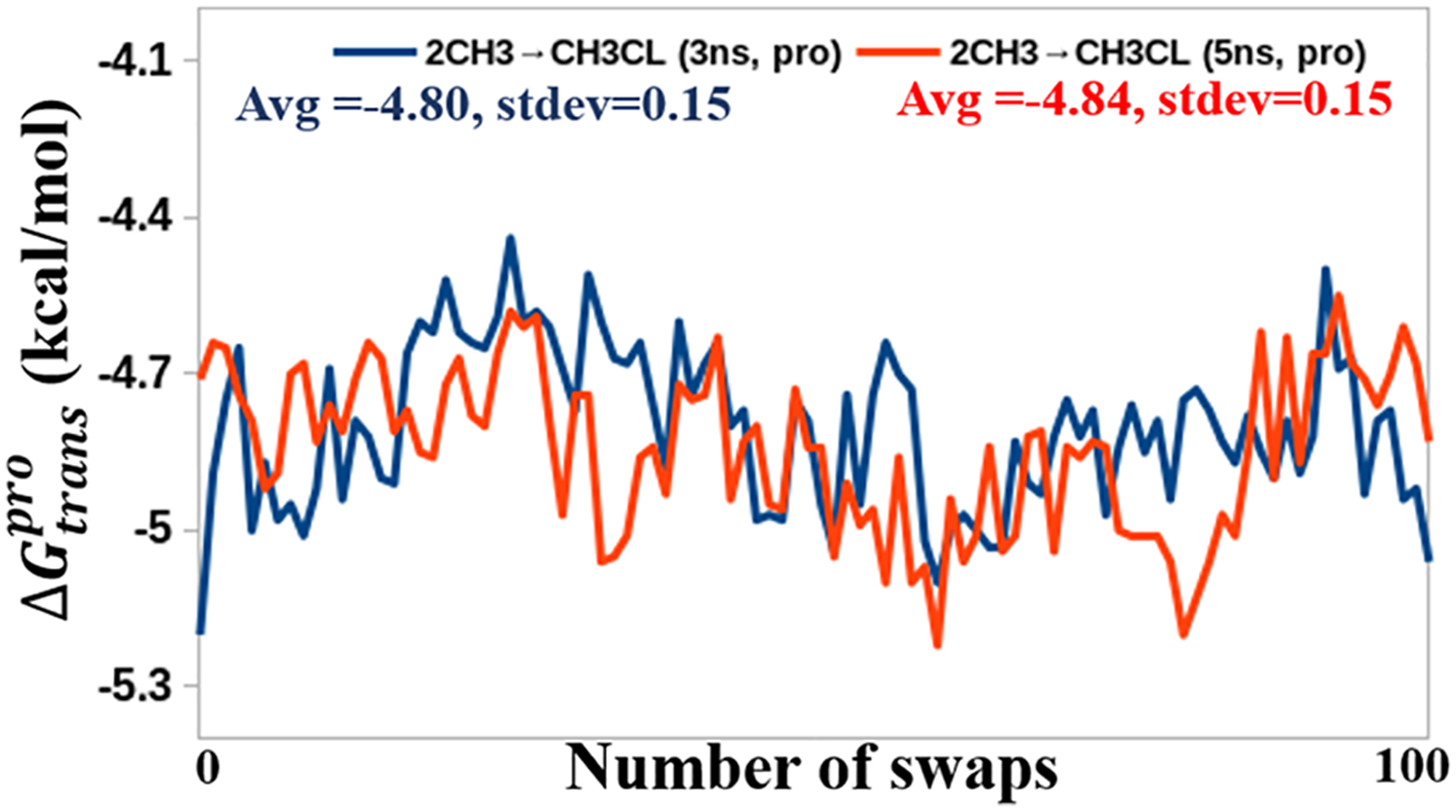
Plot of change in the free energy of transformation with the number of swaps attempted in the FEP/H-REMD simulation.
Figure 7.
Figure 7.
A comparison of absolute estimated errors in predicting relative binding energies between our calculations and that of ref 1. The blue and red bars correspond to the absolute estimated error in our calculations and those of ref 1, respectively. The X-axis represents the transformations and the number corresponds to steps in the transformation network in Figure 5.
Figure 8.
Figure 8.
A bar diagram that compares the calculated relative bind free energy with and without using H-REMD.

References

    1. Wang L; Wu Y; Deng Y; Kim B; Pierce L; Krilov G; Lupyan D; Robinson S; Dahlgren MK; Greenwood J; et al. Accurate and reliable prediction of relative ligand binding potency in prospective drug discovery by way of a modern free-energy calculation protocol and force field. J. Am. Chem. Soc 2015, 137, 2695–2703. - PubMed
    1. Cournia Z; Allen B; Sherman W Relative binding free energy calculations in drug discovery: recent advances and practical considerations. J. Chem. Inf. Model 2017, 57, 2911–2937. - PubMed
    1. Torrie GM; Valleau JP Nonphysical sampling distributions in Monte Carlo free-energy estimation: Umbrella sampling. J. Comput. Phys 1977, 23, 187–199.
    1. Sugita Y; Okamoto Y Replica-exchange molecular dynamics method for protein folding. Chem. Phys. Lett 1999, 314, 141–151.
    1. Plotnikov NV; Kamerlin SCL; Warshel A Paradynamics: an effective and reliable model for ab initio QM/MM free-energy calculations and related tasks. J. Phys. Chem. B 2011, 115, 7950–7962. - PMC - PubMed

Publication types