. 2019 Sep 26;10(10):756.
doi: 10.3390/genes10100756.

Overexpression of a Novel Cytochrome P450 Promotes Flavonoid Biosynthesis and Osmotic Stress Tolerance in Transgenic Arabidopsis

Affiliations

Overexpression of a Novel Cytochrome P450 Promotes Flavonoid Biosynthesis and Osmotic Stress Tolerance in Transgenic Arabidopsis

Naveed Ahmad et al. Genes (Basel). .

Abstract

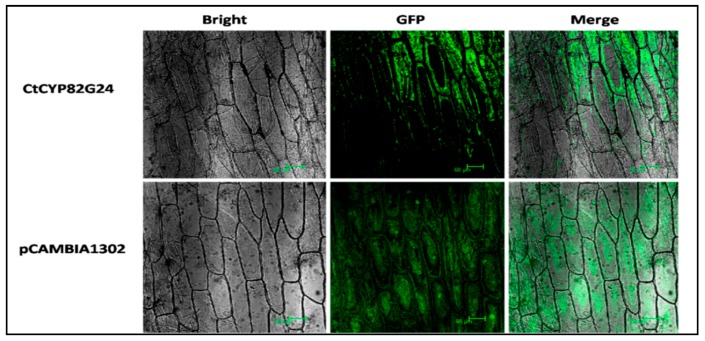
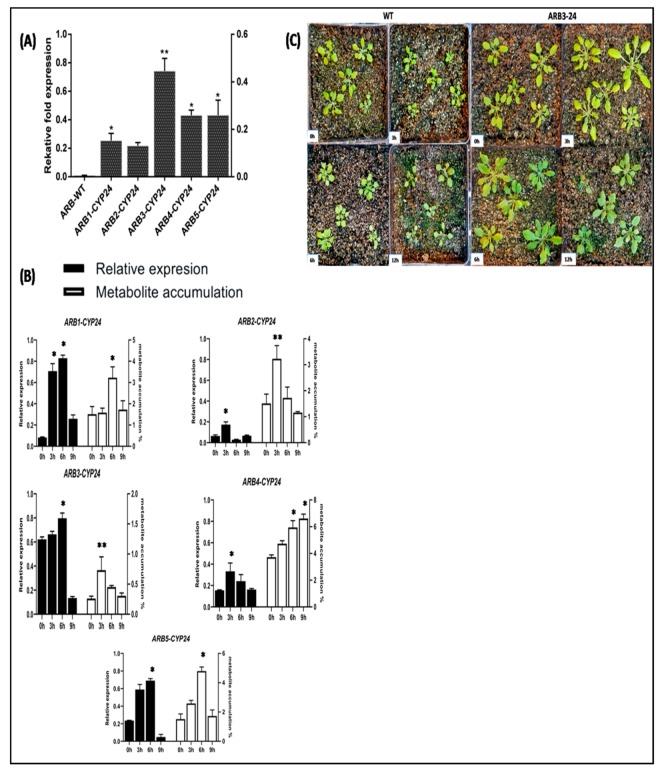
Flavonoids are mainly associated with growth, development, and responses to diverse abiotic stresses in plants. A growing amount of data have demonstrated the biosynthesis of flavonoids through multienzyme complexes of which the membrane-bounded cytochrome P450 supergene family shares a crucial part. However, the explicit regulation mechanism of Cytochrome P450s related to flavonoid biosynthesis largely remains elusive. In the present study, we reported the identification of a stress-tolerant flavonoid biosynthetic CtCYP82G24 gene from Carthamus tinctorius. The transient transformation of CtCYP82G24 determined the subcellular localization to the cytosol. Heterologously expressed CtCYP82G24 was effective to catalyze the substrate-specific conversion, promoting the de novo biosynthesis of flavonoids in vitro. Furthermore, a qRT-PCR assay and the accumulation of metabolites demonstrated that the expression of CtCYP82G24 was effectively induced by Polyethylene glycol stress in transgenic Arabidopsis. In addition, the overexpression of CtCYP82G24 could also trigger expression levels of several other flavonoid biosynthetic genes in transgenic plants. Taken together, our findings suggest that CtCYP82G24 overexpression plays a decisive regulatory role in PEG-induced osmotic stress tolerance and alleviates flavonoid accumulation in transgenic Arabidopsis.

Keywords: Cytochrome P450; abiotic stress; flavonoid biosynthesis; heterologous expression; transgenic Arabidopsis.


Conflict of interest statement

The authors declare no conflict of interest.

Figures
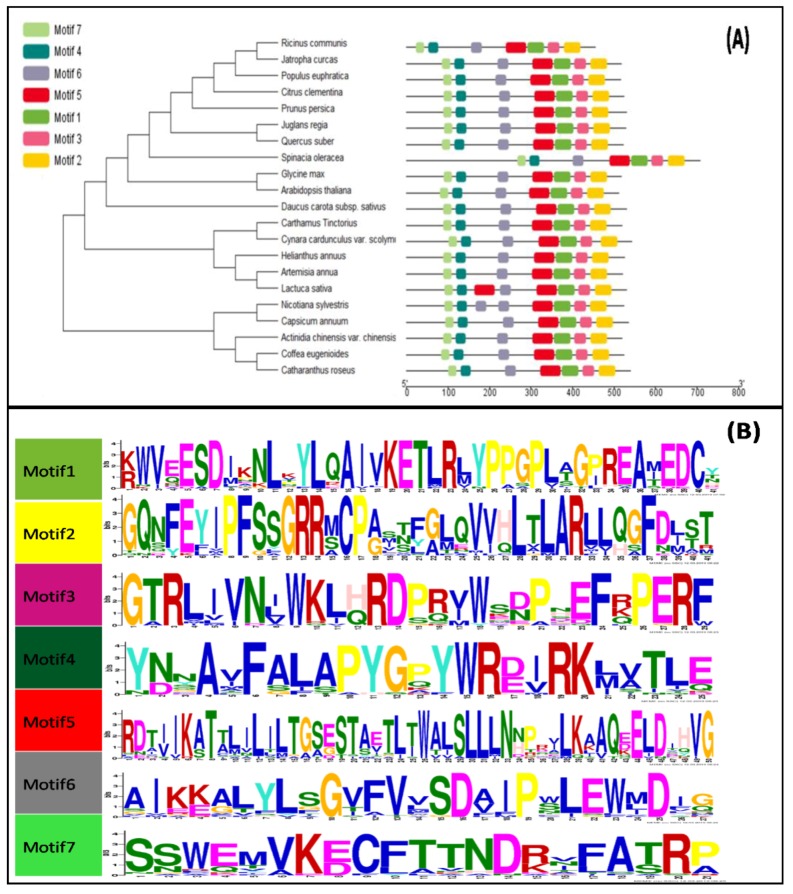
Figure 1
Figure 1
Phylogeny analysis and identification of the conserved domains (A) Phylogenetic analysis using the 1000 rapid bootstraps method was created with the MEGAx online tool. The online tool of the MEME server was used to identify the conserved motifs. The green, yellow, pink, blue, red, grey and light green colors represent motifs 1, 2, 3, 4, 5, 6 and 7, respectively. The indication of the grey line length denotes the sequence length. The presence of each block at multiple positions determines the location of the conserved motif to its matching one. The tree and motifs parameters were edited using the EVOLVIEW online tool (B) Conserved motif compositions and the representation of logos. The capital letters in the logos of individual motif represent more than 70% ratio of the conserved amino acids. The Arabic numerals appear beneath uppercase letters and indicate the width of the conserved motif.
Figure 2
Figure 2
Transient transformation of CtCYP82G24. Subcellular localization of the pBASTA1302-green fluorescent protein (GFP)-CtCYP82G24 in onion epidermal cells. The fluorescence signals were detected using a confocal laser scanning microscope.
Figure 3
Figure 3
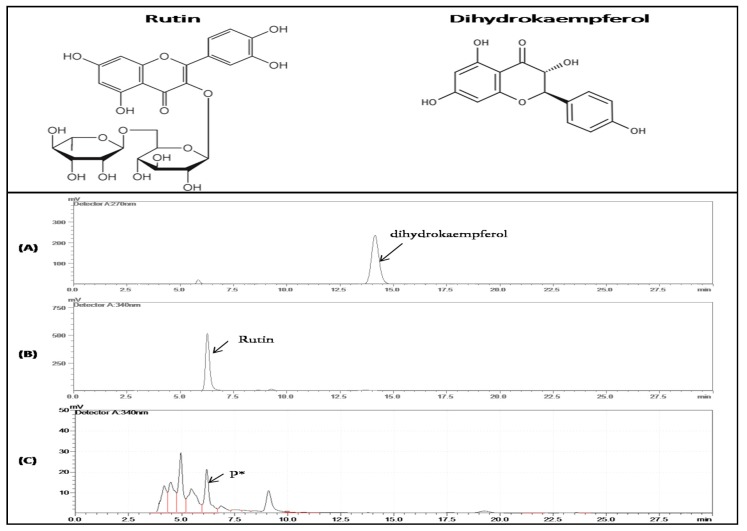
The chemical structure of rutin and dihydrokaempferol metabolites and their in vitro enzymatic activity and a high-performance liquid chromatography (HPLC) profile against the purified recombinant CtCYP82G24 protein. The protein extract was monitored at 415 nm on an Agilent Zorbax SB-C 18 column (4.6 × 150 mm, 5 μm) with methanol:acetonitrile (v:v of 1:10) as mobile phase A and 0.4% phosphoric acid as phase B. The metabolites were quantified using the aluminum chloride colorimetric method described by [35]. The total metabolite content was expressed as milligrams of rutin equivalent (CE) per 100 g dry weight (DW). (A) Peak labelled dihydrokaempferol and (B) peak marked as rutin was used as the authentic standards. (C) HPLC profile of the reaction product P* catalyzed by CtCYP82G24. The retention times of rutin and product P* showed close proximity in peak 4, which was approximately 6.3 min.
Figure 4
Figure 4
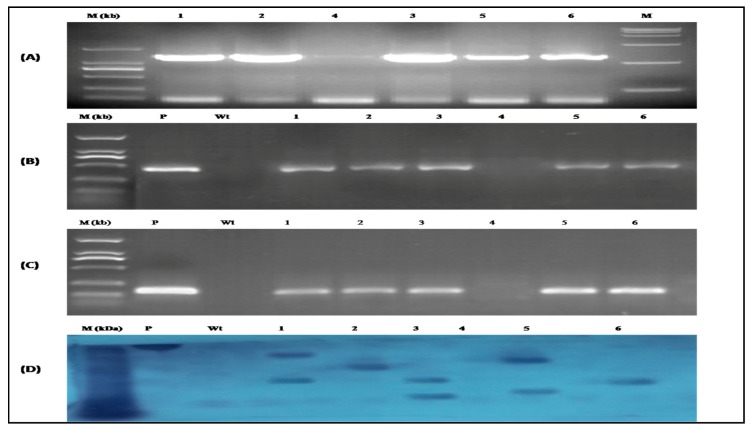
Detection of transgenic Arabidopsis lines harboring the pBASTA-CtCYP82G24 transgene. The growth stage for the detection was selected approximately 25 d at the 12-leaf stage. (A) Detection of CtCYP82G24 (1368bp) product in transgenic plants using the CYP24R/F primer pair where M: Marker; P: Plasmid, and lanes 1–6 indicate different lines of CtCYP82G24—overexpressed transgenic plants. (B) PCR amplification of the herbicide resistance gene (BAR) used as a selectable marker for genetic transformation of Arabidopsis. WT represents the negative control, P is the recombinant vector of pBASTA-CtCYP82G24 that was used as the positive control, and lanes 1–6 indicate different lines of CtCYP82G24 transformed plants. (C) Positive PCR detection of the NOS terminator gene in the aforesaid transgenic lines. P: Plasmid (positive control); WT: Negative control, and lanes 1–6 show the presence of the NOS terminator gene. (D) Southern blot analysis of transformed Arabidopsis through BAR probe hybridization. Where the representation was indicated as M: Marker; P: Plasmid—as positive control; Wt: Wild type—as a negative control, and lanes 1–6 represent transgenic lines.
Figure 5
Figure 5
The PEG-induced expression level of CtCYP82G24 associated with a notable metabolite accumulation in transgenic Arabidopsis. (A) The expression level of CtCYP82G24 in transgenic lines (B) PEG-induced qRT- PCR assay and quantification of metabolite accumulation in CtCYP82G24-overexpressed transgenic plants at four different periods. Asterisks indicate statistical significance (* p < 0.05, ** p < 0.01). The relative expression level of CtCYP82G24 was compared with that of the 18s ribosomal RNA gene (internal control). The data were calculated using the 2−△△Ct method. (C) ARB3-24 phenotypes under PEG stress at 0, 3, 6, and 9 h intervals. The growth stage for expression and metabolite analysis was selected approximately 25 days old at 12-leaf stage.
Figure 6
Figure 6
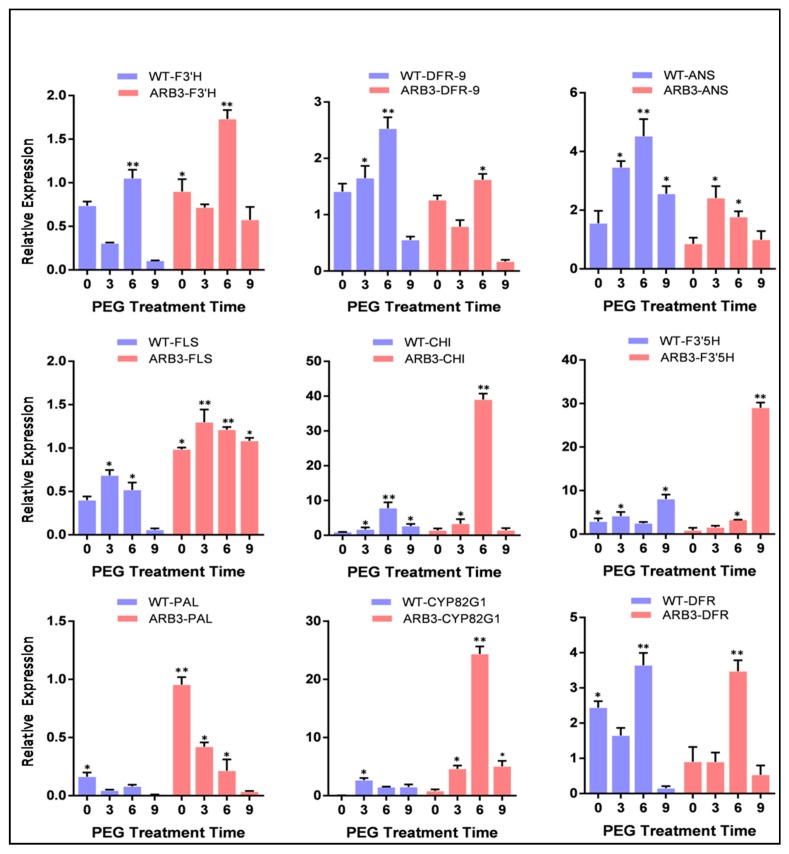
Downstream regulation of key structural genes of the flavonoid biosynthetic pathway in wild-type and CtCYP82G24 overexpressed transgenic line. The blue colour bars represent the expression level of flavonoid biosynthetic genes in WT plants under PEG-induced osmotic stress at different time points. The red colour bars indicate quantitative RT-PCR assays of eight core flavonoid pathway genes in ARB3-transgenic under the same treatments of PEG stress. The expression levels of each transcript were expressed using the 2−△△Ct method as compared to the control plants. Asterisks indicate statistical significance (* p < 0.05, ** p < 0.01). The genes were: PAL (Phenylalanine ammonia lyase), F3′5′H (Flavonoid 3′,5′-hydroxylase), DFR (Dihydroflavonol 4-reductase), CHI (Chalcone isomerase), CYP82G1 (Cytochrome P450 monooxygenase), F3′H (flavonoid 3′-hydroxylase), ANS (Anthocyanidin synthase) and FLS (Flavonol synthase).

References

    1. Winkel-Shirley B. Flavonoid biosynthesis. A colorful model for genetics, biochemistry, cell biology, and biotechnology. Plant Physiol. 2001;126:485–493. doi: 10.1104/pp.126.2.485. - DOI - PMC - PubMed
    1. Zhou X., Tang L., Xu Y., Zhou G., Wang Z. Towards a better understanding of medicinal uses of Carthamus tinctorius L. in traditional Chinese medicine: A phytochemical and pharmacological review. J. Ethnopharmacol. 2014;151:27–43. doi: 10.1016/j.jep.2013.10.050. - DOI - PubMed
    1. Kazuma K., Takahashi T., Sato K., Takeuchi H., Matsumoto T., Okuno T. Quinochalcones and flavonoids from fresh florets in different cultivars of Carthamus tinctorius L. Biosci. Biotechnol. Biochem. 2000;64:1588–1599. doi: 10.1271/bbb.64.1588. - DOI - PubMed
    1. Stafford H. Recent Advances in Phytochemistry. Volume 8. Elsevier; Warsaw, Portland: 1974. Possible multienzyme complexes regulating the formation of C6-C3 phenolic compounds and lignins in higher plants; pp. 53–79.
    1. Winkel B.S. Metabolic channeling in plants. Annu. Rev. Plant Biol. 2004;55:85–107. doi: 10.1146/annurev.arplant.55.031903.141714. - DOI - PubMed

Publication types

MeSH terms

LinkOut - more resources