


Modulated Electro-Hyperthermia as Palliative Treatment for Pancreatic Cancer: A Retrospective Observational Study on 106 Patients
- PMID: 31561722
- PMCID: PMC6767725
- DOI: 10.1177/1534735419878505
Modulated Electro-Hyperthermia as Palliative Treatment for Pancreatic Cancer: A Retrospective Observational Study on 106 Patients
Abstract
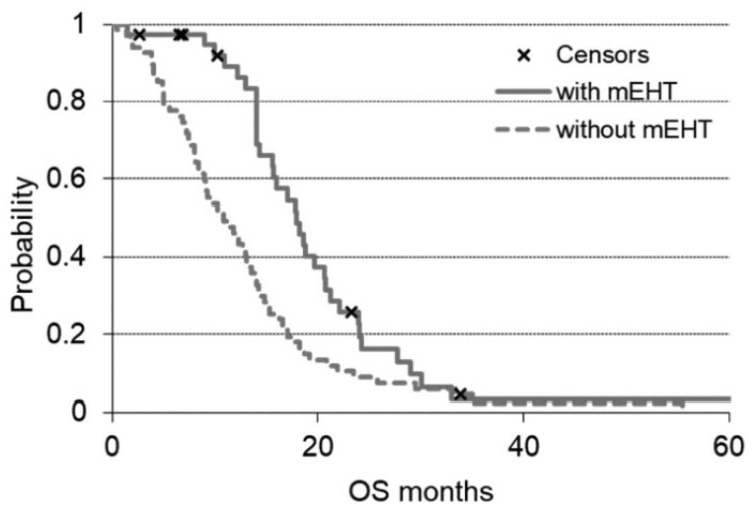
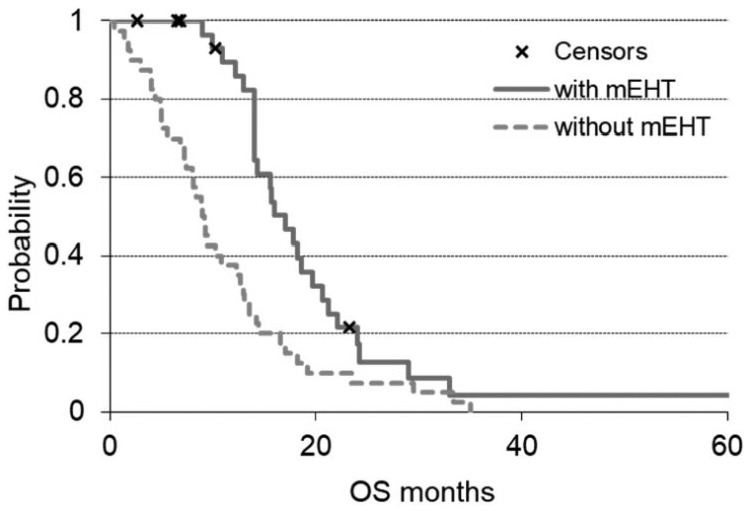
Background: Pancreatic adenocarcinoma has a poor prognosis, resulting in a <10% survival rate at 5 years. Modulated electro-hyperthermia (mEHT) has been increasingly used for pancreatic cancer palliative care and therapy. Objective: To monitor the efficacy and safety of mEHT for the treatment of advanced pancreatic cancer. Methods: We collected data retrospectively on 106 patients affected by stage III-IV pancreatic adenocarcinoma. They were divided into 2 groups: patients who did not receive mEHT (no-mEHT) and patients who were treated with mEHT. We performed mEHT applying a power of 60 to 150 W for 40 to 90 minutes. The mEHT treatment was associated with chemotherapy and/or radiotherapy for 33 (84.6%) patients, whereas 6 (15.4%) patients received mEHT alone. The patients of the no-mEHT group received chemotherapy and/or radiotherapy in 55.2% of cases. Results: Median age of the sample was 65.3 years (range = 31-80 years). After 3 months of therapy, the mEHT group had partial response in 22/34 patients (64.7%), stable disease in 10/34 patients (29.4%), and progressive disease in 2/34 patients (8.3%). The no-mEHT group had partial response in 3/36 patients (8.3%), stable disease in 10/36 patients (27.8%), and progressive disease in 23/36 patients (34.3%). The median overall survival of the mEHT group was 18.0 months (range = 1.5-68.0 months) and 10.9 months (range = 0.4-55.4 months) for the non-mEHT group. Conclusions: mEHT may improve tumor response and survival of pancreatic cancer patients.
Keywords: FOLFIRINOX; gemcitabine; modulated electro-hyperthermia; pancreatic cancer; survival; tumor response.
Conflict of interest statement
Figures



References
-
- Siegel RL, Miller KD, Jemal A. Cancer statistics, 2015. CA Cancer J Clin. 2015;65:5-29. - PubMed
-
- Long J, Luo GP, Xiao ZW, et al. Cancer statistics: current diagnosis and treatment of pancreatic cancer in Shanghai, China. Cancer Lett. 2014;346:273-277. - PubMed
-
- Schrag D. Optimizing treatment for locally advanced pancreas cancer: progress but no precision. JAMA. 2016;315:1837-1838. - PubMed
-
- Pancreatic Cancer Europe. Pancreatic Cancer Europe’s General Assembly Meeting—Barcelona, July 4, 2019. https://www.pancreaticcancereurope.eu/. Accessed September 16, 2019.
Publication types
MeSH terms
LinkOut - more resources
Full Text Sources
Medical
