Review
. 2020 Jan;293(1):230-252.
doi: 10.1111/imr.12807. Epub 2019 Sep 27.

Cerebral Plasmodium falciparum malaria: The role of PfEMP1 in its pathogenesis and immunity, and PfEMP1-based vaccines to prevent it

Affiliations
Review

Cerebral Plasmodium falciparum malaria: The role of PfEMP1 in its pathogenesis and immunity, and PfEMP1-based vaccines to prevent it

Anja Ramstedt Jensen et al. Immunol Rev. 2020 Jan.

Abstract

Malaria, a mosquito-borne infectious disease caused by parasites of the genus Plasmodium continues to be a major health problem worldwide. The unicellular Plasmodium-parasites have the unique capacity to infect and replicate within host erythrocytes. By expressing variant surface antigens Plasmodium falciparum has evolved to avoid protective immune responses; as a result in endemic areas anti-malaria immunity develops gradually over many years of multiple and repeated infections. We are studying the role of Plasmodium falciparum erythrocyte membrane protein 1 (PfEMP1) expressed by asexual stages of P. falciparum responsible for the pathogenicity of severe malaria. The immunopathology of falciparum malaria has been linked to cyto-adhesion of infected erythrocytes to specific host receptors. A greater appreciation of the PfEMP1 molecules important for the development of protective immunity and immunopathology is a prerequisite for the rational discovery and development of a safe and protective anti-disease malaria vaccine. Here we review the role of ICAM-1 and EPCR receptor adhering falciparum-parasites in the development of severe malaria; we discuss our current research to understand the factors involved in the pathogenesis of cerebral malaria and the feasibility of developing a vaccine targeted specifically to prevent this disease.

Keywords: Plasmodium falciparum; PfEMP1; antibodies; cerebral malaria; immunity; vaccine.


Conflict of interest statement

The authors declare no competing interests.

Figures
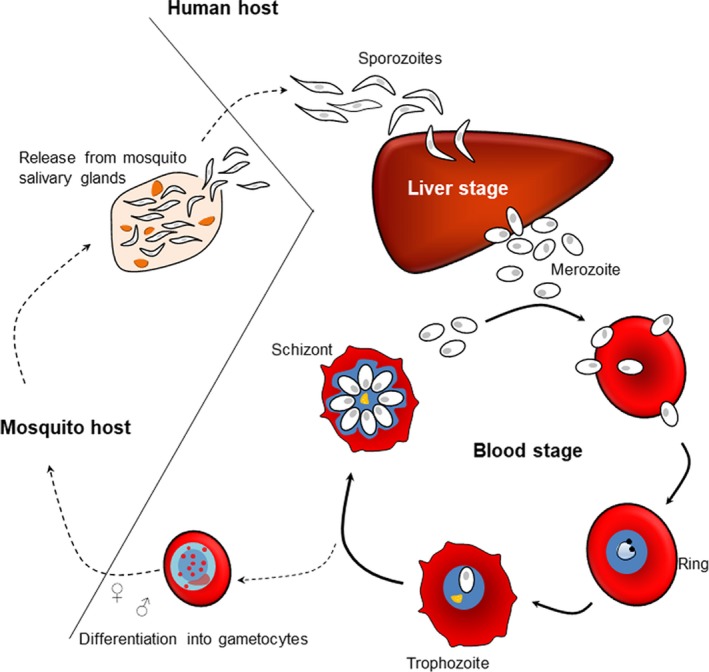
Figure 1
Figure 1
Life cycle of Plasmodium falciparum. Human infection with P. falciparum parasites is initiated when an infected female Anopheles spp. mosquito injects sporozoites during a blood meal. Sporozoites transit from the host peripheral circulation to the liver, where they infect hepatocytes. The liver stage is asymptomatic and lasts for approximately 1 wk. Eventually, the infected liver cells rupture to release extracellular merozoites into the host circulation. The merozoites invade erythrocytes, thereby initiating the asexual blood stage of the infection, which causes all the clinical symptoms of malaria. Once inside the erythrocyte, the merozoite undergoes a series of divisions (schizogony) over a period of 48 h, following which daughter merozoites are released to infect new erythrocytes. Some asexual parasites do not undergo schizogony, but develop into sexual precursors (gametocytes), which can be taken up by mosquitoes during a blood meal to complete the life cycle
Figure 2
Figure 2
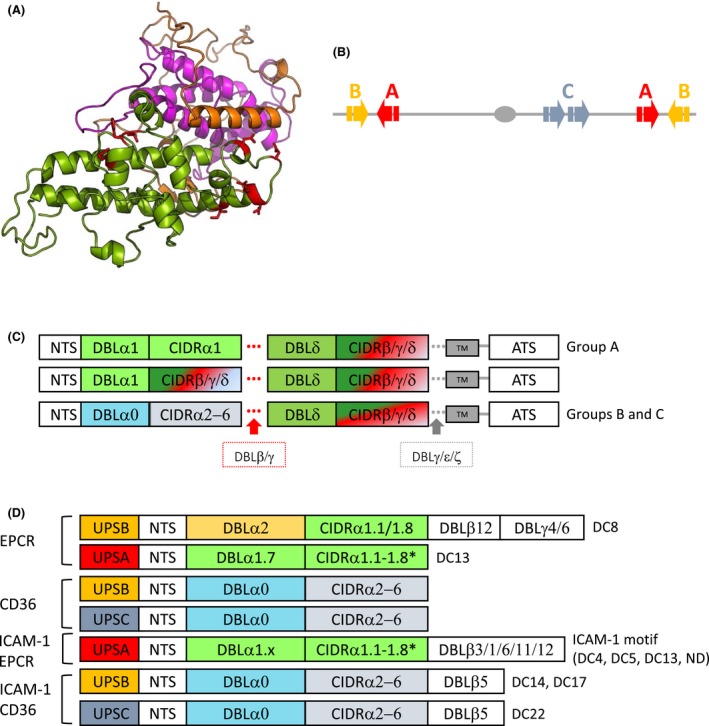
var genes and PfEMP1 structure. (A), Modeled structure of PFD1235w DBLβ. The structure consists of subdomain 1 (S1, orange) with mixed helix‐sheet structure and two helix bundles; subdomain 2 (S2 magenta) and subdomain 3 (S3 green).12 The ICAM‐1 binding site of PFD1235w in S3 is indicated in red.14, 18 (B), Group A and B var genes are located in subtelomeric regions of all chromosomes but are transcribed in opposite directions, whereas Group C var genes are found in central chromosomal regions. (C), PfEMP1 proteins are composed of different subtypes of DBL and CIDR domains. Groups B and C PfEMP1 predominantly have a four‐domain structure, while larger PfEMP1 proteins have additional DBL domains following the first or second DBL‐CIDR domains. (D), Plasmodium falciparum genomes encode tandem domain cassettes (DC) that are linked to different known adhesion phenotypes as indicated. DC8 is a chimeric gene between a group A and a group B var gene. Redrawn and modified from Hviid and Jensen17
Figure 3
Figure 3
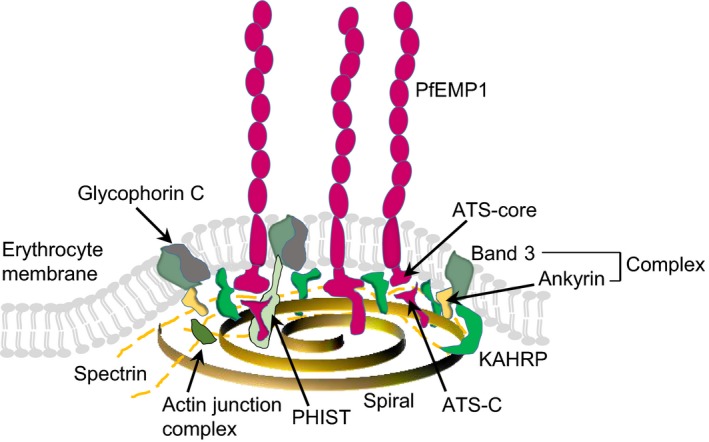
PfEMP1 presentation on knobs on the IE surface. KAHRP form the base of the knob complex. An average of three PfEMP1 molecules are located at the tip of each knob.58 KAHRP binding to spectrin is necessary for the formation of the spiral structure, but KAHRP itself does not appear to be a component of the spiral.54 PHIST protein may connect to PfEMP1 and the cytoskeleton.56 Redrawn and modified from Cutts et al53
Figure 4
Figure 4
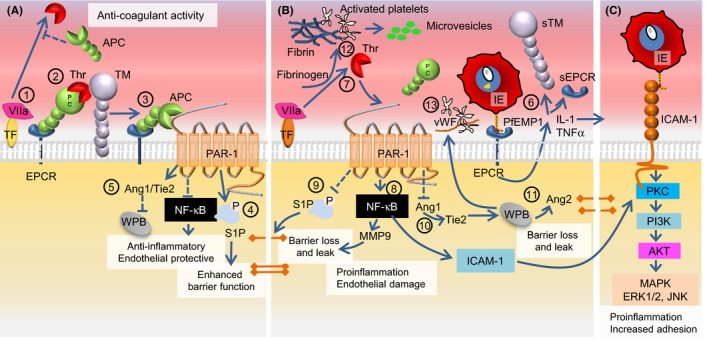
Linking the protein C pathway with EPCR‐ and ICAM‐1‐binding IEs in cerebral malaria. (A), Effects of EPCR in the absence of Plasmodium falciparum‐IE. Thrombin (Thr) is produced by the interaction between tissue factor (TF) and circulating activated factor VII (VIIa) (1). Thrombin initiates the EPCR‐ and thrombomodulin (TM)‐facilitated activation of protein C (APC) that then inhibits thrombin production (2). APC uses EPCR as a coreceptor for cleavage of proteinase‐activated receptor 1 (PAR‐1). The EPCR‐APC activation of PAR‐1 inhibits the nuclear factor‐κB pathway and exerts anti‐inflammatory and anti‐apoptotic activity (3). S1P signaling results in decreased endothelial permeability, and S1P production leads to enhancement of tight junctions and protection of endothelial barrier integrity (4). Angiopoetin‐1 (Ang1) produced in response to the APC‐PAR‐1 interaction decreases Weibel‐Palade body (WPB) exocytosis by occupying Tie2 (5). (B), The impact of infected erythrocytes expressing EPCR‐bound PfEMP1 on the surface. The IE‐EPCR interaction activates endothelial cells to release pro‐inflammatory cytokines (IL‐1, TNFα) that induce shedding of EPCR and TM from the endothelial surface and increases expression of ICAM‐1 (6). The EPCR‐IE interaction results in reduced levels of APC and increased thrombin generation with fibrin deposition (7). Increased levels of thrombin shift the PAR‐1 response toward activation of the RhoA and NFκB with increased surface expression of ICAM‐1 on the endothelial cell (8). The shift in the PAR‐1 response inhibits S1P release resulting in loss of tight junctions, and compromises endothelial barrier function by causing localized vascular leaks (9). A reduction in Ang‐1 levels increases WPB exocytosis via Tie2 and production of von Willebrand Factor (vWF) and Ang2 (10). Increased levels of Ang‐2 further increase WPB exocytosis and contribute to the loss of endothelial barrier integrity and leakage (11). Platelets become activated by thrombin and cytokines, which leads to production of platelet microvesicles (12). Thrombin and activated platelets combine to form thrombi (13). Strings of vWF and activated platelets form complexes, which like thrombi impair the cerebral circulation. (C), The increase in ICAM‐1 (in panel B) allows IE expressing PfEMP1 with a shared DBLβ ICAM‐1 motif to adhere to the brain endothelium. A large proportion of the ICAM‐1‐adhering IEs might initially bind EPCR via their CIDRα1 domains

References

    1. Alano P, Carter R. Sexual differentiation in malaria parasites. Annu Rev Microbiol. 1990;44:429‐449. - PubMed
    1. Bannister LH, Hopkins JM, Dluzewski AR, et al. The Plasmodium falciparum apical membrane antigen‐1 (PfAMA‐1) is translocated within micronemes along subpellicular microtubules during merozoite development. J Cell Sci. 2003;116:3825‐3834. - PubMed
    1. Miller LH, Ackerman HC, Su XZ, Wellems TE. Malaria biology and disease pathogenesis: insights for new treatments. Nat Med. 2013;19:156‐167. - PMC - PubMed
    1. Zanghi G, Vembar SS, Baumgarten S, et al. A specific PfEMP1 is expressed in Plasmodium falciparum sporozoites and plays a role in hepatocyte infection. Cell Rep. 2018;22:2951‐2963. - PMC - PubMed
    1. Gardner MJ, Hall N, Fung E, et al. Genome sequence of the human malaria parasite Plasmodium falciparum . Nature. 2002;419:498‐511. - PMC - PubMed

Publication types

MeSH terms

Substances