Review
. 2019 Sep;7(5):10.1128/microbiolspec.gpp3-0058-2018.
doi: 10.1128/microbiolspec.GPP3-0058-2018.
Temperate Phages of Staphylococcus aureus
Affiliations
- PMID: 31562736
- PMCID: PMC10921950
- DOI: 10.1128/microbiolspec.GPP3-0058-2018
Item in Clipboard
Review
Temperate Phages of Staphylococcus aureus
Microbiol Spectr.
2019 Sep.
Abstract
Most Staphylococcus aureus isolates carry multiple bacteriophages in their genome, which provide the pathogen with traits important for niche adaptation. Such temperate S. aureus phages often encode a variety of accessory factors that influence virulence, immune evasion and host preference of the bacterial lysogen. Moreover, transducing phages are primary vehicles for horizontal gene transfer. Wall teichoic acid (WTA) acts as a common phage receptor for staphylococcal phages and structural variations of WTA govern phage-host specificity thereby shaping gene transfer across clonal lineages and even species. Thus, bacteriophages are central for the success of S. aureus as a human pathogen.
Figures
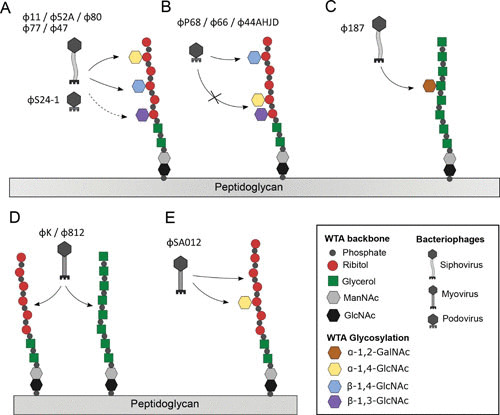
Receptor specificity of S. aureus phages. (A) Siphoviruses Φ11, Φ80, Φ52A, Φ47, and Φ77 and podovirus SA24-1 recognize α-or β-1,4-GlcNAc-RboP WTA. β-1,3-GlcNAc-WTA is adsorbed to less strongly by Φ80, Φ52A, and Φ11. (B) Podoviruses ΦP68, Φ44AHJD, and Φ66 bind to β-1,4-GlcNAc-RboP WTA and are blocked by β-1,3-GlcNAc or α-1,4-GlcNAc modifications. (C) Siphovirus Φ187 binds to α-GalNAC-GroP. (D) Myovirus ΦK, Φ812, attache to the backbone of GroP and/or RboP. (E) ΦSA012 recognizes both the RboP WTA backbone and α-1,4-GlcNAc-RboP by two different RBPs.
References
-
- Łobocka M, Hejnowicz MS, Dąbrowski K, Gozdek A, Kosakowski J, Witkowska M, Ulatowska MI, Weber-Dąbrowska B, Kwiatek M, Parasion S, Gawor J, Kosowska H, Głowacka A. 2012. Genomics of staphylococcal Twort-like phages: potential therapeutics of the post-antibiotic era. Adv Virus Res 83:143–216 10.1016/B978-0-12-394438-2.00005-0. [PubMed] - DOI - PubMed
Publication types
MeSH terms
Substances
LinkOut - more resources
Full Text Sources
Medical