


Guide posts for investment in primary health care and projected resource needs in 67 low-income and middle-income countries: a modelling study
- PMID: 31564629
- PMCID: PMC7024989
- DOI: 10.1016/S2214-109X(19)30416-4
Guide posts for investment in primary health care and projected resource needs in 67 low-income and middle-income countries: a modelling study
Abstract
Background: Primary health care (PHC) is a driving force for advancing towards universal health coverage (UHC). PHC-oriented health systems bring enormous benefits but require substantial financial investments. Here, we aim to present measures for PHC investments and project the associated resource needs.
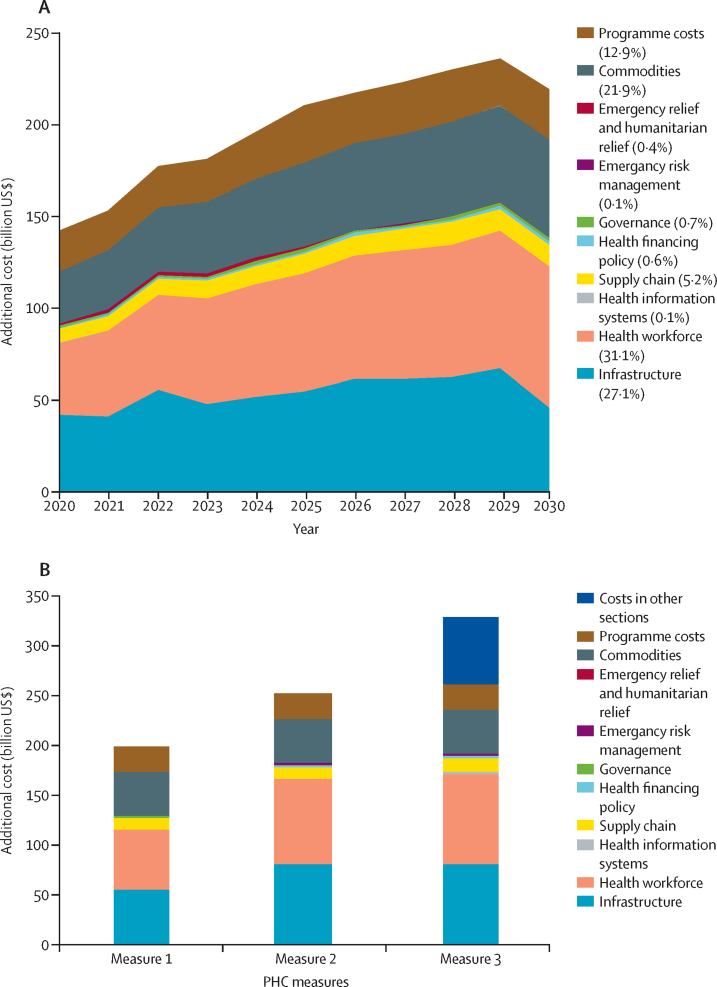
Methods: This modelling study analysed data from 67 low-income and middle-income countries (LMICs). Recognising the variation in PHC services among countries, we propose three measures for PHC, with different scope for included interventions and system strengthening. Measure 1 is centred on public health interventions and outpatient care; measure 2 adds general inpatient care; and measure 3 further adds cross-sectoral activities. Cost components included in each measure were based on the Declaration of Astana, informed by work delineating PHC within health accounts, and finalised through an expert and country validation meeting. We extracted the subset of PHC costs for each measure from WHO's Sustainable Development Goal (SDG) price tag for the 67 LMICs, and projected the associated health impact. Estimates of financial resource need, health workforce, and outpatient visits are presented as PHC investment guide posts for LMICs.
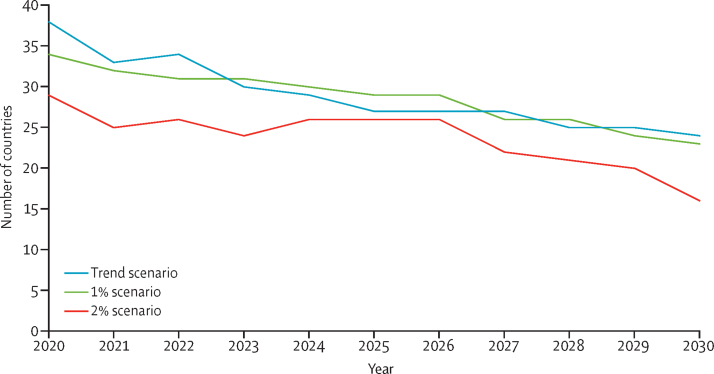
Findings: An estimated additional US$200-328 billion per year is required for the various measures of PHC from 2020 to 2030. For measure 1, an additional $32 is needed per capita across the countries. Needs are greatest in low-income countries where PHC spending per capita needs to increase from $25 to $65. Overall health workforces would need to increase from 5·6 workers per 1000 population to 6·7 per 1000 population, delivering an average of 5·9 outpatient visits per capita per year. Increasing coverage of PHC interventions would avert an estimated 60·1 million deaths and increase average life expectancy by 3·7 years. By 2030, these incremental PHC costs would be about 3·3% of projected gross domestic product (GDP; median 1·7%, range 0·1-20·2). In a business-as-usual financing scenario, 25 of 67 countries will have funding gaps in 2030. If funding for PHC was increased by 1-2% of GDP across all countries, as few as 16 countries would see a funding gap by 2030.
Interpretation: The resources required to strengthen PHC vary across countries, depending on demographic trends, disease burden, and health system capacity. The proposed PHC investment guide posts advance discussions around the budgetary implications of strengthening PHC, including relevant system investment needs and achievable health outcomes. Preliminary findings suggest that low-income and lower-middle-income countries would need to at least double current spending on PHC to strengthen their systems and universally provide essential PHC services. Investing in PHC will bring substantial health benefits and build human capital. At country level, PHC interventions need to be explicitly identified, and plans should be made for how to most appropriately reorient the health system towards PHC as a key lever towards achieving UHC and the health-related SDGs.
Funding: The Bill & Melinda Gates Foundation.
© 2019 World Health Organization; licensee Elsevier. This is an Open Access article published under the CC BY 3.0 IGO license which permits unrestricted use, distribution, and reproduction in any medium, provided the original work is properly cited. In any use of this article, there should be no suggestion that WHO endorses any specific organisation, products or services. The use of the WHO logo is not permitted. This notice should be preserved along with the article's original URL.
Figures

References
-
- Kluge H, Kelley E, Swaminathan S. After Astana: building the economic case for increased investment in primary health care. Lancet. 2018;392:2147–2152. - PubMed
-
- WHO. UNICEF Declaration of Astana. Global Conference on Primary Health Care: from Alma-Ata towards universal health coverage and the Sustainable Development Goals. Astana, Kazakhstan. Oct 25–26, 2018. https://www.who.int/docs/default-source/primary-health/declaration/gcphc...
-
- Patel M. An economic evaluation of “Health for All”. Health Policy Plan. 1986;1:37–47. - PubMed
Publication types
MeSH terms
Grants and funding
LinkOut - more resources
Full Text Sources
Miscellaneous
