. 2019 Aug;16(3):396-414.
doi: 10.20892/j.issn.2095-3941.2019.0097.

Tissue specificity of DNA damage response and tumorigenesis

Affiliations

Tissue specificity of DNA damage response and tumorigenesis

Siman Sun et al. Cancer Biol Med. 2019 Aug.

Abstract

The genome of cells is constantly challenged by DNA damages from endogenous metabolism and environmental agents. These damages could potentially lead to genomic instability and thus to tumorigenesis. To cope with the threats, cells have evolved an intricate network, namely DNA damage response (DDR) system that senses and deals with the lesions of DNA. Although the DDR operates by relatively uniform principles, different tissues give rise to distinct types of DNA damages combined with high diversity of microenvironments across tissues. In this review, we discuss recent findings on specific DNA damage among different tissues as well as the main DNA repair way in corresponding microenvironments, highlighting tissue specificity of DDR and tumorigenesis. We hope the current review will provide further insights into molecular process of tumorigenesis and generate new strategies for cancer treatment.

Keywords: DNA damage response; cancer treatment; microenvironment; tissue specificity; tumorigenesis.


Figures

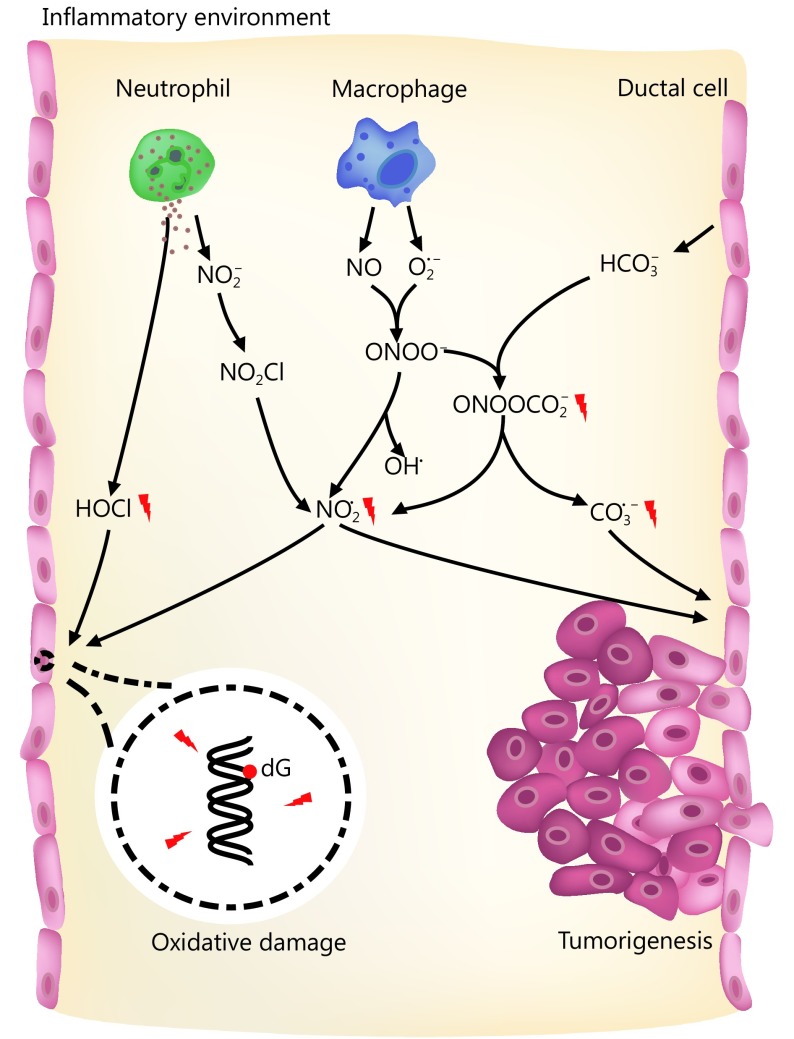
When pancreatitis occurs, macrophages and neutrophils in pancreas secrete a large amount of nitric oxide (NO), superoxide (O<sub>2</sub>·<sup>–</sup>) and nitrite (NO<sub>2</sub><sup>–</sup>) for the eradication of microbial pathogens and processing dead cells. These molecules are unstable and react with each other or microenvironment to produce hypochlorous acid (HOCl) and nitrosoperoxycarbonate (ONOOCO<sub>2</sub><sup>–</sup>), generating RNS and ROS including nitrogen dioxide radical (NO<sub>2</sub>·), and carbonate radical (CO<sub>3</sub>·<sup>–</sup>). The reactive species have significant side effects on normal cells such as ductal cells in pancreas via attacking their genomic DNA. This poses great threat on genomic integrity and potentially causes pancreatic cancer.
1
RNS and ROS in pancreas and the potential risk of tumorigenesis.
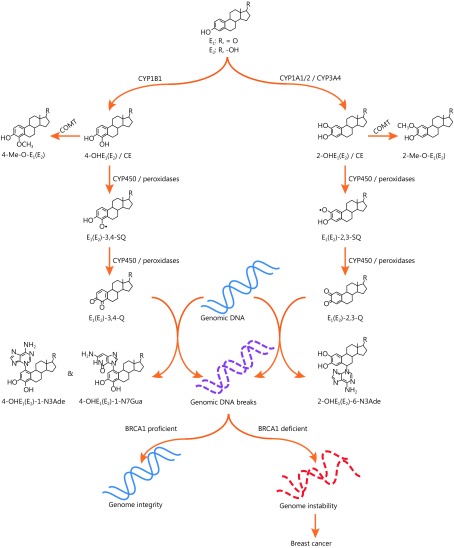
Estrogens (E<sub>1</sub>: estrone; E<sub>2</sub>: estradiol) are metabolized through two main pathways, forming 4- and 2-hydroxylated estrogens respectively, known as catechol estrogens (CEs). With further oxidation, CEs are converted to semiquinones (CE-SQs) and then to CE-quinones (CE-Qs), including E-3,4-Q and E-2,3-Q. CE-Q is a type of dangerous ROS, which attacks genomic DNA. This reaction results in the formation of depurinating adducts including 4-OHE-1-N3Ade, 4-OHE-1-N7Gua, and 2-OHE-6-N3Ade, leaving breaks in DNA. If lacking BRCA1, cells cannot repair the DNA damage. Accumulative DNA lesions lead to genomic instability and further breast cancer.
2
Estrogen oxidation-induced DNA damage and breast cancer.

References

    1. Lindahl T Instability and decay of the primary structure of DNA. Nature. 1993;362:709–15. doi: 10.1038/362709a0. - DOI - PubMed
    1. Sancar A, Lindsey-Boltz LA, Ünsal-Kaçmaz K, Linn S Molecular mechanisms of mammalian DNA repair and the DNA damage checkpoints. Annu Rev Biochem. 2004;73:39–85. doi: 10.1146/annurev.biochem.73.011303.073723. - DOI - PubMed
    1. Jackson SP, Bartek J The DNA-damage response in human biology and disease. Nature. 2009;461:1071–8. doi: 10.1038/nature08467. - DOI - PMC - PubMed
    1. Borrego-Soto G, Ortiz-López R, Rojas-Martínez A Ionizing radiation-induced DNA injury and damage detection in patients with breast cancer. Genet Mol Biol. 2015;38:420–32. doi: 10.1590/S1415-475738420150019. - DOI - PMC - PubMed
    1. Sinha RP, Häder DP Uv-induced DNA damage and repair: a review. Photochem Photobiol Sci. 2002;1:225–36. doi: 10.1039/b201230h. - DOI - PubMed

LinkOut - more resources