


Primary Spinal Astrocytomas: A Literature Review
- PMID: 31565645
- PMCID: PMC6759039
- DOI: 10.7759/cureus.5247
Primary Spinal Astrocytomas: A Literature Review
Abstract
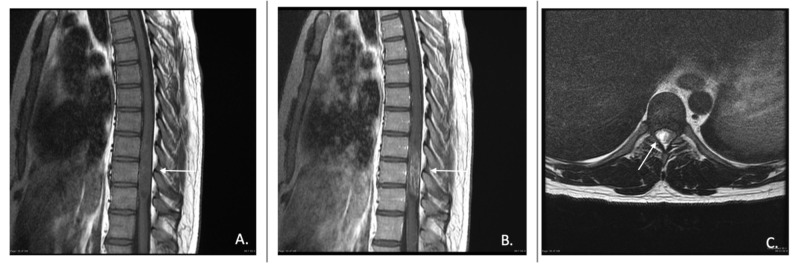
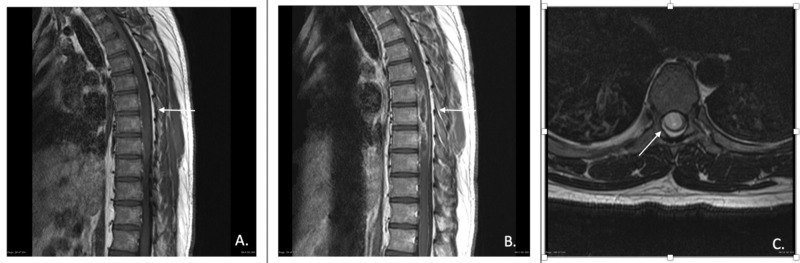
Primary spinal astrocytoma is a subtype of glioma, the most common spinal cord tumor found in the intradural intramedullary compartment. Spinal astrocytomas account for 6-8% of all spinal cord tumors and are primarily low grade (World Health Organization grade I (WHO I) or WHO II). They are seen in both the adult and pediatric population with the most common presenting symptoms being back pain, sensory dysfunction, or motor dysfunction. Magnetic Resonance Imaging (MRI) with and without gadolinium is the imaging of choice, which usually reveals a hypointense T1 weighted and hyperintense T2 weighted lesion with a heterogeneous pattern of contrast enhancement. Further imaging which may aid in surgical planning includes computerized tomography, diffusion tensor imaging, and tractography. Median survival in spinal cord astrocytomas ranges widely. The factors most significantly associated with poor prognosis and shorter median survival are older age at initial diagnosis, higher grade lesion based on histology, and extent of resection. The mainstay of treatment for primary spinal cord astrocytomas is surgical resection, with the goal of preservation of neurologic function, guided by intraoperative neuromonitoring. Adjunctive radiation has been shown beneficial and may increase overall survival. The role of adjunctive chemotherapy is employed, however, its benefit has not been clearly defined. Primary spinal cord astrocytomas are rare and challenging to treat. The gold standard treatment is surgical resection. Second-line treatments include radiation and chemotherapy, although, the optimal regimen for adjunctive therapy has not yet been clearly defined.
Keywords: astrocytoma; glioblastoma; glioma; intradural; intramedullary; spinal astrocytoma; spinal cord neoplasms; spinal tumor.
Copyright © 2019, Ogunlade et al.
Conflict of interest statement
The authors have declared that no competing interests exist.
Figures
References
-
- Intramedullary spinal cord tumors: molecular insights and surgical innovation. Parsa AT, Chi JH, Acosta FL, Ames CP, McCormick PC. https://pdfs.semanticscholar.org/3670/0a3f1d0a6d5158c2b062b6d5be7617a88d.... Clin Neurosurg. 2005;52:76–84. - PubMed
-
- Surgical management of spinal cord hemangioblastomas in patients with von Hippel-Lindau disease. Lonser RR, Weil RJ, Wanebo JE, Devroom HL, Oldfield EH. J Neurosurg. 2003;98:106–116. - PubMed
-
- Primary spinal cord glioma: a surveillance, epidemiology, and end results database study. Milano MT, Johnson MD, Sul J, Mohile NA, Korones DN, Okunieff P, Walter KA. J Neurooncol. 2010;98:83–92. - PubMed
-
- Intramedullary spinal cord tumors: a review of current and future treatment strategies. Tobin MK, Geraghty JR, Engelhard HH, Linninger AA, Mehta AI. Neurosurg Focus. 2015;39:14. - PubMed
-
- Prognosis and treatment of spinal cord astrocytoma. Minehan KJ, Brown PD, Scheithauer BW, Krauss WE, Wright MP. Int J Radiat Oncol Biol Phys. 2009;73:727–733. - PubMed
Publication types
LinkOut - more resources
Full Text Sources
Medical