. 2019 Dec 1;317(6):F1462-F1474.
doi: 10.1152/ajprenal.00352.2019. Epub 2019 Sep 30.

Functional implications of the sex differences in transporter abundance along the rat nephron: modeling and analysis

Affiliations

Functional implications of the sex differences in transporter abundance along the rat nephron: modeling and analysis

Rui Hu et al. Am J Physiol Renal Physiol. .

Abstract

The goal of the present study was to investigate the functional implications of sexual dimorphism in the pattern of transporters along the rodent nephron as reported by Veiras et al. (J Am Soc Nephrol 28: 3504-3517, 2017). To do so, we developed sex-specific computational models of water and solute transport along the superficial nephrons from male and female rat kidneys. The models account for the sex differences in the abundance of apical and basolateral transporters, single nephron glomerular filtration rate, and tubular dimensions. Model simulations predict that ~70% and 60% of filtered Na+ is reabsorbed by the proximal tubule of male and female rat kidneys, respectively. The lower fractional Na+ reabsorption in female kidneys is due primarily to their smaller transport area, lower Na+/H+ exchanger activity, and lower claudin-2 abundance, culminating in significantly larger fractional delivery of water and Na+ to the downstream nephron segments in female kidneys. Conversely, the female distal nephron exhibits a higher abundance of key Na+ transporters, including Na+-K+-Cl- cotransporters, Na+-Cl- cotransporters, and epithelial Na+ channels. The higher abundance of transporters accounts for the enhanced water and Na+ transport along the female, relative to male, distal nephron, resulting in similar urine excretion between the sexes. Consequently, in response to a saline load, the Na+ load delivered distally is greater in female rats than male rats, overwhelming transport capacity and resulting in higher natriuresis in female rats.

Keywords: epithelial transport; sex differences.


Conflict of interest statement

No author conflict of interest, financial or otherwise, is declared by the authors.

Figures

Fig. 1.
Fig. 1.
Profile of renal transporters along the female nephron plotted relative to mean male abundance defined as 1. NHE3, Na+/H+ exchanger isoform 3; NaPi2, Na+-Pi cotransporter 2; NKA α1, Na+-K+-ATPase α1-catalytic subunit; AQP, aquaporin water channel subunit; NKCC2, Na+-K+-Cl cotransporter isoform 2; NCC, Na+-Cl cotransporter; pS71 and -pT53, phosphorylation sites associated with activation; ENaC, epithelial Na+ channel; fl, full-length form; cl, cleaved forms; ROMK, renal outer medullary K+ channel. For the box and whisker plots, the ends of the box are the upper and lower quartiles such that the box spans the interquartile range, the median is marked by the vertical line inside the box, and the whiskers outside the box extend to the highest and lowest observations. The nephron cartoon was loosely adapted from Ref. .
Fig. 2.
Fig. 2.
Schematic diagram of the superficial nephron. The model accounts for the transport of water and 15 solutes. The diagram displays only the main Na+, K+, and Cl transporters. PCT, proximal convoluted tubule; mTAL, medullary thick ascending limb; cTAL, cortical thick ascending limb; DCT, distal convoluted tubule; CNT, connecting tubule; CCD, cortical collecting duct; OMCD, outer medullary collecting duct; IMCD, inner medullary collecting duct. Reprinted from Ref. .
Fig. 3.
Fig. 3.
Delivery of key solutes (AG) and fluid (H) to the beginning of individual nephron segments in male and female rats. PT, proximal tubule; SDL, short descending limb; mTAL, medullary thick ascending limb; DCT, distal convoluted tubule; CNT, connecting tubule; CCD, cortical collecting duct; TA, titratable acid. Insets: reproductions of distal segment values.
Fig. 4.
Fig. 4.
Net transport of key solutes (AG) and fluid (H) along individual nephron segments, in male and female rats. Transport is taken positive out of a nephron segment. PT, proximal tubule; SDL, short descending limb; TAL, thick ascending limb; DCT, distal convoluted tubule; CNT, connecting tubule; CD, collecting duct; TA, titratable acid. Insets: reproductions of distal segment values.
Fig. 5.
Fig. 5.
Accumulative transport of key solutes (AG) and fluid (H) up to and including differing nephron segments in male and female rats. PT, proximal tubule; SDL, short descending limb; TAL, thick ascending limb; DCT, distal convoluted tubule; CNT, connecting tubule; CD, collecting duct; TA, titratable acid.
Fig. 6.
Fig. 6.
Tubular fluid solute concentrations (A–G), pH (H), and osmolality (I) in male and female rats. Tubular fluid solute concentrations are similar in the two sexes along the proximal segments but diverge downstream of the thick ascending limbs. PT, proximal tubule; SDL, short descending limb; TAL, thick ascending limb; DCT, distal convoluted tubule; CNT, connecting tubule; CD, collecting duct; TA, titratable acid. Brackets denote concentration.
Fig. 7.
Fig. 7.
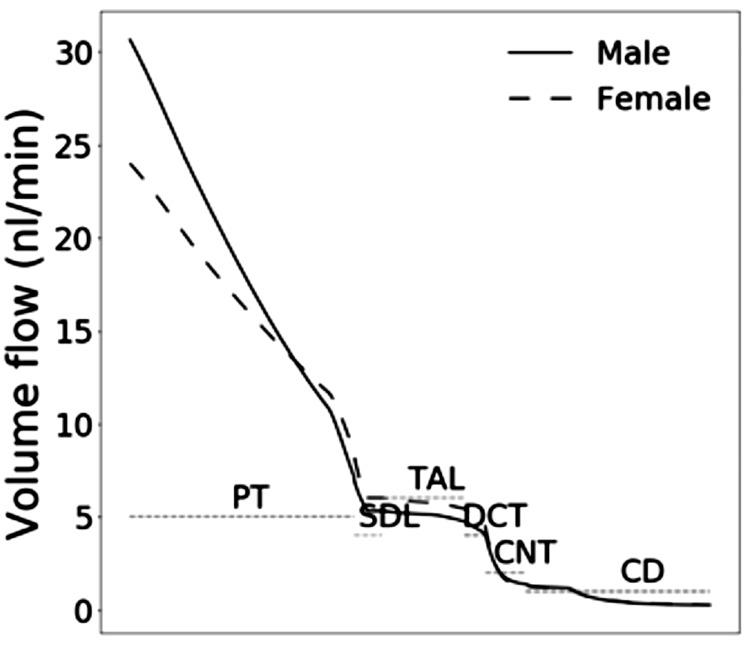
Tubular fluid flow in male and female rats. PT, proximal tubule; SDL, short descending limb; TAL, thick ascending limb; DCT, distal convoluted tubule; CNT, connecting tubule; CD, collecting duct. The single nephron glomerular filtration rate in the female rat is 80% that of the male rat. However, proximal tubular outflow is slightly higher in female rats because of its lower water reabsorption. That excess fluid is reabsorbed along the distal segments so that urine output is similar in the two sexes.
Fig. 8.
Fig. 8.
Delivery of key solutes (AG) and fluid (H) to the beginning of individual nephron segments in male and female rats. After a Na+ load, the single nephron glomerular filtration rate increases by 50%, resulting in elevated volume and solute deliveries to all nephron segments. Net urine volume and NaCl excretion are predicted to be similar in male and female rats, with higher fractional excretion rates in female rats. PT, proximal tubule; SDL, short descending limb; mTAL, medullary thick ascending limb; DCT, distal convoluted tubule; CNT, connecting tubule; CCD, cortical collecting duct; TA, titratable acid. Insets: reproductions of distal segment values.
Fig. 9.
Fig. 9.
Net transport of key solutes (AG) and fluid (H) along individual nephron segments in male and female rats. Transport is taken positive out of a nephron segment. After a Na+ load, the single nephron glomerular filtration rate and filtered load increase by 50%. Reabsorption of Na+ and Cl increases in all segments, but primarily along the proximal tubule (PT). K+ reabsorption markedly increases along the PT and thick ascending limb (TAL), and K+ secretion by the connecting tubule (CNT) increases by severalfold. SDL, short descending limb; DCT, distal convoluted tubule; CD, collecting duct; TA, titratable acid. Insets: reproductions of distal segment values.
Fig. 10.
Fig. 10.
Sensitivity of key model predictions to sex differences in parameters. Individual model parameters in the female model were set to male values. PCT, proximal convoluted tubule; S3, proximal straight tubule; NHE3, Na+/H+ exchanger isoform 3; Pf, transcellular water permeability; TAL, thick ascending limb; NKCC2, Na+-K+-Cl cotransporter isoform 2; NKA, Na+-K+-ATPase; DCT, distal convoluted tubule; NCC, Na+-Cl cotransporter; CNT, connecting tubule; ENaC, epithelial Na+ channel; CCD, cortical collecting duct; OMCD, outer medullary collecting duct; IMCD, inner medullary collecting duct; PK, apical K+ permeability; SNGFR, single nephron glomerular filtration rate.

References

    1. Blantz RC, Singh P, Deng A, Thomson SC, Vallon V. Acute saline expansion increases nephron filtration and distal flow rate but maintains tubuloglomerular feedback responsiveness: role of adenosine A1 receptors. Am J Physiol Renal Physiol 303: F405–F411, 2012. doi:10.1152/ajprenal.00329.2011. - DOI - PMC - PubMed
    1. Brasen JC, Burford JL, McDonough AA, Holstein-Rathlou NH, Peti-Peterdi J. Local pH domains regulate NHE3-mediated Na+ reabsorption in the renal proximal tubule. Am J Physiol Renal Physiol 307: F1249–F1262, 2014. doi:10.1152/ajprenal.00174.2014. - DOI - PMC - PubMed
    1. Brown RD, Hilliard LM, Head GA, Jones ES, Widdop RE, Denton KM. Sex differences in the pressor and tubuloglomerular feedback response to angiotensin II. Hypertension 59: 129–135, 2012. doi:10.1161/HYPERTENSIONAHA.111.178715. - DOI - PubMed
    1. Fry BC, Edwards A, Layton AT. Impact of nitric-oxide-mediated vasodilation and oxidative stress on renal medullary oxygenation: a modeling study. Am J Physiol Renal Physiol 310: F237–F247, 2016. doi:10.1152/ajprenal.00334.2015. - DOI - PMC - PubMed
    1. Fry BC, Edwards A, Layton AT. Impacts of nitric oxide and superoxide on renal medullary oxygen transport and urine concentration. Am J Physiol Renal Physiol 308: F967–F980, 2015. doi:10.1152/ajprenal.00600.2014. - DOI - PMC - PubMed

Publication types

LinkOut - more resources