. 2019 Sep 27;24(19):3509.
doi: 10.3390/molecules24193509.

Anti-Inflammatory Activity of the Wild Mushroom, Echinodontium tinctorium, in RAW264.7 Macrophage Cells and Mouse Microcirculation

Affiliations

Anti-Inflammatory Activity of the Wild Mushroom, Echinodontium tinctorium, in RAW264.7 Macrophage Cells and Mouse Microcirculation

Sumreen Javed et al. Molecules. .

Abstract

The aim of this study was to investigate the anti-inflammatory activity of a previously un-studied wild mushroom, Echinodontium tinctorium, collected from the forests of north-central British Columbia. The lipopolysaccharide (LPS)-induced RAW264.7 macrophage model was used to study the in vitro anti-inflammatory activity. The crude alkaline extract demonstrated potent anti-inflammatory activity, and was further purified using a "bio-activity-guided-purification" approach. The size-exclusion and ion-exchange chromatography yielded a water-soluble anti-inflammatory polysaccharide (AIPetinc). AIPetinc has an average molecular weight of 5 kDa, and is a heteroglucan composed of mainly glucose (88.6%) with a small amount of galactose (4.0%), mannose (4.4%), fucose (0.7%), and xylose (2.3%). In in vivo settings, AIPetinc restored the histamine-induced inflammatory event in mouse gluteus maximus muscle, thus confirming its anti-inflammatory activity in an animal model. This study constitutes the first report on the bioactivity of Echinodontium tinctorium, and highlights the potential medicinal benefits of fungi from the wild forests of northern British Columbia. Furthermore, it also reiterates the need to explore natural resources for alternative treatment to modern world diseases.

Keywords: British Columbia; Echinodontium tinctorium; anti-inflammation; mushroom; polysaccharide.


Conflict of interest statement

The authors declare no conflict of interest.

Figures

Figure 1
Figure 1
Immuno-modulatory activities of crude extracts obtained from Echinodontium tinctorium. (a) At 1 mg/mL, crude extracts (80% ethanol, 50% methanol, water, 2% ammonium oxalate, and 5% NaOH) were assessed for their ability to induce TNF-α production in RAW264.7 macrophage cells as an indicator of immuno-stimulation. Lipopolysaccharide (LPS) was used as positive control, whereas media and water were used as negative controls. (b) Crude extracts (1 mg/mL) that were inactive for immuno-stimulation (80% ethanol, 50% methanol, and 5% NaOH) were tested for their ability to inhibit LPS-induced TNF-α production as an indicator of anti-inflammatory activity. Polymyxin B (PMB; an inhibitor of LPS) was used as a positive control, whereas media and water treated with LPS were used as negative controls. (c) Comparison of the anti-inflammatory activity of 5% NaOH extract from two different collections of E. tinctorium. Due to the large quantity of a new collection, the new NaOH extract was used for further purification studies and in vivo experiments. Data shown were pooled from three biological replicates (n = 3). Error bars are S.D., and one-way ANOVA was performed as statistical analysis. * denotes p < 0.05 as compared to the water control using Sidak’s multiple comparison test.
Figure 2
Figure 2
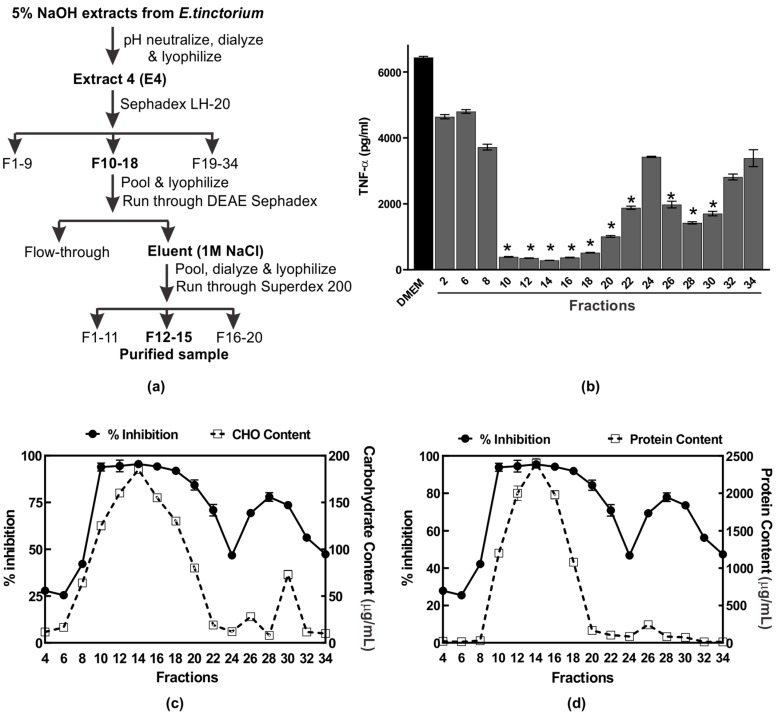
Purification of the anti-inflammatory polysaccharide from Echinodontium tinctorium (AIPetinc). (a) Summary of the purification scheme used; (b) Profile of anti-inflammatory activity of the NaOH extract after elution from Sephadex™ LH-20 column. The assays were performed in triplicate and the data shown is a representative from three biological replicates (n = 3). Error bars represent standard deviation. One-way ANOVA was performed as described in Materials and Methods. * denotes p < 0.05 as compared to DMEM using Sidak’s multiple comparison test. Fractions which contained anti-inflammatory activity (expressed as % inhibition) were also assessed for carbohydrate (c) and protein (d) contents. The data shown in (c) and (d) also result from three biological replicates (n = 3).
Figure 3
Figure 3
Purification of the anti-inflammatory polysaccharide from Echinodontium tinctorium (AIPetinc) using Superdex 200. Fractions collected were assessed for anti-inflammatory activity where percent inhibition represents the inhibition of LPS-induced TNF-α plotted against (a) dextran standards, (b) carbohydrate contents, and (c) protein contents. Results are representative from two separate experiments (n = 2).
Figure 4
Figure 4
MTT assay demonstrating mild toxicity of AIPetinc on RAW264.7 cells. RAW264.7 cells plated at 10,000 cells/well (a) and at 100,000 cells/well (b) were incubated with crude (E4) and semi-purified extracts (post-LH20 and post-LH20-DEAE) of E. tinctorium for six hours before the MTT assay was performed to determine cell viability. Error bars are S.D., obtained from two biological replicates (n = 2).
Figure 5
Figure 5
The inhibitory effect of AIPetinc on LPS-stimulated TNF-α response requires co-incubation with LPS. (a) LPS-stimulated TNF-α production in RAW264.7 cells with pre-incubation of mushroom extracts isolated from P. aurea (ISPaurea) or E. tinctorium crude extract (E4) and the semi-purified fraction post-LH20. After incubation for six hours with the indicated extracts and controls, the cells were washed two times before LPS was added for a further six hours incubation. TNF-α production in the medium was then measured. (b) LPS-stimulated TNF-α production in RAW264.7 cells co-incubated with mushroom extracts. Error bars are S.D., obtained from three biological replicates (n = 3), and one-way ANOVA was performed as statistical analysis. * denotes p < 0.05 as compared to H2O control using Sidak’s multiple comparison test.
Figure 6
Figure 6
In vitro anti-inflammatory activity of AIPetinc. (a) At 1 mg/mL, AIPetinc inhibited LPS-induced nitric acid production in RAW264.7 macrophage cells. PMB was used as a positive control for anti-inflammatory response. Purified sample inhibited ≥ 98% of stimulated nitric oxide (NO). (b) At 1 mg/mL, 5% NaOH extract containing AIPetinc inhibited histamine-induced TNF-α production in RAW264.7 macrophage cells. The histamine concentration used is 10−6 M. Error bars are S.D., data obtained from three biological replicates (n = 3), and one-way ANOVA was performed as statistical analysis. * denotes p < 0.05 as compared to DMEM using Sidak’s multiple comparison test.
Figure 7
Figure 7
In vivo anti-inflammatory activity of AIPetinc. (a) Local response to conducted vasodilation in intact arterioles of C57BL6 mice (n = 10). Responses to acetylcholine (Ach) (1psi, 500 ms) were recorded at the site of stimulation (local: distance = 0). There was no significant difference in the local response in arterioles of C57BL6 mice under different treatment. (b) Responses to ACh (1psi, 500 ms) were recorded upstream (with respect to blood flow) at a distance of 500 µm (conducted response). At each site, change in diameter was calculated as peak response diameter minus resting diameter. There is a significant difference between conducted response of histamine vs. histamine + AIPetinc indicating the anti-inflammatory potential of the molecule. Error bars represents mean ± S.D. One-way ANOVA was performed as described in methods. * denotes p < 0.05 as compared to control.

References

    1. Smith A., Javed S., Barad A., Myhre V., Li W.M., Reimer K., Massicotte H.B., Tackaberry L.E., Payne G.W., Egger K.N., et al. Growth-inhibitory and immunomodulatory activities of wild mushrooms from North-Central British Columbia (Canada) Int. J. Med. Mushrooms. 2017;19:485–497. doi: 10.1615/IntJMedMushrooms.v19.i6.10. - DOI - PubMed
    1. Deo G., Khatra J., Buttar S., Li W.M., Tackaberry L.E., Massicotte H.B., Egger K.N., Reimer K., Lee C.H. Anti-proliferative, immuno-stimulatory and anti-inflammatory activities of extracts derived from mushrooms collected in Haida Gwaii, British Columbia, Canada. Int. J. Med. Mushrooms. 2019;21:629–643. doi: 10.1615/IntJMedMushrooms.2019031193. - DOI - PubMed
    1. Allen E.A., Morrison D.J., Wallis G.W. Common Tree Diseases of British Columbia. Pacific Forestry Center; Hull, QC, Canada: 1996.
    1. Gilbertson R.L., Ryvarden L. North American Polypores. Volume 1. Fungiflora; Oslo, Norway: 1986. p. 433.
    1. Hansen E.M., Lewis K.J., Chastagner G.A. Compendium of Conifer Diseases. 2nd ed. APS Press, the American Phytopathological Society; St. Paul, MN, USA: 2018. p. 224.

MeSH terms

LinkOut - more resources