Review
. 2019 Oct 1;39(1):53.
doi: 10.1186/s40880-019-0402-8.

Pathological transition as the arising mechanism for drug resistance in lung cancer

Affiliations
Review

Pathological transition as the arising mechanism for drug resistance in lung cancer

Yueqing Chen et al. Cancer Commun (Lond). .

Abstract

Despite the tremendous efforts for improving therapeutics of lung cancer patients, its prognosis remains disappointing. This can be largely attributed to the lack of comprehensive understanding of drug resistance leading to insufficient development of effective therapeutics in clinic. Based on the current progresses of lung cancer research, we classify drug resistance mechanisms into three different levels: molecular, cellular and pathological level. All these three levels have significantly contributed to the acquisition and evolution of drug resistance in clinic. Our understanding on drug resistance mechanisms has begun to change the way of clinical practice and improve patient prognosis. In this review, we focus on discussing the pathological changes linking to drug resistance as this has been largely overlooked in the past decades.

Keywords: Drug resistance; Lung cancer; Pathological transition.


Conflict of interest statement

The authors declare that they have no competing interests.

Figures
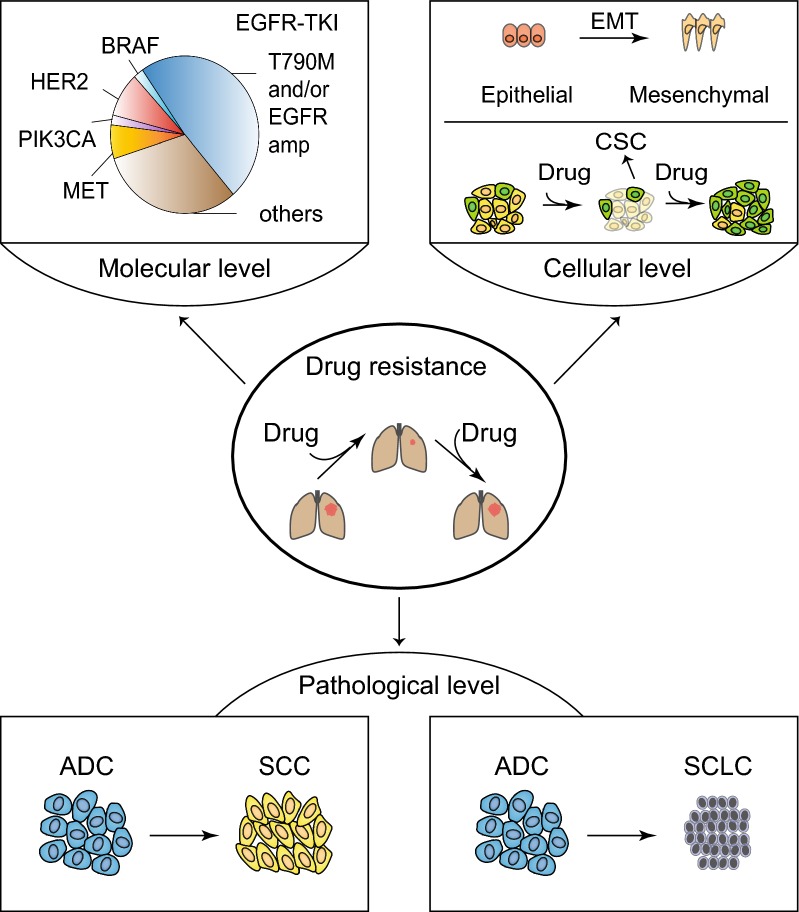
Fig. 1
Fig. 1
Three different levels of drug resistance mechanisms in lung cancer. Drug resistance develops at three different levels: molecular, cellular, and pathological level. Molecular level mechanism includes secondary EGFR T790M and MET amplification after the relapse from EGFR-TKI therapy. Cellular level mechanism mainly involves CSC and EMT. Pathological level mechanism includes the ADC-to-SCC transition and ADC or SCC-to-SCLC transition. EGFR epidermal growth factor receptor, EGFR-TKI epidermal growth factor receptor-tyrosine kinase inhibitor, BRAF serine/threonine-protein kinase B-raf, HER2 receptor tyrosine-protein kinase erbB-2, PIK3CA phosphatidylinositol-4,5-bisphosphate 3-kinase catalytic subunit alpha, MET hepatocyte growth factor receptor, EMT epithelial-to-mesenchymal transition, CSC cell stem cell, ADC adenocarcinoma, SCC squamous cell carcinoma, SCLC small cell lung cancer
Fig. 2
Fig. 2
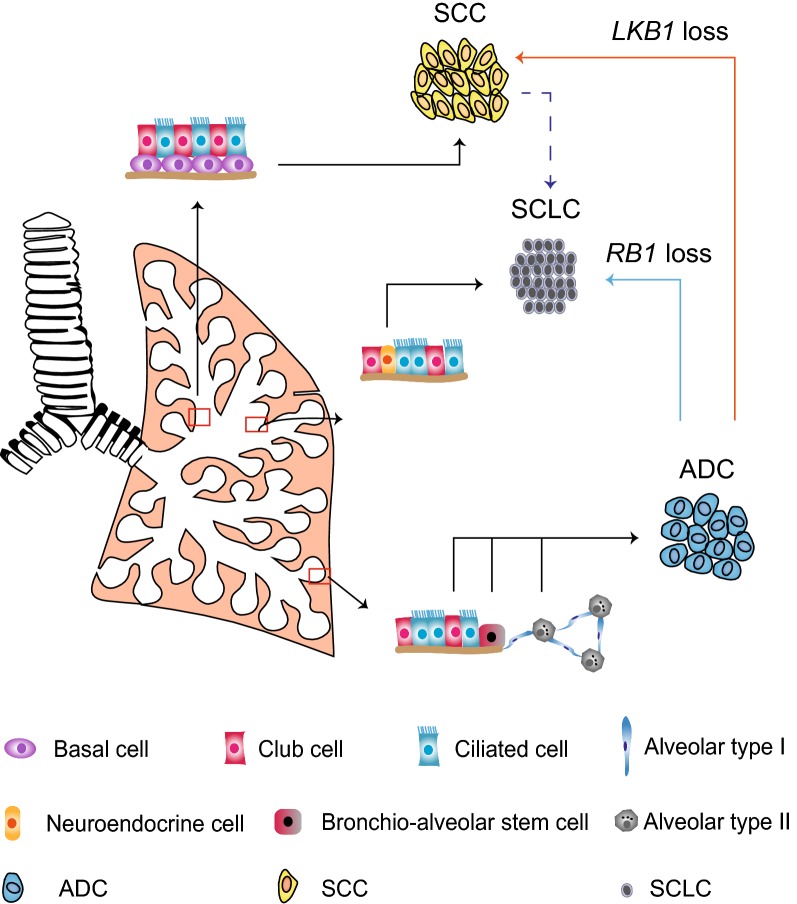
Pathological transition of different lung cancer subtypes. Lung cancer can be divided into two subtypes: NSCLC and SCLC. NSCLC can be further divided into three subtypes: ADC, SCC, and LCC. ADCs are considered to originate from alveolar type II cells, club cells or BASCs. SCC frequently found at more proximal airways is presumably derived from basal cells. SCLC is typically derived from neuroendocrine cells. Pathological transition is observed in clinic including lung ADC-to-SCC transdifferentiation and ADC or SCC-to-SCLC transition. Loss of LKB1 or RB1 potentially contributes to the squamous and SCLC transition, respectively. NSCLC non-small cell lung cancer, SCLC small cell lung cancer, ADC adenocarcinoma, SCC squamous cell carcinoma, LCC large cell carcinoma, BASC bronchio-alveolar stem cell, LKB1 liver kinase B1, RB1 retinoblastoma
Fig. 3
Fig. 3
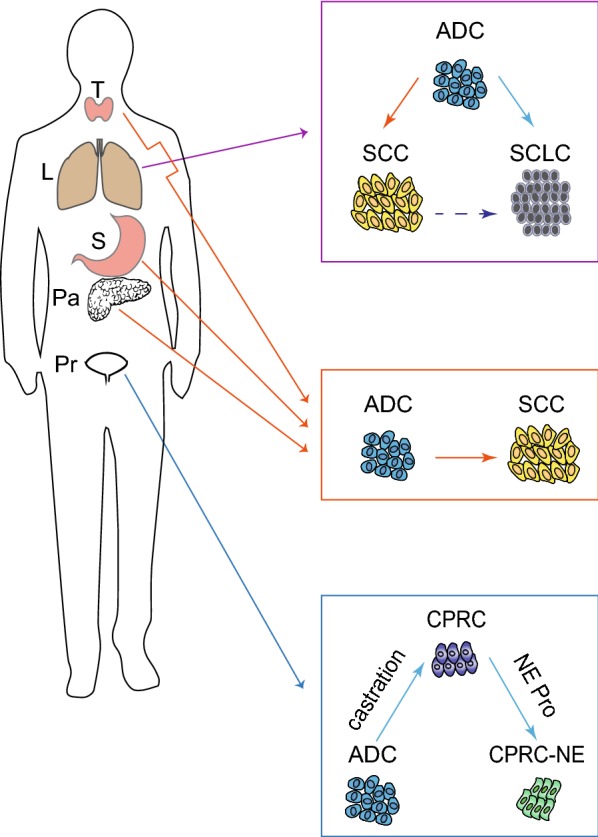
Pathological transition of different types of cancers. Pathological transition in lung cancer includes AST and ADC or SCC-to-SCLC transition. The AST or AST-like process is previously reported in thyroid gland carcinoma, pancreatic cancer as well as gastric cancer. Moreover, neuroendocrine differentiation in ADC has also been reported in prostate cancer. T thyroid gland, L lung, S stomach, Pa pancreas, Pr prostate, Pro proliferation, SCLC small cell lung cancer, ADC adenocarcinoma, SCC squamous cell carcinoma, AST ADC to SCC transition, CPRC castration-resistant prostate cancer, NE neuroendocrine

References

    1. Testa U, Castelli G, Pelosi E. Lung cancers: molecular characterization, clonal heterogeneity and evolution, and cancer stem cells. Cancers. 2018 doi: 10.3390/cancers10080248. - DOI - PMC - PubMed
    1. Fujii T, Dracheva T, Player A, Chacko S, Clifford R, Strausberg RL, et al. A preliminary transcriptome map of non-small cell lung cancer. Can Res. 2002;62(12):3340. - PubMed
    1. Rekhtman N, Ang DC, Sima CS, Travis WD, Moreira AL. Immunohistochemical algorithm for differentiation of lung adenocarcinoma and squamous cell carcinoma based on large series of whole-tissue sections with validation in small specimens. Mod Pathol. 2011;24:1348. doi: 10.1038/modpathol.2011.92. - DOI - PubMed
    1. Righi L, Graziano P, Fornari A, Rossi G, Barbareschi M, Cavazza A, et al. Immunohistochemical subtyping of nonsmall cell lung cancer not otherwise specified in fine-needle aspiration cytology: a retrospective study of 103 cases with surgical correlation. Cancer. 2011;117(15):3416–3423. doi: 10.1002/cncr.25830. - DOI - PubMed
    1. Barlesi F, Pinot D, Legoffic A, Doddoli C, Chetaille B, Torre JP, et al. Positive thyroid transcription factor 1 staining strongly correlates with survival of patients with adenocarcinoma of the lung. Br J Cancer. 2005;93(4):450–452. doi: 10.1038/sj.bjc.6602717. - DOI - PMC - PubMed

Publication types

MeSH terms