


Trends in the risk of second primary malignancies among survivors of chronic lymphocytic leukemia
- PMID: 31570695
- PMCID: PMC6768881
- DOI: 10.1038/s41408-019-0237-1
Trends in the risk of second primary malignancies among survivors of chronic lymphocytic leukemia
Abstract
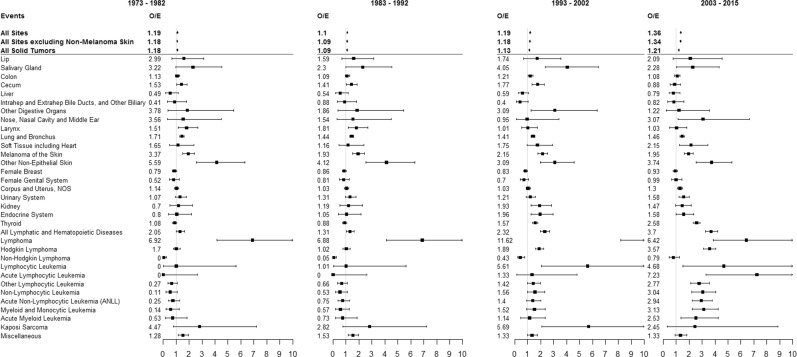
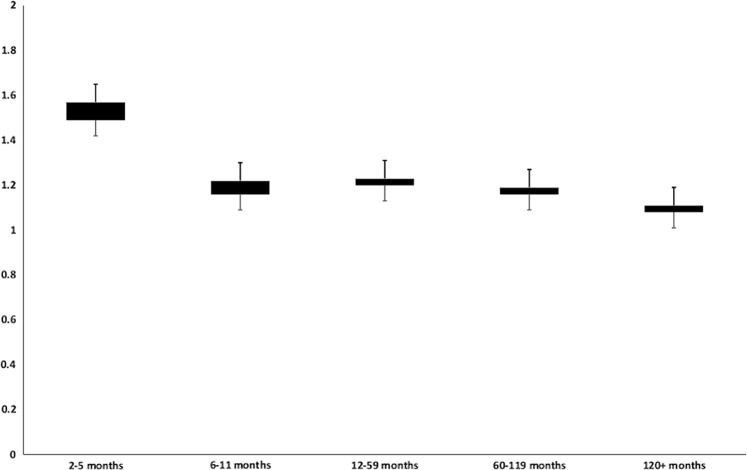
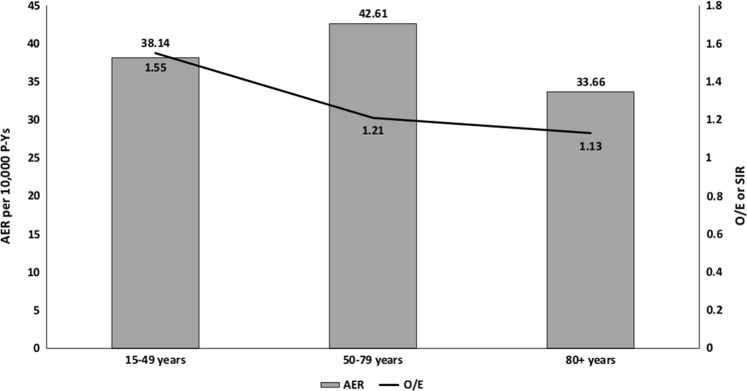
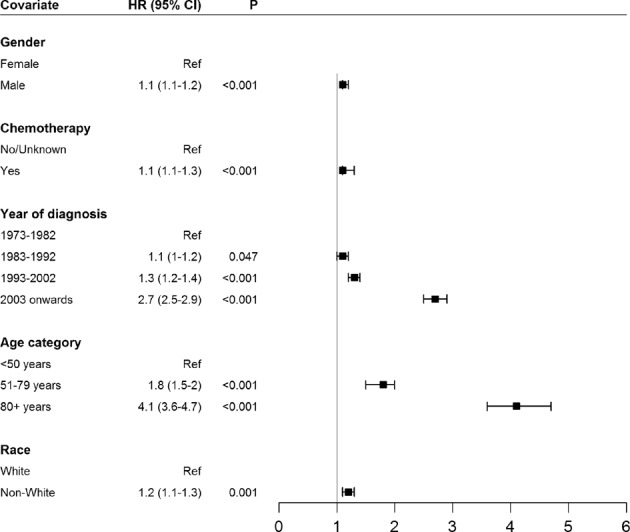
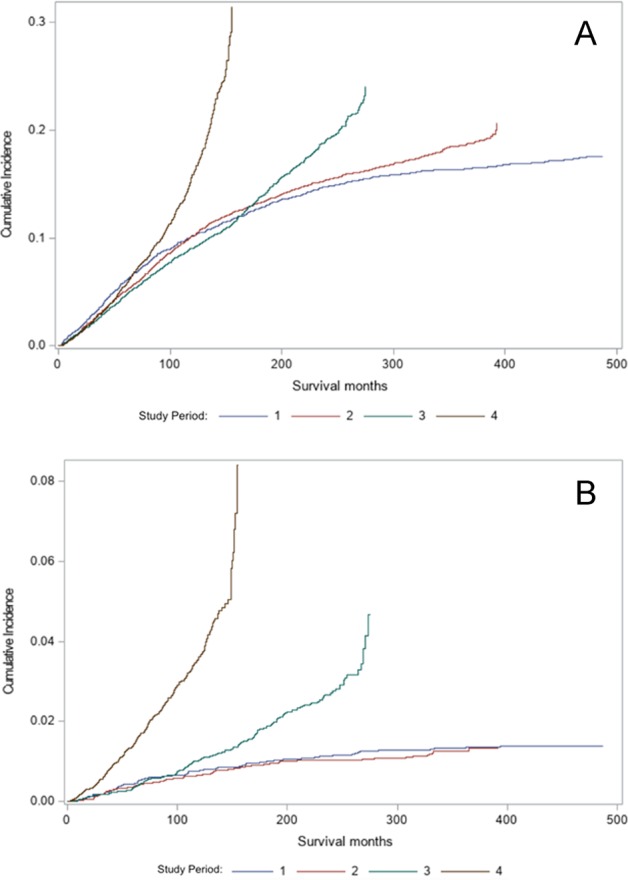
With improving survivorship in chronic lymphocytic leukemia (CLL), the risk of second primary malignancies (SPMs) has not been systematically addressed. Differences in risk for SPMs among CLL survivors from the Surveillance, Epidemiology, and End Results (SEER) database (1973-2015) were compared to risk of individual malignancies expected in the general population. In ~270,000 person-year follow-up, 6487 new SPMs were diagnosed with a standardized incidence ratio (SIR) of 1.2 (95% CI:1.17-1.23). The higher risk was for both solid (SIR 1.15; 95% CI:1.12-1.18) and hematological malignancies (SIR 1.61; 95% CI:1.5-1.73). The highest risk for SPMs was noted between 2 and 5 months after CLL diagnosis (SIR 1.57; 95% CI:1.41-1.74) and for CLL patients between 50- and 79-years-old. There was a significant increase in SPMs in years 2003-2015 (SIR 1.36; 95% CI:1.3-1.42) as compared to 1973-1982 (SIR 1.19; 95% CI:1.12-1.26). The risk of SPMs was higher in CLL patients who had received prior chemotherapy (SIR 1.38 95% CI:1.31-1.44) as compared to those untreated/treatment status unknown (SIR 1.16, 95% CI:1.13-1.19, p < 0.001). In a multivariate analysis, the hazard of developing SPMs was higher among men, post-chemotherapy, recent years of diagnosis, advanced age, and non-Whites. Active survivorship plans and long-term surveillance for SPMs is crucial for improved outcomes of patients with a history of CLL.
Conflict of interest statement
S. Ai serves as a consultant for Celgene, Takeda, Janssen, Pharmacyclics, and Amgen, and has received institutional research support from Pharmacyclics, Cellectar, and Amgen; R.M. has served as an advisor for Takeda, Guardant Health, AstraZanaca, and Novocure; M.A. has an immediate family member as a consultant for Celgene, Takeda, Janssen, Pharmacyclics, and Amgen, and who has received institutional research support from Pharmacyclics, Cellectar, and Amgen. The other authors declare that they have no conflict of interest.
Figures
References
-
- Surveillance, Epidemiology, and End Results Program (SEER) Program Populations (1969-2016) [Internet]. National Cancer Institute, DCCPS, Surveillance Research Program. December 2017 [cited 11 July 2019]. Available from: https://seer.cancer.gov/popdata.
MeSH terms
Grants and funding
LinkOut - more resources
Full Text Sources
Medical
Molecular Biology Databases
