


Cardiovascular safety of antimuscarinic add-on therapy in patients with overactive bladder who had a suboptimal response to mirabegron monotherapy: A post hoc analysis from the Japanese MILAI II study
- PMID: 31571403
- PMCID: PMC7004007
- DOI: 10.1111/luts.12286
Cardiovascular safety of antimuscarinic add-on therapy in patients with overactive bladder who had a suboptimal response to mirabegron monotherapy: A post hoc analysis from the Japanese MILAI II study
Abstract
Objective: This analysis was conducted to investigate the cardiovascular (CV) safety outcomes from the MILAI II study. MILAI II was conducted to evaluate the long-term safety and efficacy of antimuscarinic add-on therapy to mirabegron over 52 weeks in patients with overactive bladder (OAB) symptoms.
Methods: MILAI II consisted of a 2-week screening period (patients received mirabegron 50 mg once daily) plus a 52-week treatment period (patients were randomized to receive a combination of mirabegron 50 mg/d plus solifenacin 5 mg/d, propiverine 20 mg/d, imidafenacin 0.2 mg/d, or tolterodine 4 mg/d). CV safety was assessed using treatment-emergent adverse events (TEAEs), vital signs, and 12-lead electrocardiograms (ECGs). Vital signs and ECG data were evaluated for each patient using worst post-baseline values reported.
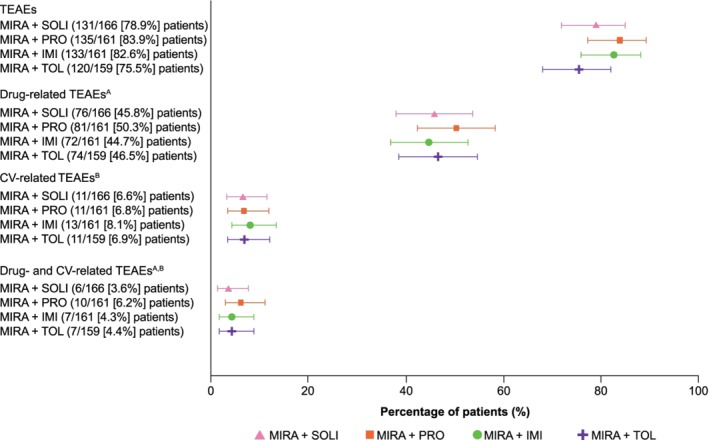
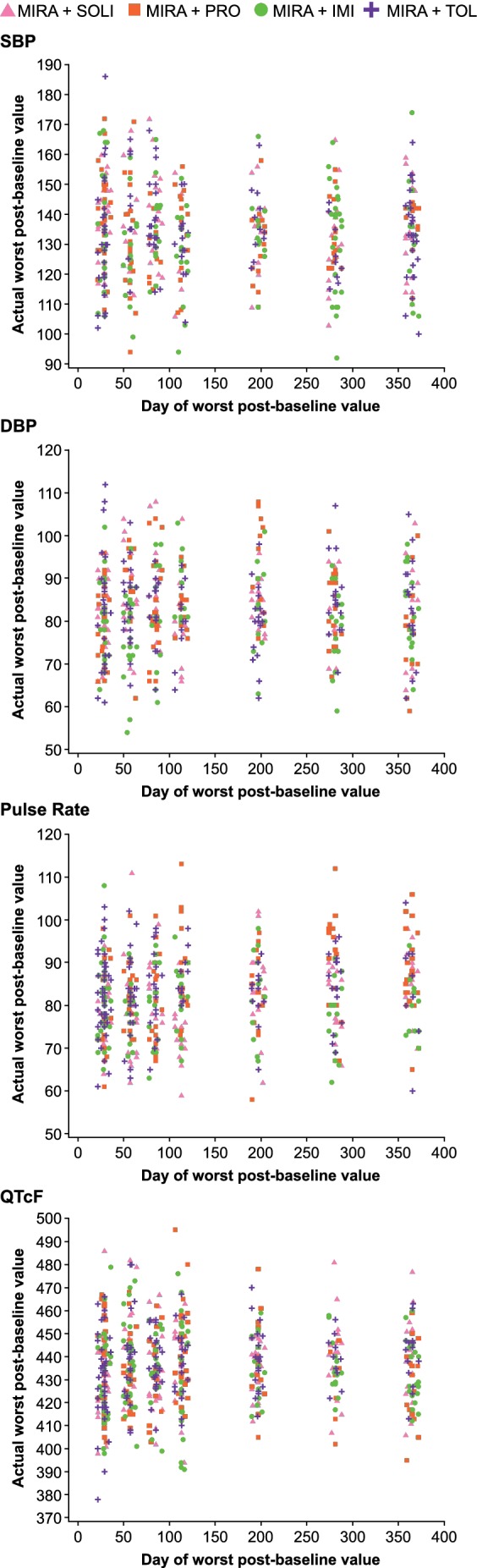
Results: Of 647 patients, 570 (88.1%) were female with a mean age of 65 years. CV history at baseline and CV-related concomitant medication use throughout the study were balanced between groups. The incidences of overall and drug-related CV TEAEs were ≤8.1% and ≤6.2%, respectively, for all groups. The most common TEAEs were ECG T wave amplitude decreased, ECG QT prolonged, and ventricular extrasystoles. Overall, 36 TEAEs of interest related to the CV system that were possibly/probably related to treatment were reported with similar incidences for each group. For the worst post-baseline vital signs and ECGs, no relationships were noted in terms of either timing or treatment group.
Conclusion: A favorable CV safety profile was observed following long-term combination treatment with mirabegron and an antimuscarinic in patients with OAB symptoms.
Keywords: antimuscarinics; cardiovascular; combination therapy; mirabegron; overactive bladder.
© 2019 The Authors. LUTS: Lower Urinary Tract Symptoms published by John Wiley & Sons Australia, Ltd.
Conflict of interest statement
Takao Katoh has received non‐financial support and consultancy fees from Astellas Pharma and consultancy fees from Sumitomo Dainippon Pharma, Ono, and Kissei. Yasuhiko Igawa has received non‐financial support, medical writing assistance, research grants, and consultancy, lectureship, and advisory board member fees from Astellas Pharma; research grants and consultancy and lectureship fees from Pfizer, Kissei, and Nippon Shinyaku; research grants and lectureship fees from Kyorin, Daiichi Sankyo, Ono, and Taiho; and research grants from RaQualia. Osamu Yamaguchi has received non‐financial support, medical writing assistance, and consultancy, lectureship, and advisory board member fees from Astellas Pharma; grants and consultancy and lectureship fees from Hisamitsu; lectureship fees from Pfizer; consultancy fees from Taiho; and grants from Asahi Kasei. Daisuke Kato, Takuya Hamada, and Kentaro Kuroishi are all employees of Astellas Pharma Inc.
Figures
References
-
- Homma Y, Yamaguchi O, Hayashi K, The members of the Neurogenic Bladder Society Committee. An epidemiological survey of overactive bladder symptoms in Japan. BJU Int. 2005;96:1314‐1318. - PubMed
-
- Asche CV, Kim J, Kulkarni AS, Chakravarti P, Andersson K‐E. Presence of central nervous system, cardiovascular and overall co‐morbidity burden in patients with overactive bladder disorder in a real‐world setting. BJU Int. 2012;109:572‐580. - PubMed
-
- Andersson K‐E, Sarawate C, Kahler KH, Stanley EL, Kulkarni AS. Cardiovascular morbidity, heart rates and use of antimuscarinics in patients with overactive bladder. BJU Int. 2010;106:268‐274. - PubMed
-
- Abrams P, Andersson K‐E. Muscarinic receptor antagonists for overactive bladder. BJU Int. 2007;100:987‐1006. - PubMed
Publication types
MeSH terms
Substances
Grants and funding
LinkOut - more resources
Full Text Sources
Medical
