Review
. 2019 Sep;63(9):737-745.
doi: 10.4103/ija.IJA_489_19.

Vascular access in children

Affiliations
Review

Vascular access in children

Vibhavari M Naik et al. Indian J Anaesth. 2019 Sep.

Abstract

Securing stable vascular access is an important clinical skill for the anaesthesiologist. Sick children, complex surgeries, chronic illnesses, multiple hospitalisations, and prolonged treatments can make vascular access challenging. A search was done in the English language literature using the keywords "paediatric," "vascular access," "venous access," and "techniques" or "complications" in Pubmed, Embase, and Google scholar databases. Articles were screened and appropriate content was included. Intraosseous access is a lifesaving technique that can be performed even in hypovolaemic patients rapidly. Transillumination and near-infrared light improve visualisation of superficial veins in difficult access. Ultrasonography has become the standard of care in selecting the vessel, size of catheter, guide placement, and prevent complications. Fluoroscopy is used during insertion of long-term vascular access devices. This article reviews the various routes of access, their indications, most appropriate site, securing techniques, advantages, disadvantages, and complications associated with vascular access in children.

Keywords: Paediatric; vascular access; vascular access complications; vascular access techniques; venous access.


Conflict of interest statement

There are no conflicts of interest.

Figures
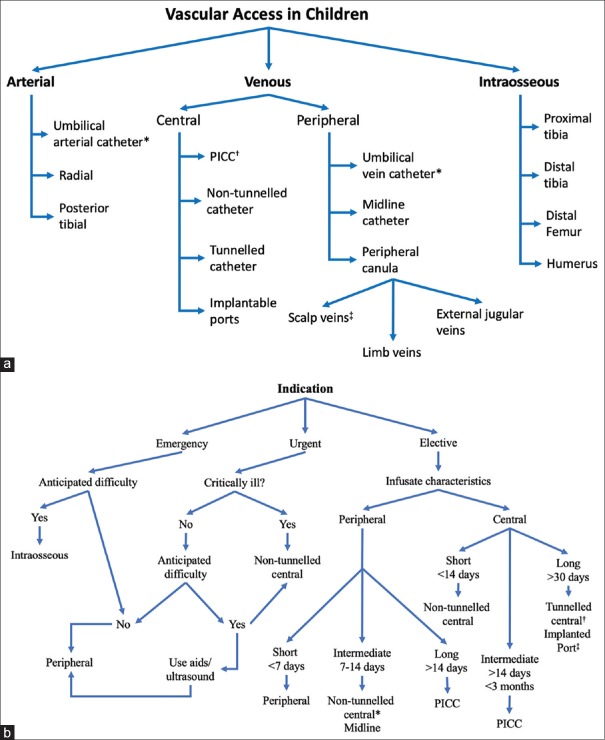
Figure 1
Figure 1
(a and b) Overview of Vascular Access in Children. (a) depicts the types of vascular access. (* Only in neonates, † Peripherally inserted central catheter, and ‡ In neonates and infants).(b) depicts the decision tree for venous access in children. (* Non-tunneled central line preferred if critically ill or haemodynamic monitoring needed; † Tunneled central catheters preferred if wide bore access desired; ‡ Implanted ports preferred if wide bore access not necessary)
Figure 2
Figure 2
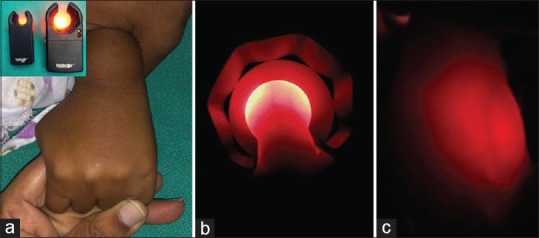
Techniques for difficult peripheral venous cannulation. (a) shows dorsum of hand with non-visible and non-palpable veins. Inset shows adult and paediatric infrared vein visualizing device. (b and c) show veins visualised by infrared and transillumination techniques, respectively
Figure 3
Figure 3
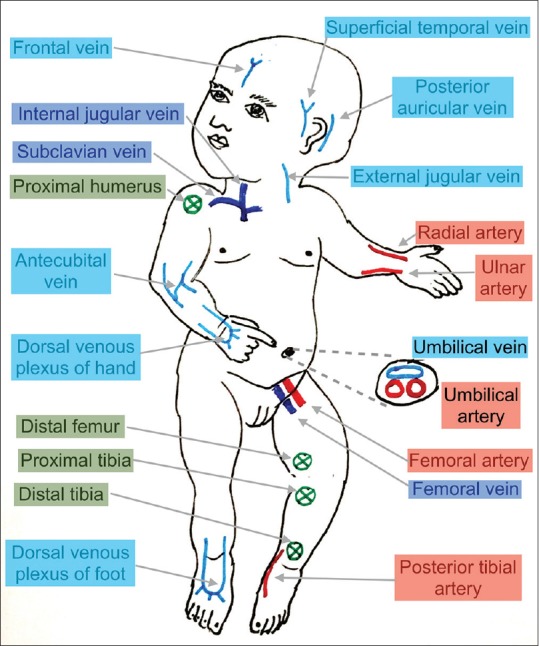
Common vascular access locations for peripheral venous access (light blue), central venous access (dark blue), arterial access (red), and intraosseous access (green)

References

    1. Bodenham Chair A, Babu S, Bennett J, Binks R, Fee P, Fox B, et al. Association of Anaesthetists of Great Britain and Ireland: Safe vascular access 2016. Anaesthesia. 2016;71:573–85. - PMC - PubMed
    1. Lininger RA. Pediatric peripheral i.v. insertion success rates. Pediatr Nurs. 2003;29:351–4. - PubMed
    1. Harrison D, Reszel J, Bueno M, Sampson M, Shah VS, Taddio A, et al. Breastfeeding for procedural pain in infants beyond the neonatal period. Cochrane Database Syst Rev. 2016;10:CD011248. - PMC - PubMed
    1. Kuo HC, Pan HH, Creedy DK, Tsao Y. Distraction-based interventions for children undergoing venipuncture procedures: A randomized controlled study. Clin Nurs Res. 2018;27:467–82. - PubMed
    1. Pillai Riddell RR, Racine NM, Gennis HG, Turcotte K, Uman LS, Horton RE, et al. Non-pharmacological management of infant and young child procedural pain. Cochrane Database Syst Rev. 2015;12:CD006275. - PMC - PubMed