


A study on the epidemiology of tinnitus in the United Kingdom
- PMID: 31572016
- PMCID: PMC6750864
- DOI: 10.2147/CLEP.S213136
A study on the epidemiology of tinnitus in the United Kingdom
Abstract
Purpose: Subjective tinnitus is a common symptom with potentially negative impact on quality of life. More research is required to gain a deeper understanding of the disease and its clinical presentation. To estimate the incidence of tinnitus and to describe patient-related characteristics such as lifestyle factors and comorbidities.
Patients and methods: Using the Clinical Practice Research Datalink, we calculated incidence rates of first-time diagnosed tinnitus in an adult population between 2000 and 2016. We stratified incidence rates by sex, age, and year of diagnosis. Additionally, we performed a 1:1 matched case-control study comparing body mass index, lifestyle factors and selected comorbidities between patients with incident tinnitus and tinnitus-free controls.
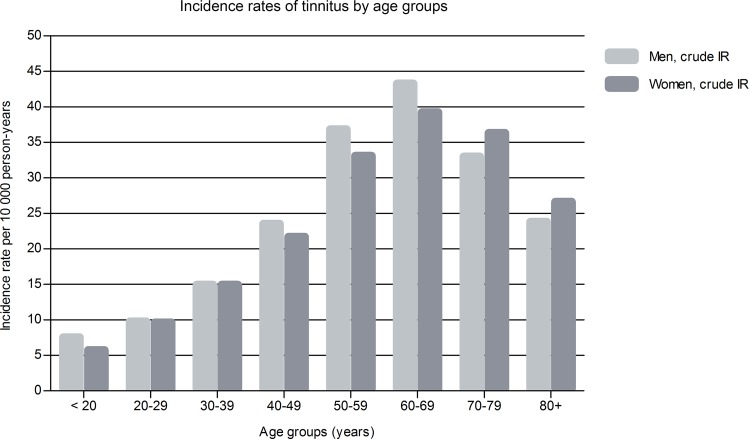
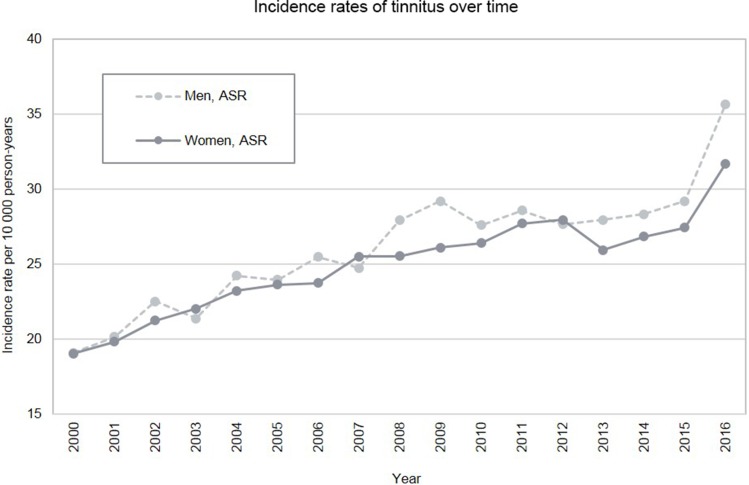
Results: We identified 109 783 adults with a first-time diagnosis of tinnitus between 2000 and 2016, yielding an overall age-standardized incidence rate of 25.0 new tinnitus cases per 10,000 person-years (95% CI: 24.6-25.5). There was a steady increase in tinnitus incidence throughout the study period. Approximately 80% of tinnitus cases were diagnosed at age 40 years or older. We observed the highest incidence rate in individuals aged 60-69 years (41.2 per 10,000 person-years, 95% CI: 40.7-41.7). Smokers and alcohol drinkers were at lower risk of being diagnosed with tinnitus compared with non-smokers and non-drinkers, respectively. The occurrence of tinnitus was strongly associated with a recent diagnosis of several otological and vestibular disorders as well as head and neck disorders.
Conclusion: The present observational study found an increasing incidence of tinnitus over time, emphasizing the continuously growing health burden. The findings on patient characteristics, lifestyle factors, and selected comorbidities contribute to a better understanding of risk factors for tinnitus.
Keywords: case-control study; clinical practice research datalink; incidence rates; lifestyle factors; tinnitus.
© 2019 Stohler et al.
Conflict of interest statement
The authors report no conflicts of interest in this work.
Figures
Similar articles
-
Population-Based Study on the Epidemiology of Ménière's Disease.Audiol Neurootol. 2017;22(2):74-82. doi: 10.1159/000475875. Epub 2017 Jul 20. Audiol Neurootol. 2017. PMID: 28723686
-
Incidence rates of clinically significant tinnitus: 10-year trend from a cohort study in England.Ear Hear. 2015 May-Jun;36(3):e69-75. doi: 10.1097/AUD.0000000000000121. Ear Hear. 2015. PMID: 25470370 Free PMC article.
-
Global Prevalence and Incidence of Tinnitus: A Systematic Review and Meta-analysis.JAMA Neurol. 2022 Sep 1;79(9):888-900. doi: 10.1001/jamaneurol.2022.2189. JAMA Neurol. 2022. PMID: 35939312 Free PMC article.
-
Increased Incidence of Tinnitus Following a Hyperthyroidism Diagnosis: A Population-Based Longitudinal Study.Front Endocrinol (Lausanne). 2021 Nov 3;12:741719. doi: 10.3389/fendo.2021.741719. eCollection 2021. Front Endocrinol (Lausanne). 2021. PMID: 34803911 Free PMC article.
-
Modifiable lifestyle-related risk factors for tinnitus in the general population: An overview of smoking, alcohol, body mass index and caffeine intake.Prog Brain Res. 2021;263:1-24. doi: 10.1016/bs.pbr.2021.04.005. Epub 2021 May 20. Prog Brain Res. 2021. PMID: 34243884
Cited by
-
Changes in Tinnitus Experiences During the COVID-19 Pandemic.Front Public Health. 2020 Nov 5;8:592878. doi: 10.3389/fpubh.2020.592878. eCollection 2020. Front Public Health. 2020. PMID: 33251179 Free PMC article.
-
Tinnitus after COVID-19 vaccination: Findings from the vaccine adverse event reporting system and the vaccine safety datalink.Am J Otolaryngol. 2024 Nov-Dec;45(6):104448. doi: 10.1016/j.amjoto.2024.104448. Epub 2024 Jul 30. Am J Otolaryngol. 2024. PMID: 39096568
-
Impact of Common Dizziness Associated Symptoms on Dizziness Handicap in Older Adults.Front Neurol. 2021 Dec 17;12:801499. doi: 10.3389/fneur.2021.801499. eCollection 2021. Front Neurol. 2021. PMID: 34975741 Free PMC article.
-
Low Evidence for Tinnitus Risk Factors: A Systematic Review and Meta-analysis.J Assoc Res Otolaryngol. 2023 Feb;24(1):81-94. doi: 10.1007/s10162-022-00874-y. Epub 2022 Nov 15. J Assoc Res Otolaryngol. 2023. PMID: 36380120 Free PMC article.
-
ChatGPT for Tinnitus Information and Support: Response Accuracy and Retest after Three and Six Months.Brain Sci. 2024 May 7;14(5):465. doi: 10.3390/brainsci14050465. Brain Sci. 2024. PMID: 38790444 Free PMC article.
References
-
- NICE CKS (2017). Tinnitus. Available from: https://cks.nice.org.uk/tinnitus. Accessed May 11, 2018.
LinkOut - more resources
Full Text Sources
