Comparative evaluation of forced air warming and infusion of amino acid-enriched solution on intraoperative hypothermia in patients undergoing head and neck cancer surgeries: A prospective randomised study
- PMID: 31572076
- PMCID: PMC6753748
- DOI: 10.4103/sja.SJA_839_18
Comparative evaluation of forced air warming and infusion of amino acid-enriched solution on intraoperative hypothermia in patients undergoing head and neck cancer surgeries: A prospective randomised study
Abstract
Background: Inadvertent core hypothermia is a common occurrence during general anaesthesia. Forced air warming (FAW) is the most effective perianaesthetic warming system, but it may lead to thermal discomfort. Amino acids (AAs) have been used to prevent hypothermia, but no study has compared the effect of AA infusion with FAW systems. We have conducted this study to compare the effects of external heating (FAW system) and internal heat generation (AA infusion) in preventing hypothermia during anaesthesia.
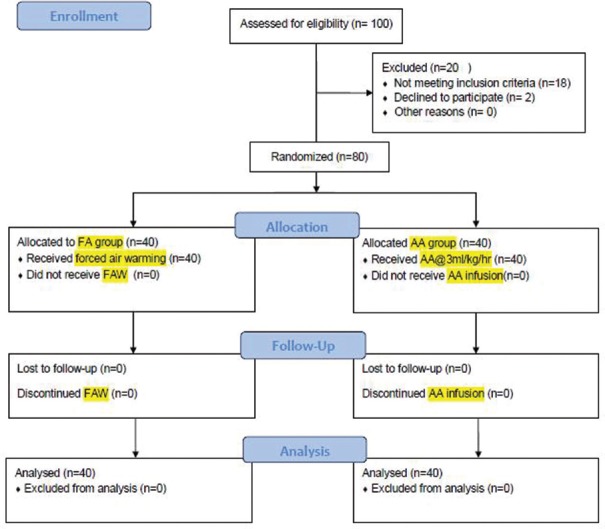
Methods: After institutional review board approval, 80 American Society of Anesthesiologists Grade I/II adult patients admitted for head and neck cancer surgeries lasting more than 2 h under general anaesthesia were included. The patients were randomly divided into two groups using computer-generated codes to receive AA infusion at 3 mL/kg/h, Group AA (N = 40), or normal saline at 3 mL/kg/h with FAW, Group FA (N = 40) till the end of surgery. Standard anaesthetic technique and monitoring was used in all the patients.
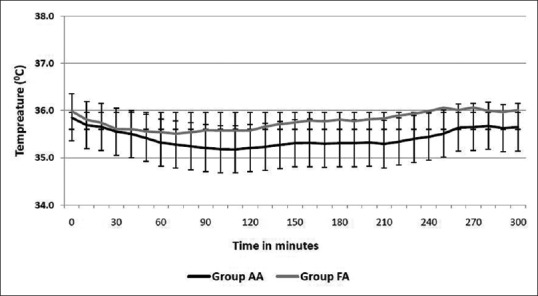
Results: The baseline mean temperature in both the groups was comparable. The core temperature was similar in the two groups at 30 min (35.6 ± 0.54 vs 35.5 ± 0.54), 60 min (35.5 ± 0.63 vs 35.3 ± 0.60), 90 min (35.5 ± 0.79 vs 35.2 ± 0.66), 120 min (35.6 ± 0.93 vs 35.2 ± 0.78), 150 min (35.7 ± 0.88 vs 35.3 ± 0.89) and 180 min (35.8 ± 1.01 vs 35.3 ± 0.95) in Groups FA and AA, respectively (P > 0.05). However, the core temperature was significantly higher in Group FA at 210 min (35.8 ± 1.0 vs 35.3 ± 0.85; P = 0.01), 240 min (35.9 ± 1.0 vs 35.4 ± 0.90; (P = 0.001), 270 min (35.9 ± 1.12 vs 35.6 ± 0.97; P = 0.002) and 300 min (36.0 ± 1.12 vs 35.6 ± 1.02; P = 0.002), respectively. Clinically relevant hypothermia (at least one measurement <35.5°C) was comparable between the two groups.
Conclusion: The AA infusion can be used as an alternative to FAW in preventing intraoperative hypothermia under general anaesthesia especially in places where FAW system is unavailable.
Keywords: Amino acid infusion; forced air warming; general anaesthesia; head and neck cancer surgery; hypothermia.
Copyright: © 2019 Saudi Journal of Anesthesia.
Conflict of interest statement
There are no conflicts of interest.
Figures
References
-
- Sessler DI. Perioperative heat balance. Anesthesiology. 2000;92:578–96. - PubMed
-
- Matsukawa T, Sessler DI, Sessler M, Schroeder M, Ozaki M, Kurz A, et al. Heat flow and distribution during induction of general anesthesia. Anesthesiology. 1995;82:662–73. - PubMed
-
- Frank SM, Fleisher LA, Breslow MJ, Higgins MS, Olson KF, Kelly S, et al. Perioperative maintenance of normothermia reduces the incidence of morbid cardiac events. A randomized clinical trial. JAMA. 1997;277:1127–34. - PubMed
-
- Kurz A, Sessler DI, Lenhardt R. Perioperative normothermia to reduce the incidence of surgical-wound infection and shorten hospitalization. Study of wound infection and temperature group. N Engl J Med. 1996;334:1209–15. - PubMed
-
- Schmied H, Kurz A, Sessler DI, Kozek S, Reiter A. Mild hypothermia increases blood loss and transfusion requirements during total hip arthroplasty. Lancet. 1996;347:289–92. - PubMed