


Interventions for preventing falls in people after stroke
- PMID: 31573069
- PMCID: PMC6770464
- DOI: 10.1002/14651858.CD008728.pub3
Interventions for preventing falls in people after stroke
Abstract
Background: Falls are one of the most common complications after stroke, with a reported incidence ranging between 7% in the first week and 73% in the first year post stroke. This is an updated version of the original Cochrane Review published in 2013.
Objectives: To evaluate the effectiveness of interventions aimed at preventing falls in people after stroke. Our primary objective was to determine the effect of interventions on the rate of falls (number of falls per person-year) and the number of fallers. Our secondary objectives were to determine the effects of interventions aimed at preventing falls on 1) the number of fall-related fractures; 2) the number of fall-related hospital admissions; 3) near-fall events; 4) economic evaluation; 5) quality of life; and 6) adverse effects of the interventions.
Search methods: We searched the trials registers of the Cochrane Stroke Group (September 2018) and the Cochrane Bone, Joint and Muscle Trauma Group (October 2018); the Cochrane Central Register of Controlled Trials (CENTRAL; 2018, Issue 9) in the Cochrane Library; MEDLINE (1950 to September 2018); Embase (1980 to September 2018); CINAHL (1982 to September 2018); PsycINFO (1806 to August 2018); AMED (1985 to December 2017); and PEDro (September 2018). We also searched trials registers and checked reference lists.
Selection criteria: Randomised controlled trials of interventions where the primary or secondary aim was to prevent falls in people after stroke.
Data collection and analysis: Two review authors (SD and WS) independently selected studies for inclusion, assessed trial quality and risk of bias, and extracted data. We resolved disagreements through discussion, and contacted study authors for additional information where required. We used a rate ratio and 95% confidence interval (CI) to compare the rate of falls (e.g. falls per person-year) between intervention and control groups. For risk of falling we used a risk ratio and 95% CI based on the number of people falling (fallers) in each group. We pooled results where appropriate and applied GRADE to assess the quality of the evidence.
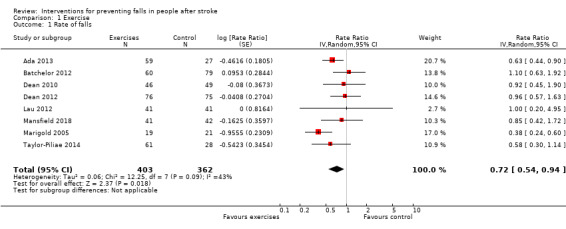
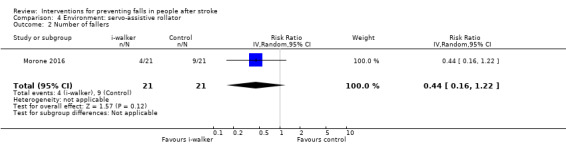
Main results: We included 14 studies (of which six have been published since the first version of this review in 2013), with a total of 1358 participants. We found studies that investigated exercises, predischarge home visits for hospitalised patients, the provision of single lens distance vision glasses instead of multifocal glasses, a servo-assistive rollator and non-invasive brain stimulation for preventing falls.Exercise compared to control for preventing falls in people after strokeThe pooled result of eight studies showed that exercise may reduce the rate of falls but we are uncertain about this result (rate ratio 0.72, 95% CI 0.54 to 0.94, 765 participants, low-quality evidence). Sensitivity analysis for single exercise interventions, omitting studies using multiple/multifactorial interventions, also found that exercise may reduce the rate of falls (rate ratio 0.66, 95% CI 0.50 to 0.87, 626 participants). Sensitivity analysis for the effect in the chronic phase post stroke resulted in little or no difference in rate of falls (rate ratio 0.58, 95% CI 0.31 to 1.12, 205 participants). A sensitivity analysis including only studies with low risk of bias found little or no difference in rate of falls (rate ratio 0.88, 95% CI 0.65 to 1.20, 462 participants). Methodological limitations mean that we have very low confidence in the results of these sensitivity analyses.For the outcome of number of fallers, we are very uncertain of the effect of exercises compared to the control condition, based on the pooled result of 10 studies (risk ratio 1.03, 95% CI 0.90 to 1.19, 969 participants, very low quality evidence). The same sensitivity analyses as described above gives us very low certainty that there are little or no differences in number of fallers (single interventions: risk ratio 1.09, 95% CI 0.93 to 1.28, 796 participants; chronic phase post stroke: risk ratio 0.94, 95% CI 0.73 to 1.22, 375 participants; low risk of bias studies: risk ratio 0.96, 95% CI 0.77 to 1.21, 462 participants).Other interventions for preventing falls in people after strokeWe are very uncertain whether interventions other than exercise reduce the rate of falls or number of fallers. We identified very low certainty evidence when investigating the effect of predischarge home visits (rate ratio 0.85, 95% CI 0.43 to 1.69; risk ratio 1.48, 95% CI 0.71 to 3.09; 85 participants), provision of single lens distance glasses to regular wearers of multifocal glasses (rate ratio 1.08, 95% CI 0.52 to 2.25; risk ratio 0.74, 95% CI 0.47 to 1.18; 46 participants) and a servo-assistive rollator (rate ratio 0.44, 95% CI 0.16 to 1.21; risk ratio 0.44, 95% CI 0.16 to 1.22; 42 participants).Finally, transcranial direct current stimulation (tDCS) was used in one study to examine the effect on falls post stroke. We have low certainty that active tDCS may reduce the number of fallers compared to sham tDCS (risk ratio 0.30, 95% CI 0.14 to 0.63; 60 participants).
Authors' conclusions: At present there exists very little evidence about interventions other than exercises to reduce falling post stroke. Low to very low quality evidence exists that this population benefits from exercises to prevent falls, but not to reduce number of fallers.Fall research does not in general or consistently follow methodological gold standards, especially with regard to fall definition and time post stroke. More well-reported, adequately-powered research should further establish the value of exercises in reducing falling, in particular per phase, post stroke.
Conflict of interest statement
Stijn Denissen: none known
Wouter Staring: none known
Dorit Kunkel: none known
Ruth M Pickering: none known
Sheila Lennon: none known
Alexander CH Geurts: none known
Vivian Weerdesteyn: none known
Geert SAF Verheyden: none known
Figures





Update of
References
References to studies included in this review
Ada 2013 {published data only}
-
- Ada L, Dean CM, Lindley R. Randomized trial of treadmill training to improve walking in community‐dwelling people after stroke: the AMBULATE trial. International Journal of Stroke 2013;8(6):436‐44. - PubMed
Andrade 2017 {published data only}
-
- Andrade SM, Ferreira JJdA, Rufino TS, Medeiros G, Brito JD, Silva MA, et al. Effects of different montages of transcranial direct current stimulation on the risk of falls and lower limb function after stroke. Neurological Research 2017;39(12):1037‐43. [DOI: 10.1080/01616412.2017.1371473] - DOI - PubMed
Batchelor 2012 {published data only}
-
- Batchelor F, Hill K, Mackintosh S, Said C, Fryer C, Whitehead C. Falls prevention after stroke: does adherence to exercise influence falls?. Neurorehabilitation and Neural Repair 2012;26(6):735.
-
- Batchelor F, Hill K, Mackintosh S, Said C, Whitehead C. Does a multifactorial falls prevention programme reduce falls in people with stroke returning home after rehabilitation? A randomised controlled trial. International Journal of Stroke 2010;5:17.
-
- Batchelor FA, Hill KD, Mackintosh SF, Said CM, Whitehead CH. Effects of a multifactorial falls prevention programme for people with stroke returning home after rehabilitation: a randomised controlled trial. Archives of Physical Medicine and Rehabilitation 2012;93(9):1648‐55. [DOI: 10.1016/j.apmr.2012.03.031] - DOI - PubMed
Dean 2010 {published data only}
-
- Dean CM, Ada L, Bampton J, Morris ME, Katrak PH, Potts S. Treadmill walking with body weight support in subacute non‐ambulatory stroke improves walking capacity more than overground walking: a randomised trial. Journal of Physiotherapy 2010;56(2):97‐103. - PubMed
Dean 2012 {published data only}
-
- Dean CM, Rissel C, Sherrington C, Sharkey M, Cumming R, Lord SR, et al. Weight‐bearing exercise improves mobility in stroke survivors and may prevent falls in faster walkers. Neurorehabilitation and Neural Repair 2012;26(6):730‐1. - PubMed
Drummond 2012 {published data only}
-
- Drummond AE, Whitehead P, Fellows K, Sprigg N, Sampson CJ, Edwards C, et al. Occupational therapy predischarge home visits for patients with a stroke (HOVIS): results of a feasibility randomized controlled trial. Clinical Rehabilitation 2012;27(5):387‐97. - PubMed
Green 2002 {published data only}
-
- Green J, Forster A, Bogle S, Young J. Physiotherapy for patients with mobility problems more than 1 year after stroke: a randomised controlled trial. Lancet 2002;359(9302):199‐203. - PubMed
Haran 2010 {unpublished data only}
Holmgren 2010 {published data only (unpublished sought but not used)}
Lau 2012 {published data only}
Mansfield 2018 {published data only}
Marigold 2005 {published data only}
Morone 2016 {published data only}
-
- Morone G, Annicchiarico R, Iosa M, Federici A, Paolucci S, Cortés U, et al. Overground walking training with the i‐Walker, a robotic servo‐assistive device, enhances balance in patients with subacute stroke: a randomized controlled trial. Journal of Neuroengineering and Rehabilitation 2016;13(1):47. [DOI: 10.1186/s12984-016-0155-4] - DOI - PMC - PubMed
Taylor‐Piliae 2014 {published data only}
References to studies excluded from this review
Barreca 2004 {published data only}
-
- Barreca S, Sigouin CS, Lambert C, Ansley B. Effects of extra training on the ability of stroke survivors to perform an independent sit‐to‐stand: a randomised controlled trial. Journal of Geriatric Physical Therapy 2004;27(2):59‐64.
Bernhardt 2008 {published data only}
-
- Sorbello D, Dewey HM, Churilov L, Thrift AG, Collier JM, Donnan G, et al. Very early mobilisation and complications in the first 3 months after stroke: further results from phase II of a very early rehabilitation trial (AVERT). Cerebrovascular Diseases 2009;28(4):378‐83. [DOI: 10.1159/000230712] - DOI - PubMed
Boysen 2009 {published data only}
Cadilhac 2011 {published data only}
Calugi 2016 {published data only}
-
- Calugi S, Taricco M, Rucci P, Fugazzaro S, Stuart M, Dallolio L, et al. Effectiveness of adaptive physical activity combined with therapeutic patient education in stroke survivors at twelve months: a non‐randomized parallel group study. European Journal of Physical and Rehabilitation Medicine 2016;52(1):72‐80. - PubMed
Cheng 2001 {published data only}
-
- Cheng PT, Wu SH, Liam MY, Wong AM, Tang FT. Symmetrical body‐weight distribution training in stroke patients and its effect on fall prevention. Archives of Physical Medicine and Rehabilitation 2001;82(12):1650‐4. - PubMed
Creamer 2018 {published data only}
-
- Creamer M, Cloud G, Kossmehl P, Yochelson M, Francisco GE, Ward AB, et al. Intrathecal baclofen therapy versus conventional medical management for severe poststroke spasticity: results from a multicentre, randomised, controlled, open‐label trial (SISTERS). Journal of Neurology, Neurosurgery, and Psychiatry 2018;89(6):642‐50. - PMC - PubMed
-
- Yochelson M, Creamer M, Cloud G, Kossmehl P, Francisco G, Ward A, et al. Intrathecal baclofen therapy decreases pain and improves quality of life compared to conventional medical management in severe post‐stroke spasticity: the SISTERS study. Neurology 2018;90(15 Supplement):5.014.
Dai 2013 {published data only}
-
- Dai C‐Y, Huang Y‐H, Chou L‐W, Wu SC, Wang R‐Y, Lin L‐C. Effects of primary caregiver participation in vestibular rehabilitation for unilateral neglect patients with right hemispheric stroke: a randomized controlled trial. Neuropsychiatric Disease and Treatment 2013;9:477‐84. [DOI: 10.2147/NDT.S42426] - DOI - PMC - PubMed
Duncan 2011 {published data only}
Eng 2010 {published data only}
Gervasoni 2017 {published data only}
-
- Gervasoni E, Parelli R, Uszynski M, Crippa A, Marzegan A, Montesano A, et al. Effects of functional electrical stimulation on reducing falls and improving gait parameters in multiple sclerosis and stroke. American Academy of Physical Medicine and Rehabilitation 2017;9(4):392‐7. - PubMed
Goljar 2016 {published data only}
-
- Goljar N, Globokar D, Puzić N, Kopitar N, Vrabič M, Ivanovski M, et al. Effectiveness of a fall‐risk reduction programme for inpatient rehabilitation after stroke. Disability and Rehabilitation 2016;38(18):1811‐9. - PubMed
Halvarsson 2011 {published data only}
-
- Halvarsson A, Oddsson L, Olsson E, Farén E, Pettersson A, Ståhle A. Effects of new, individually adjusted, progressive balance group training for elderly people with fear of falling and tend to fall: a randomized controlled trial. Clinical Rehabilitation 2011;25(11):1021‐31. [DOI: 10.1177/0269215511411937] - DOI - PubMed
Hesse 2011 {published data only}
-
- Hesse S, Welz A, Werner C, Quentin B, Wissel J. Comparison of an intermittent high‐intensity vs continuous low‐intensity physiotherapy service over 12 months in community‐dwelling people with stroke: a randomised trial. Clinical Rehabilitation 2011;25(2):146‐56. [DOI: 10.1177/0269215510382148] - DOI - PubMed
Hill 2015 {published data only}
-
- Hill A‐M, McPhail SM, Waldron N, Etherton‐Beer C, Ingram K, Flicker L, et al. Fall rates in hospital rehabilitation units after individualised patient and staff education programmes: a pragmatic, stepped‐wedge, cluster‐randomised controlled trial. Lancet 2015;385(9987):2592–9. - PubMed
Johansson 2018 {published data only}
-
- Johansson E, Jonsson H, Dahlberg R, Patomella A‐H. The efficacy of a multifactorial falls‐prevention programme, implemented in primary health care. British Journal of Occupational Therapy 2018;81(8):474‐81.
Kluding 2013 {published data only}
-
- Dunning K, O'Dell M, Kluding P, Wu SS, Feld J, Ginosian J, et al. The functional ambulation: standard treatment vs. electrical stimulation therapy (fastest) trial for stroke: study design and protocol. Open Access Journal of Clinical Trials 2013;5:39.
-
- Kluding PM, Dunning K, O'Dell MW, Wu SS, Ginosian J, Feld J, et al. Foot drop stimulation versus ankle foot orthosis after stroke: 30‐week outcomes. Stroke 2013;44(6):1660‐9. - PubMed
Kong 2009 {published data only}
-
- Kong KH, Wee SK, Ng CY, Chua K, Chan KF, Venketasubramanian N, et al. A double‐blind, placebo‐controlled, randomised phase II pilot study to investigate the potential efficacy of the traditional Chinese medicine Neuroaid (MLC601) in enhancing recovery after stroke (TIERS). Cerebrovascular Diseases 2009;28(5):514‐21. [DOI: 10.1159/000247001] - DOI - PubMed
Kwok 2005 {published data only}
-
- Kwok T, Mok F, Chien WT, Tam E. Does access to bed‐chair pressure sensors reduce physical restraint use in the rehabilitative care setting. Journal of Clinical Nursing 2006;15(5):581‐7. - PubMed
Langhorne 2017 {published data only}
Mansfield 2017 {published data only}
Mayo 1994 {published data only (unpublished sought but not used)}
-
- Mayo NE, Gloutney L, Levy AR. A randomised trial of identification bracelets to prevent falls among patients in a rehabilitation hospital. Archives of Physical Medicine and Rehabilitation 1994;75(12):1302‐8. - PubMed
Plummer‐D'Amato 2012 {published data only}
Poletto 2015 {published data only}
Rosendahl 2008 {published data only}
-
- Rosendahl E, Gustafson Y, Nordin E, Lundin‐Olsson L, Nyberg L. A randomized controlled trial of fall prevention by a high‐intensity functional exercise program for older people living in residential care facilities. Aging Clinical and Experimental Research 2008;20(1):67‐75. - PubMed
Rossi 1990 {published data only}
-
- Rossi PW, Kheyfets S, Reding MJ. Fresnel prisms improve visual perception in stroke patients with homonymous hemianopia or unilateral visual neglect. Neurology 1990;40(10):1597‐9. - PubMed
Sato 2003 {published data only}
-
- Sato Y, Metoki N, Iwamoto J, Satoh K. Amelioration of osteoporosis and hypovitaminosis D by sunlight exposure in stroke patients. Neurology 2003;61(3):338‐42. - PubMed
Sato 2005a {published data only}
Sato 2005b {published data only}
-
- Sato Y, Iwamoto J, Kanoko T, Satoh K. Risedronate sodium therapy for prevention of hip fracture in men 65 years or older after stroke (RETRACTED ARTICLE). Archives of Internal Medicine 2005;165(15):1743‐8. - PubMed
Sato 2005c {published data only}
-
- Sato Y, Iwamoto J, Kanoko T, Satoh K. Risedronate therapy for prevention of hip fracture after stroke in elderly women. Neurology 2005;64(5):811‐6. - PubMed
Sato 2011 {published data only}
Schmid 2013 {published data only}
-
- Schmid AA, Yaggi HK, Burrus N, McClain V, Austin C, Ferguson J, et al. Circumstances and consequences of falls among people with chronic stroke. Journal of Rehabilitation Research and Development 2013;50(9):1277‐86. - PubMed
Stark 2017 {published data only}
Tao 2015 {published data only}
Taylor‐Piliae 2011 {published data only}
-
- Taylor‐Piliae RE, Coull BM. Community‐based Yang‐style Tai Chi is safe and feasible in chronic stroke: a pilot study. Clinical Rehabilitation 2012;26(2):121‐31. - PubMed
Tyson 2018 {published data only}
-
- Tyson SF, Vail A, Thomas N, Woodward‐Nutt K, Plant S, Tyrrell PJ. Bespoke versus off‐the‐shelf ankle‐foot orthosis for people with stroke: randomized controlled trial. Clinical Rehabilitation 2018;32(3):367‐76. - PubMed
Von Koch 2001 {published data only}
-
- Thorsén AM, Widén Holmqvist LW, Pedro‐Cuesta J, Koch L. A randomised controlled trial of early supported discharge and continued rehabilitation at home after stroke: five‐year follow‐up of patient outcome. Stroke 2005;36(2):297‐303. - PubMed
-
- Thorsén AM, Widén Holmqvist L, Von Koch L. Early supported discharge and continued rehabilitation at home after stroke: 5‐year follow‐up of resource use. Journal of Stroke and Cerebrovascular Diseases 2006;15(4):139‐43. - PubMed
-
- Koch L, Widén Holmqvist L, Kostulas V, Almazan J, Pedro‐Cuesta J. A randomised controlled trial of rehabilitation at home after stroke in southwest Stockholm: outcome at six months. Scandinavian Journal of Rehabilitation Medicine 2000;32(2):80‐6. - PubMed
-
- Koch L, Pedro‐Cuesta J, Kostulas V, Almazan J, Widén Holmqvist L. Randomized controlled trial of rehabilitation at home after stroke: one‐year follow‐up of patient outcome, resource use and cost. Cerebrovascular Diseases 2001;12(2):131‐8. - PubMed
-
- Widén Holmqvist L, Koch L, Kostulas V, Holm M, Widsell G, Tegler H, et al. A randomised controlled trial of rehabilitation at home after stroke in southwest Stockholm. Stroke 1998;29(3):591‐7. - PubMed
References to studies awaiting assessment
Pedreira 2017 {published data only}
Additional references
Andersson 2008
-
- Andersson AG, Kamwendo K, Appelros P. Fear of falling in stroke patients: relationship with previous falls and functional characteristics. International Journal of Rehabilitation Research. Internationale Zeitschrift fur Rehabilitationsforschung. Revue Internationale de Recherches de Readaptation 2008;31(3):261‐4. - PubMed
Ashburn 2008
Atkins 2004
Batchelor 2010
Belgen 2006
-
- Belgen B, Beninato M, Sullivan PE, Narielwalla K. The association of balance capacity and falls self‐efficacy with history of falling in community‐dwelling people with chronic stroke. Archives of Physical Medicine and Rehabilitation 2006;87(4):554‐61. - PubMed
Bernhardt 2017
-
- Bernhardt J, Hayward KS, Kwakkel G, Ward NS, Wolf SL, Borschmann K, et al. Agreed definitions and a shared vision for new standards in stroke recovery research: the Stroke Recovery and Rehabilitation Roundtable Taskforce. Neurorehabilitation and Neural Repair 2017;31(9):793‐9. [DOI: 10.1177/1545968317732668] - DOI - PubMed
Burridge 2007
-
- Burridge JH, Haugland M, Larsen B, Pickering RM, Svaneborg N, Iversen HK, et al. Phase II trial to evaluate the ActiGait implanted drop‐foot stimulator in established hemiplegia. Journal of Rehabilitation Medicine 2007;39(3):212‐8. - PubMed
Cameron 2018
Collins 2018
-
- Collins M, Clifton E, Wijck F, Mead GE. Cost‐effectiveness of physical fitness training for stroke survivors. Journal of the Royal College of Physicians of Edinburgh 2018;48(1):62–8. - PubMed
CONSORT
-
- Schulz KF, Altman DG, Moher D, CONSORT Group. CONSORT 2010 statement: updated guidelines for reporting parallel group randomized trials. Annals of Internal Medicine 2010;152(11):726‐32. - PubMed
Davenport 1996
-
- Davenport RJ, Dennis MS, Wellwood I, Warlow CP. Complications after acute stroke. Stroke 1996;27(3):415‐20. - PubMed
Demaerschalk 2010
-
- Demaerschalk BM, Hwang HM, Leung G. US cost burden of ischemic stroke: a systematic literature review. American Journal of Managed Care 2010;16(7):525‐33. - PubMed
Eng 2008
-
- Eng JJ, Pang MY, Ashe MC. Balance, falls, and bone health: role of exercise in reducing fracture risk after stroke. Journal of Rehabilitation Research and Development 2008;45(2):297‐313. - PubMed
English 2017
Faes 2010
-
- Faes MC, Reelick MF, Joosten‐Weyn Banningh LW, Gier M, Esselink RA, Olde Rikkert MG. Qualitative study on the impact of falling in frail older persons and family caregivers: foundations for an intervention to prevent falls. Aging & Mental Health 2010;14(7):834‐42. - PubMed
Gillespie 2012
GRADEpro GDT [Computer program]
-
- McMaster University (developed by Evidence Prime). GRADEpro GDT. Version accessed 29 November 2018. Hamilton (ON): McMaster University (developed by Evidence Prime).
Grossman 2018
Harris 2005
-
- Harris JE, Eng JJ, Marigold DS, Tokuno CD, Louis CL. Relationship of balance and mobility to fall incidence in people with chronic stroke. Physical Therapy 2005;85(2):150‐8. - PubMed
Hauer 2006
-
- Hauer K, Lamb SE, Jorstad EC, Todd C, Becker C, the ProFaNE‐group. Systematic review of definitions and methods of measuring falls in randomised controlled fall prevention trials. Age and Ageing 2006;35(1):5‐10. - PubMed
Higgins 2003
Higgins 2011
-
- Higgins JP, Green S (editors). Cochrane Handbook for Systematic Reviews of Interventions Version 5.1.0 [updated March 2011]. The Cochrane Collaboration, 2011. Available from handbook.cochrane.org.
Higgins 2017
-
- Higgins JP, Altman DG, Sterne JA, editor(s). Chapter 8: Assessing risk of bias in included studies. In: Higgins JP, Churchill R, Chandler J, Cumpston MS, editor(s), Cochrane Handbook for Systematic Reviews of Interventions version 5.2.0 (updated June 2017). The Cochrane Collaboration, 2017. Available from www.training.cochrane.org/handbook.
Hoffmann 2014
-
- Hoffmann T, Glasziou P, Boutron I, Milne R, Perera R, Moher D, et al. Better reporting of interventions: template for intervention description and replication (TIDieR) checklist and guide. BMJ 2014;348:g1687. - PubMed
Indredavik 2008
-
- Indredavik B, Rohweder G, Naalsund E, Lydersen S. Medical complications in a comprehensive stroke unit and an early supported discharge service. Stroke 2008;39(2):414‐20. - PubMed
Introduction to Meta‐Analysis 2009
-
- Borenstein M, Hedges LV, Higgins JP, Rothstein HR. Introduction to Meta‐Analysis. John Wiley & Sons, Ltd, 2009. [DOI: 10.1002/9780470743386.refs; ISBN 9780470057247] - DOI
Jung 2015
Kerse 2008
Kuan 1999
-
- Kuan TS, Tsou JY, Su FC. Hemiplegic gait of stroke patients: the effect of using a cane. Archives of Physical Medicine and Rehabilitation 1999;80(7):777‐84. - PubMed
Kunkel 2011
Lamb 2005
-
- Lamb SE, Jorstad‐Stein EC, Hauer K, Becker C, Prevention of Falls Network Europe and Outcomes Consensus Group. Development of a common outcome data set for fall injury prevention trials: the Prevention of Falls Network Europe consensus. Journal of the American Geriatrics Society 2005;53(9):1618–22. - PubMed
Lamb 2007
-
- Lamb SE, Hauer K, Becker C. Manual for the fall prevention classification system. www.profane.eu.org/documents/Falls_Taxonomy.pdf (accessed 30 January 2013).
Lamb 2011
Landers 2016
-
- Landers MR, Oscar S, Sasaoka J, Vaughn K. Balance confidence and fear of falling avoidance behavior are most predictive of falling in older adults: prospective analysis. Physical Therapy 2016;96(4):433‐42. [DOI: ] - PubMed
Langhorne 2000
-
- Langhorne P, Stott DJ, Robertson L, MacDonald J, Jones L, McAlpine C, et al. Medical complications after stroke: a multicenter study. Stroke 2000;31(6):1223‐9. - PubMed
Laver 2017
Li 2018
Lin 2017
-
- Lin MH, Chen SR, Liao MN, Chen YC, Chang WY. Factors and medical costs associated with fall events in hospitalized patients. Journal of Nursing 2017;64(4):44‐52. - PubMed
Maeda 2015
Mao 2015
-
- Mao Y‐R, Lo WL, Lin Q, Li L, Xiao X, Raghavan P, et al. The effect of body weight support treadmill training on gait recovery, proximal lower limb motor pattern, and balance in patients with subacute stroke. BioMed Research International 2015;2015:175719. [DOI: 10.1155/2015/175719] - DOI - PMC - PubMed
Marigold 2006
NICE 2013
-
- NICE. Stroke Rehabilitation 2013:CG162.
Punt 2017
-
- Punt M, Bruijn SM, Wittink H, Port IG, Dieën JH. Do clinical assessments, steady‐state or daily‐life gait characteristics predict falls in ambulatory chronic stroke survivors?. Journal of Rehabilitation Medicine 2017;49(5):402‐9. - PubMed
Review Manager 2014 [Computer program]
-
- Nordic Cochrane Centre, The Cochrane Collaboration. Review Manager 5 (RevMan 5). Version 5.3. Copenhagen: Nordic Cochrane Centre, The Cochrane Collaboration, 2014.
Sackley 2008
Sherrington 2019
Stack 1999
-
- Stack E, Ashburn A. Fall events described by people with Parkinson’s disease: implications for clinical interviewing and the research agenda. Physiotherapy Research International 1999;4(3):190‐200. - PubMed
Tricco 2017
Van Duijnhoven 2016
-
- Duijnhoven HJ, Heeren A, Peters MAM, Veerbeek JM, Kwakkel G, Geurts ACH, et al. Effects of exercise therapy on balance capacity in chronic stroke: systematic review and meta‐analysis. Stroke 2016;47(10):2603‐10. - PubMed
Wagner 2009
Weerdesteyn 2008
-
- Weerdesteyn V, Niet M, Duijnhoven HJ, Geurts AC. Falls in individuals with stroke. Journal of Rehabilitation Research and Development 2008;45(8):1195‐213. - PubMed
Winser 2018
-
- Winser SJ, Tsang WWN, Krishnamurthy K, Kannan P. Does Tai Chi improve balance and reduce falls incidence in neurological disorders? A systematic review and meta‐analysis.. Clinical Rehabilitation 2018;32(9):1157‐68. [DOI: ] - PubMed
Xu 2018
-
- Xu T, Clemson L, O'Loughlin K, Lannin NA, Dean C, Koh G. Risk factors for falls in community stroke survivors: a systematic review and meta‐analysis. Archives of Physical Medicine and Rehabilitation 2018;99(3):563‐73. - PubMed
References to other published versions of this review
Publication types
Grants and funding
LinkOut - more resources
Full Text Sources
