


Objective User Engagement With Mental Health Apps: Systematic Search and Panel-Based Usage Analysis
- PMID: 31573916
- PMCID: PMC6785720
- DOI: 10.2196/14567
Objective User Engagement With Mental Health Apps: Systematic Search and Panel-Based Usage Analysis
Abstract
Background: Understanding patterns of real-world usage of mental health apps is key to maximizing their potential to increase public self-management of care. Although developer-led studies have published results on the use of mental health apps in real-world settings, no study yet has systematically examined usage patterns of a large sample of mental health apps relying on independently collected data.
Objective: Our aim is to present real-world objective data on user engagement with popular mental health apps.
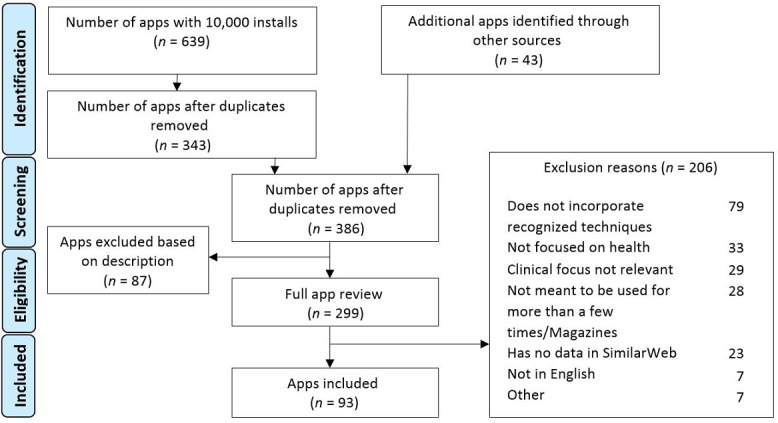
Methods: A systematic engine search was conducted using Google Play to identify Android apps with 10,000 installs or more targeting anxiety, depression, or emotional well-being. Coding of apps included primary incorporated techniques and mental health focus. Behavioral data on real-world usage were obtained from a panel that provides aggregated nonpersonal information on user engagement with mobile apps.
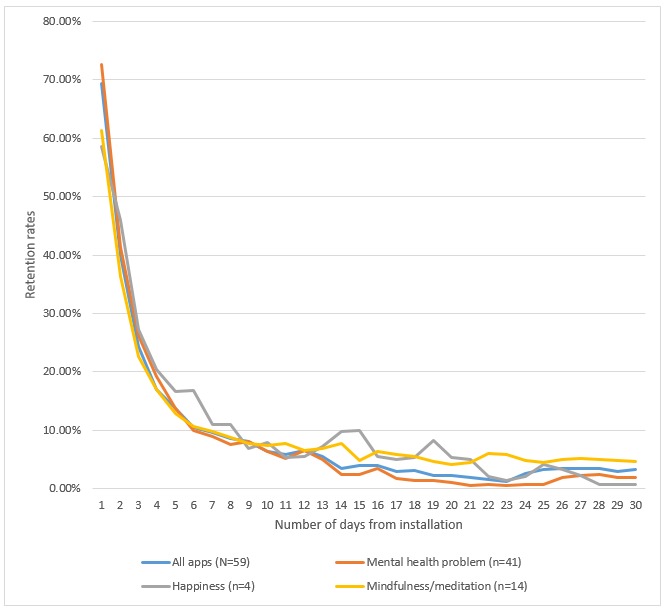
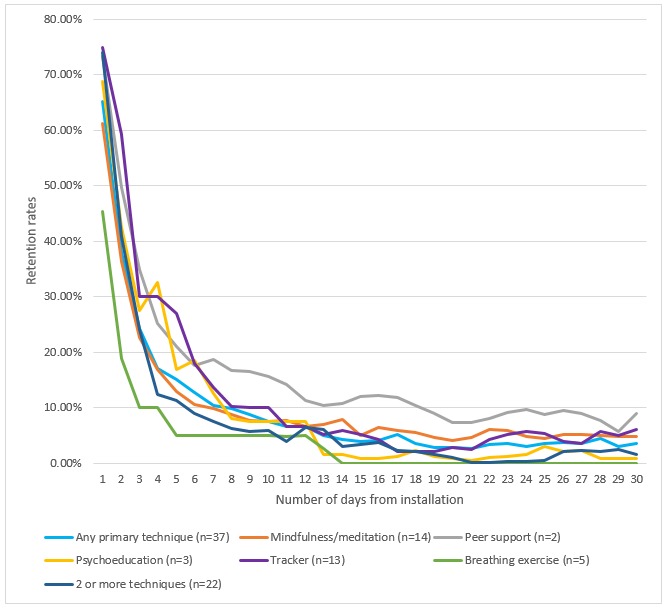
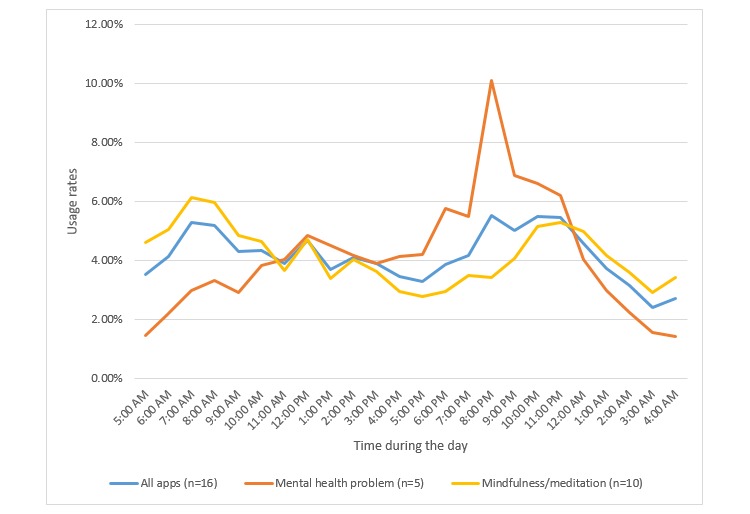
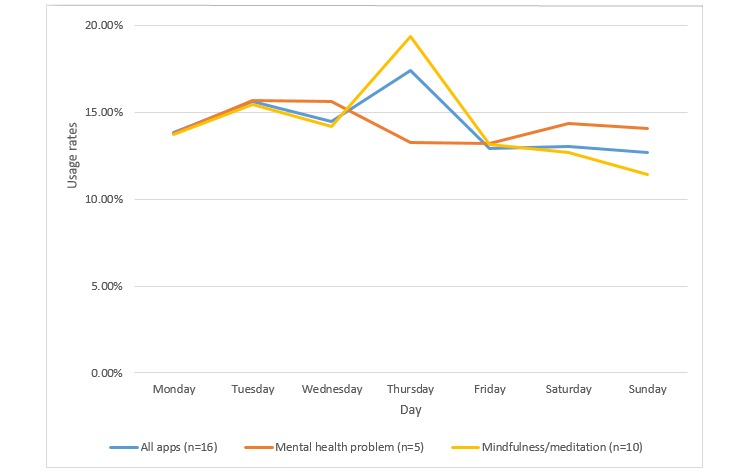
Results: In total, 93 apps met the inclusion criteria (installs: median 100,000, IQR 90,000). The median percentage of daily active users (open rate) was 4.0% (IQR 4.7%) with a difference between trackers (median 6.3%, IQR 10.2%) and peer-support apps (median 17.0%) versus breathing exercise apps (median 1.6%, IQR 1.6%; all z≥3.42, all P<.001). Among active users, daily minutes of use were significantly higher for mindfulness/meditation (median 21.47, IQR 15.00) and peer support (median 35.08, n=2) apps than for apps incorporating other techniques (tracker, breathing exercise, psychoeducation: medians range 3.53-8.32; all z≥2.11, all P<.05). The medians of app 15-day and 30-day retention rates were 3.9% (IQR 10.3%) and 3.3% (IQR 6.2%), respectively. On day 30, peer support (median 8.9%, n=2), mindfulness/meditation (median 4.7%, IQR 6.2%), and tracker apps (median 6.1%, IQR 20.4%) had significantly higher retention rates than breathing exercise apps (median 0.0%, IQR 0.0%; all z≥2.18, all P≤.04). The pattern of daily use presented a descriptive peak toward the evening for apps incorporating most techniques (tracker, psychoeducation, and peer support) except mindfulness/meditation, which exhibited two peaks (morning and night).
Conclusions: Although the number of app installs and daily active minutes of use may seem high, only a small portion of users actually used the apps for a long period of time. More studies using different datasets are needed to understand this phenomenon and the ways in which users self-manage their condition in real-world settings.
Keywords: adherence; anxiety; depression; mHealth; mental health; retention; usage; user engagement.
©Amit Baumel, Frederick Muench, Stav Edan, John M Kane. Originally published in the Journal of Medical Internet Research (http://www.jmir.org), 25.09.2019.
Conflict of interest statement
Conflicts of Interest: None declared.
Figures
References
-
- Norman GJ, Zabinski MF, Adams MA, Rosenberg DE, Yaroch AL, Atienza AA. A review of eHealth interventions for physical activity and dietary behavior change. Am J Prev Med. 2007 Oct;33(4):336–345. doi: 10.1016/j.amepre.2007.05.007. http://europepmc.org/abstract/MED/17888860 S0749-3797(07)00363-7 - DOI - PMC - PubMed
-
- Naslund J, Marsch L, McHugo G, Bartels S. Emerging mHealth and eHealth interventions for serious mental illness: a review of the literature. J Ment Health. 2015;24(5):321–332. doi: 10.3109/09638237.2015.1019054. http://europepmc.org/abstract/MED/26017625 - DOI - PMC - PubMed
-
- Pew Research Center. 2019. Jun 12, [2019-01-07]. Mobile fact sheet http://www.pewinternet.org/fact-sheet/mobile/
-
- WalkerSands Communications. 2019. [2019-01-07]. How technology is expanding the scope of online commerce beyond retail https://www.walkersands.com/resources/the-future-of-retail-2018/
Publication types
MeSH terms
LinkOut - more resources
Full Text Sources
Other Literature Sources
Medical
Miscellaneous
