


Optimal first-line treatment for advanced thymic carcinoma
- PMID: 31574576
- PMCID: PMC6825903
- DOI: 10.1111/1759-7714.13181
Optimal first-line treatment for advanced thymic carcinoma
Abstract
Background: Thymic carcinomas (TCs) are rare aggressive tumors with no standard first-line treatment. This study was conducted to determine the optimal chemotherapy regimen for advanced TC.
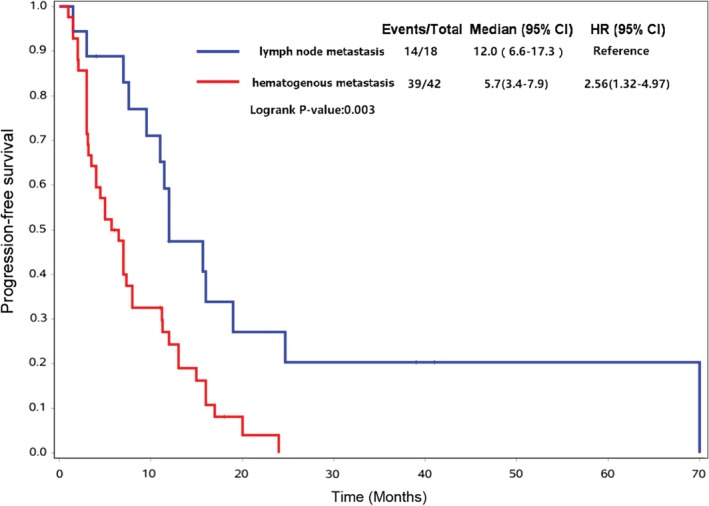
Methods: This retrospective study included 67 patients treated for stage IV TC in 2006-2015. The primary endpoints were the objective response rate (ORR) and progression-free survival (PFS) with different chemotherapy regimens. Multivariate Cox regression analysis was used to identify factors associated with PFS, including metastatic status, radiotherapy post-chemotherapy, primary lesion resection before chemotherapy, and chemotherapy regimen.
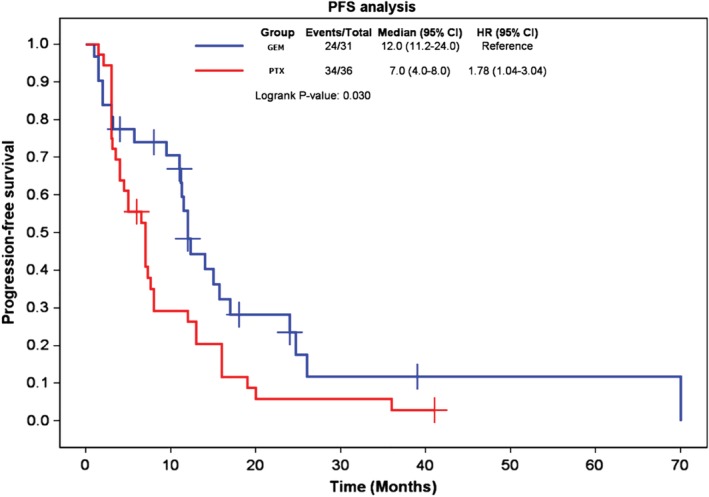
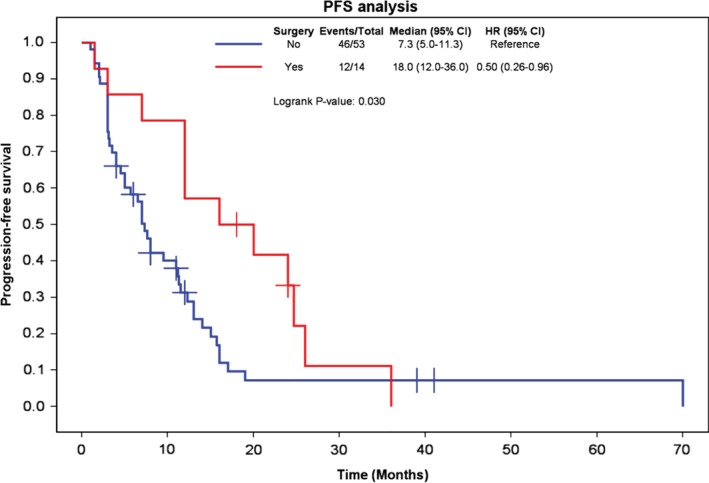
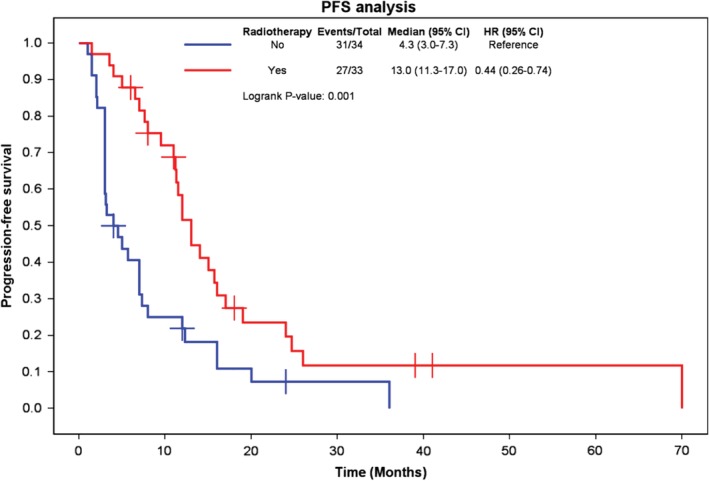
Results: A total of 36 patients received a paclitaxel-platinum regimen, 31 received a gemcitabine-platinum regimen, 14 underwent primary lesion resection, and 33 underwent radiotherapy. ORR was 31% (11/36) and 29% (9/31) in the paclitaxel-platinum and gemcitabine-platinum groups, respectively (P = 0.890). Median PFS, one-year PFS rate, and two-year PFS rate were 7.0 months, 26%, and 6% with paclitaxel-platinum treatment and 12 months, 48%, and 24% with gemcitabine-platinum treatment (log-rank P = 0.030). Median PFS, one-year PFS rate, and two-year PFS rate were 18.0 months, 57%, and 33% with surgical resection and 7.3 months, 31%, and 7% without resection (log-rank P = 0.030). Median PFS, one-year PFS rate, and two-year PFS rate were 13.0 months, 52%, and 20% with radiotherapy and 4.3 months, 22%, and 7% without radiotherapy (log-rank P = 0.001). In multivariate analysis, metastatic status (hazard ratio [HR], 0.33, P = 0.004), surgical resection (HR, 0.32; P = 0.004), and radiotherapy (HR, 0.32; P < 0.001) were associated with superior PFS.
Conclusions: Both gemcitabine-platinum and paclitaxel-platinum regimens were efficacious for advanced TC. Primary lesion resection and radiotherapy may also benefit selected patients.
Keywords: Chemotherapy; prognosis; radiation therapy; resection; thymic carcinoma.
© 2019 The Authors. Thoracic Cancer published by China Lung Oncology Group and John Wiley & Sons Australia, Ltd.
Figures
References
-
- Proceedings of the First International Conference on Thymic Malignancies. August 20‐21, 2009. Bethesda, Maryland, USA. J Thorac Oncol 2010; 5 (10 Suppl. 4): S259–370. PMID: 21275152. - PubMed
-
- Detterbeck FC, Parsons AM. Management of stage I and II thymoma. Thorac Surg Clin 2011; 21: 59–67, vi‐vii. - PubMed
-
- Scorsetti M, Leo F, Trama A et al Thymoma and thymic carcinomas. Crit Rev Oncol Hematol 2016; 99: 332–50. - PubMed
-
- Engels EA, Pfeiffer RM. Malignant thymoma in the United States: Demographic patterns in incidence and associations with subsequent malignancies. Int J Cancer 2003; 105 (4): 546–51. - PubMed
-
- Kondo K, Monden Y. Therapy for thymic epithelial tumors: A clinical study of 1,320 patients from Japan. Ann Thorac Surg 2003; 76 (3): 878–84; discussion 884‐5. - PubMed
Publication types
MeSH terms
Substances
LinkOut - more resources
Full Text Sources
Medical
Molecular Biology Databases
