Review
. 2019 Sep 30;8(10):1178.
doi: 10.3390/cells8101178.

Insights into Biological Role of LncRNAs in Epithelial-Mesenchymal Transition

Affiliations
Review

Insights into Biological Role of LncRNAs in Epithelial-Mesenchymal Transition

Jun-Ting Cheng et al. Cells. .

Abstract

Long non-coding RNAs (lncRNAs) are versatile regulators of gene expression and play crucial roles in diverse biological processes. Epithelial-mesenchymal transition (EMT) is a cellular program that drives plasticity during embryogenesis, wound healing, and malignant progression. Increasing evidence shows that lncRNAs orchestrate multiple cellular processes by modulating EMT in diverse cell types. Dysregulated lncRNAs that can impact epithelial plasticity by affecting different EMT markers and target genes have been identified. However, our understanding of the landscape of lncRNAs important in EMT is far from complete. Here, we summarize recent findings on the mechanisms and roles of lncRNAs in EMT and elaborate on how lncRNAs can modulate EMT by interacting with RNA, DNA, or proteins in epigenetic, transcriptional, and post-transcriptional regulation. This review also highlights significant EMT pathways that may be altered by diverse lncRNAs, thereby suggesting their therapeutic potential.

Keywords: cancer; epithelial-mesenchymal transition (EMT); long non-coding RNA; signaling pathways.


Conflict of interest statement

The authors declare no conflict of interest.

Figures
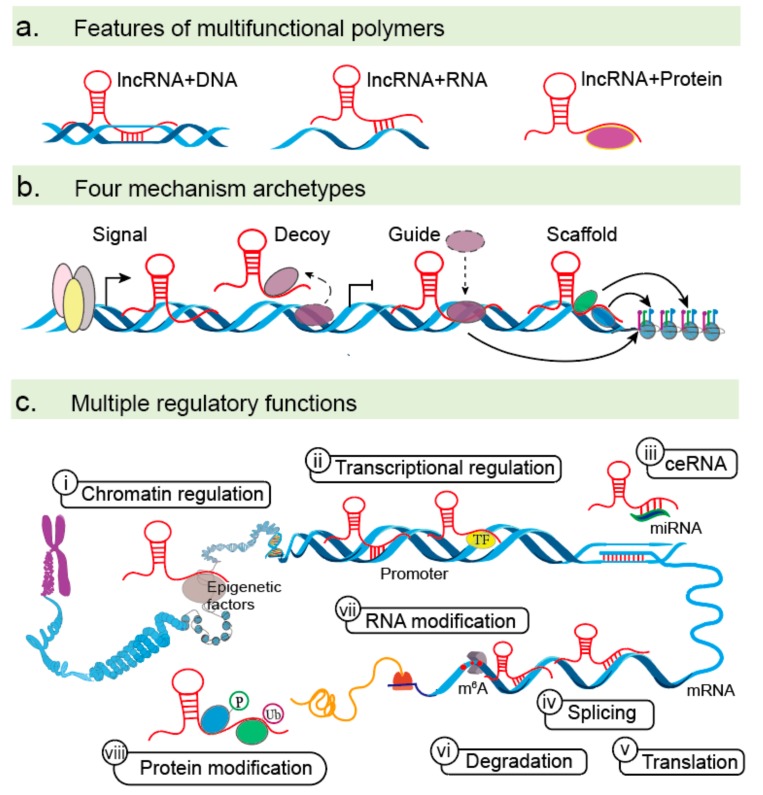
Figure 1
Figure 1
LncRNA functions. (a) lncRNAs can bind DNA, RNA, and protein molecules to regulate gene expression at multiple levels via base pairing or secondary structure formation. (b) LncRNAs have four primary roles as signals, decoys, guides, and scaffolds. (c) Mechanism of action for lncRNAs in the nucleus (i–ii) and cytoplasm (iii–viii). (i) LncRNAs can recruit epigenetic factors to change patterns of chromatin organization, (ii) activate or repress the transcription of certain genes by interacting with DNA sequences or TFs, (iii) act as ceRNAs by base pairing with miRNA and diminishing its inhibitory effects, and manipulate mRNA function by base pairing to (iv) regulate alternative splicing (e.g., MALAT 1), (v) affect mRNA translation (e.g., TTN-AS1 and AC132217.4), and (vi) mRNA degradation (e.g., CASC11). (vii–viii) lncRNAs can modify mRNA and proteins, playing regulatory roles in methylation, phosphorylation, and ubiquitination.
Figure 2
Figure 2
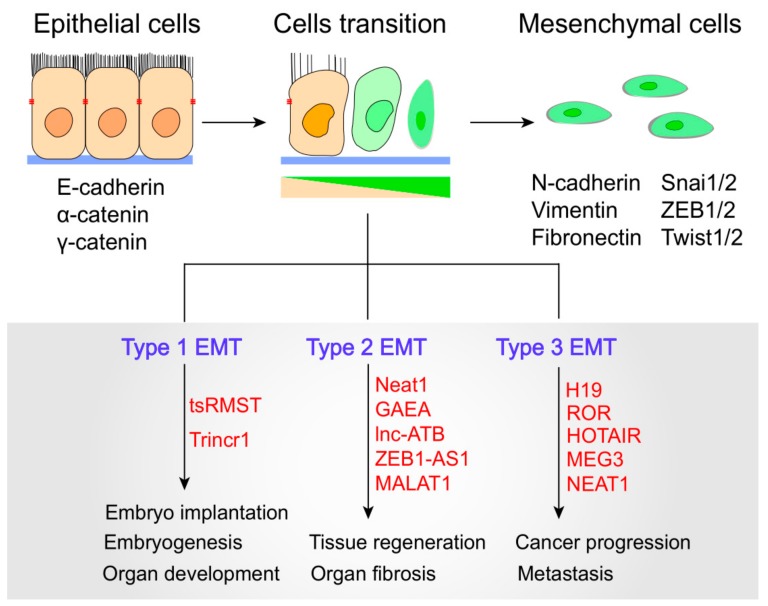
LncRNAs modulate three Epithelial-mesenchymal transition (EMT) subtypes. EMTs involve the functional transition of polarized epithelial cells into mobile and secretory mesenchymal cells. Cells transition indicates progressive loss of epithelial markers and gain of mesenchymal markers. Epithelial and mesenchymal cell markers and related lncRNAs are shown.
Figure 3
Figure 3
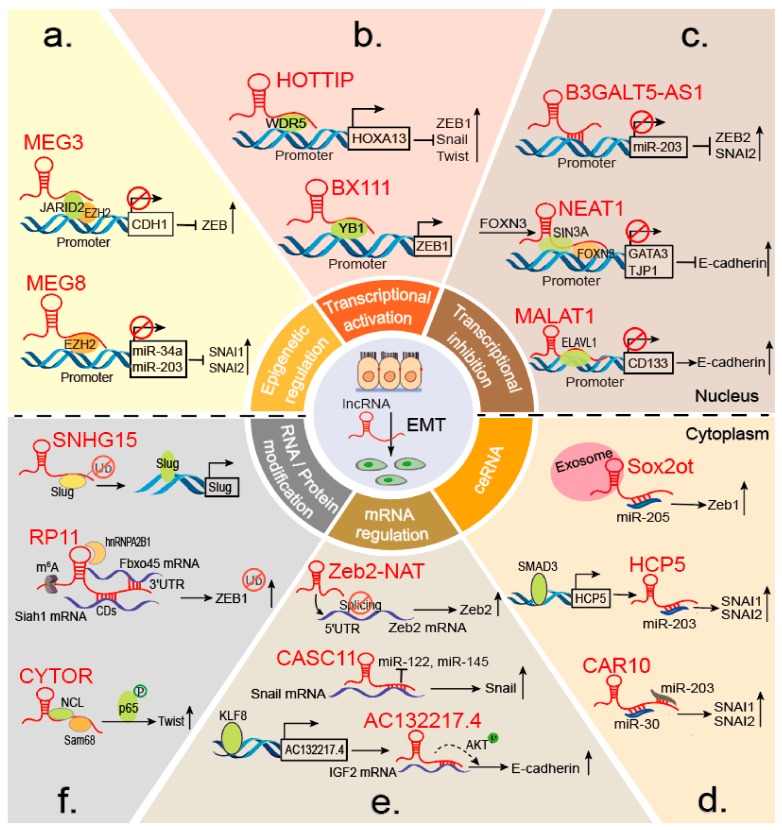
LncRNAs regulate EMT at different levels. (a) LncRNAs regulate RNA-protein interactions at the epigenetic level. Both MEG8 and MEG3 suppress the expression of downstream target genes by interacting with EZH2, resulting in EMT marker upregulation. (b–c) During transcription, lncRNAs function via RNA-TF or RNA-DNA (e.g., B3GALT5-AS1) interactions. LncRNAs act as guides and molecular scaffolds for TF activation (e.g., HOTTIP and BX111) or target gene repression (e.g., MALAT1 and NEAT1) to regulate EMT-related genes such as ZEB1 and E-cadherin. Furthermore, lncRNA B3GALT5-AS1 directly binds the miRNA-203 promotor to repress miR-203 expression, upregulate SNAI2 and ZEB2, and induce EMT. (d) LncRNAs (e.g., CAR10 and HCP5) and exosomal lncRNAs (e.g., Sox2ot) act as ceRNAs by competitively binding miRNAs to increase EMT TF expression. (e) LncRNAs affect mRNA splicing (e.g., Zeb2-NAT) and stability (e.g., lnc-ATB and AC132217.4) to modulate EMT. (f) LncRNAs regulate protein and mRNA modifications to manipulate EMT. They also act as scaffolds to recruit proteins and impact protein phosphorylation and ubiquitination (e.g., SNHG15 and CYTOR). Additionally, m6A methylation can induce lncRNA expression (e.g., RP11) by increasing lncRNA accumulation in nuclei.
Figure 4
Figure 4
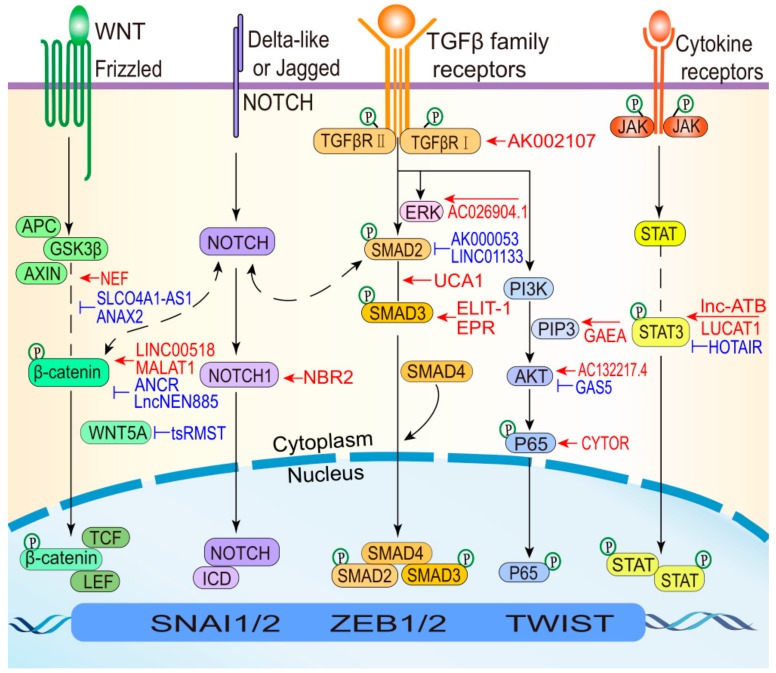
LncRNAs regulate EMT signaling pathways. When the canonical Wnt pathway is activated, β-catenin is released from the GSK3β-AXIN-APC complex. Then, β-catenin translocates to the nucleus and drives EMT. Thus, lncRNAs regulate this pathway by targeting β-catenin, resulting in EMT induction (red) or inhibition (blue). Additionally, lncRNAs can modulate non-canonical Wnt signaling to suppress EMT by repressing WNT5A (e.g., tsRMST). The Notch pathway controls cell fate decisions, differentiation, and proliferation. LncRNAs can inhibit EMT by regulating Notch1 signaling (e.g., NBR2). In TGF-β pathway, TGF-β-induced SMAD (Sekelsky mothers against dpp) complexes transcriptionally activate EMT TFs. Once they are activated, EMT TFs can increase the expression of TGF-β ligands and drive a positive feedback loop, thereby helping cells to maintain an EMT state. Thus, lncRNAs can regulate EMT through SMAD2 (e.g., AK000053 and LINC01133), SMAD3 (e.g., ELIT-1 and EPR), and the SMAD2/3 complex (e.g., UCA1), and TGFBR1 (e.g., AK002107). Alternate pathways involve collaboration between TGF-β and proteins such as ERK, PI3K-AKT, and NF-κB (P65), which are also regulated by lncRNAs (e.g., AC026904.1, GAEA, AC132217.4, and CYTOR). STAT3 in the STAT pathway is a key TF that determines the EMT state and tumor aggression. LncRNAs can impact EMT via STAT3 activation (red) or inactivation (blue).

References

    1. Ransohoff J.D., Wei Y., Khavari P.A. The functions and unique features of long intergenic non-coding RNA. Nat. Rev. Mol. Cell Biol. 2018;19:143–157. doi: 10.1038/nrm.2017.104. - DOI - PMC - PubMed
    1. Morris K.V., Mattick J.S. The rise of regulatory RNA. Nat. Rev. Genet. 2014;15:423–437. doi: 10.1038/nrg3722. - DOI - PMC - PubMed
    1. Chew C.L., Conos S.A., Unal B., Tergaonkar V. Noncoding RNAs: Master Regulators of Inflammatory Signaling. Trends Mol. Med. 2018;24:66–84. doi: 10.1016/j.molmed.2017.11.003. - DOI - PubMed
    1. Li Y., Egranov S.D., Yang L., Lin C. Molecular mechanisms of long noncoding RNAs-mediated cancer metastasis. Genes Chromosomes Cancer. 2019;58:200–207. doi: 10.1002/gcc.22691. - DOI - PMC - PubMed
    1. Liu H., Luo J., Luan S., He C., Li Z. Long non-coding RNAs involved in cancer metabolic reprogramming. Cell. Mol. Life Sci. 2019;76:495–504. doi: 10.1007/s00018-018-2946-1. - DOI - PMC - PubMed

Publication types

MeSH terms

Substances

LinkOut - more resources