


Effectiveness and safety of early intramuscular botulinum toxin injections to prevent shoulder deformity in babies with brachial plexus birth injury (POPB-TOX), a randomised controlled trial: study protocol
- PMID: 31575585
- PMCID: PMC6773354
- DOI: 10.1136/bmjopen-2019-032901
Effectiveness and safety of early intramuscular botulinum toxin injections to prevent shoulder deformity in babies with brachial plexus birth injury (POPB-TOX), a randomised controlled trial: study protocol
Abstract
Introduction: In children with brachial plexus birth injury (BPBI), denervation of the shoulder muscles leads to bony deformity in the first months of life, reducing active and passive range of motion (ROM) and causing activity limitation. The aim of this multicentre randomised controlled trial is to evaluate the effectiveness of botulinum toxin injections (BTI) in the shoulder internal rotator muscles of 12-month-old babies in limiting the progression of posterior subluxation of the glenohumeral joint, compared with a sham procedure mimicking BTI. The secondary aims are to evaluate the effectiveness of BTI in (1) limiting the progression of glenoid retroversion and three-dimensional (3D) deformity and (2) improving shoulder ROM and upper limb function, as well as to confirm the tolerance of BTI.
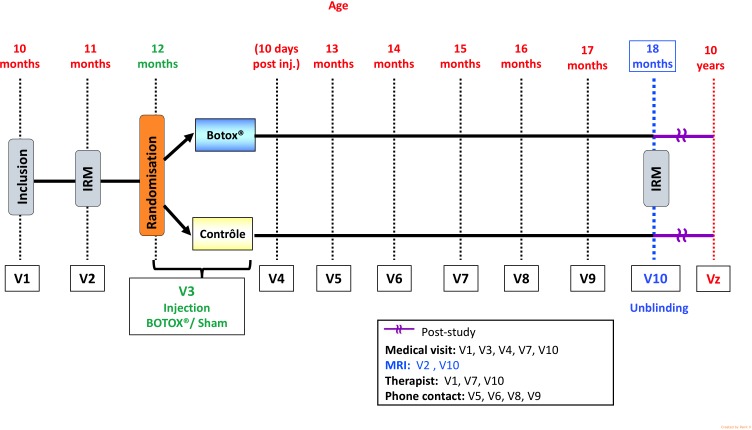
Methods and analysis: Sixty-two babies with unilateral BPBI and a risk of posterior humeral head subluxation will be included. Only those with at least 7% posterior subluxation of the humeral head compared with the contralateral shoulder on the MRI will be randomised to one of two groups: 'BTI' and 'Sham'. The BTI group will receive BOTOX injections at the age of 12 months in the internal shoulder rotator muscles (8 UI/kg). The sham group will undergo a sham BTI procedure. Both groups will undergo repeated shoulder MRI at 18 months of age to quantify changes in the percentage of posterior migration of the humeral head (primary outcome), glenoid version and 3D bone deformity. Clinical evaluations (passive shoulder ROM, active movement scale) will be carried out at baseline and 15 and 18 months of age. The mini-assisting hand assessment will be rated between 10 and 11 months and at 18 months of age. Adverse events will be recorded at least monthly for each child.
Ethics and dissemination: Full ethical approval for this study has been obtained. The findings will be disseminated in peer-reviewed publications.
Trial registration number: EudraCT: 2015-001402-34 in European Clinical Trial database; NCT03198702 in Clinical Trial database; Pre-results.
Keywords: Brachial Plexus Birth Injury; bone deformity; botulinum toxin; shoulder.
© Author(s) (or their employer(s)) 2019. Re-use permitted under CC BY-NC. No commercial re-use. See rights and permissions. Published by BMJ.
Conflict of interest statement
Competing interests: CP reports non-financial support from Biogen, outside the submitted work. SB reports non-financial support from Allergan, outside the submitted work. GLG reports other from Portola Pharmaceuticals, other from Boehringer-Ingelheim, other from Pfizer, other from Bristol-Myers Squibb, other from LEO Pharma, other from Daiichi Sankyo, other from Bayer, other from Bayer, other from Pfizer, other from LEO Pharma, other from Sanofi, other from bioMérieux, outside the submitted work.
References
Publication types
MeSH terms
Substances
Associated data
LinkOut - more resources
Full Text Sources
Medical
