. 2019 Nov 8;294(45):16897-16907.
doi: 10.1074/jbc.RA119.010214. Epub 2019 Oct 1.

2'-C-methylated nucleotides terminate virus RNA synthesis by preventing active site closure of the viral RNA-dependent RNA polymerase

Affiliations

2'-C-methylated nucleotides terminate virus RNA synthesis by preventing active site closure of the viral RNA-dependent RNA polymerase

Alyson K Boehr et al. J Biol Chem. .

Abstract

The 2'-C-methyl ribonucleosides are nucleoside analogs representing an important class of antiviral agents, especially against positive-strand RNA viruses. Their value is highlighted by the highly successful anti-hepatitis C drug sofosbuvir. When appropriately phosphorylated, these nucleotides are successfully incorporated into RNA by the virally encoded RNA-dependent RNA polymerase (RdRp). This activity prevents further RNA extension, but the mechanism is poorly characterized. Previously, we had identified NMR signatures characteristic of formation of RdRp-RNA binary and RdRp-RNA-NTP ternary complexes for the poliovirus RdRp, including an open-to-closed conformational change necessary to prepare the active site for catalysis of phosphoryl transfer. Here we used these observations as a framework for interpreting the effects of 2'-C-methyl adenosine analogs on RNA chain extension in solution-state NMR spectroscopy experiments, enabling us to gain additional mechanistic insights into 2'-C-methyl ribonucleoside-mediated RNA chain termination. Contrary to what has been proposed previously, poliovirus RdRp that was bound to RNA with an incorporated 2'-C-methyl nucleotide could still bind to the next incoming NTP. Our results also indicated that incorporation of the 2'-C-methyl nucleotide does not disrupt RdRp-RNA interactions and does not prevent translocation. Instead, incorporation of the 2'-C-methyl nucleotide blocked closure of the RdRp active site upon binding of the next correct incoming NTP, which prevented further nucleotide addition. We propose that other nucleotide analogs that act as nonobligate chain terminators may operate through a similar mechanism.

Keywords: 2′-C-methyl ribonucleoside; NMR; RNA polymerase; antiviral agent; hepatitis C virus (HCV); nucleoside/nucleotide analogue; plus-stranded RNA virus; poliovirus; positive-strand RNA virus; viral polymerase.


Conflict of interest statement

The authors declare that they have no conflicts of interest with the contents of this article. The content is solely the responsibility of the authors and does not necessarily represent the official views of the National Institutes of Health

Figures
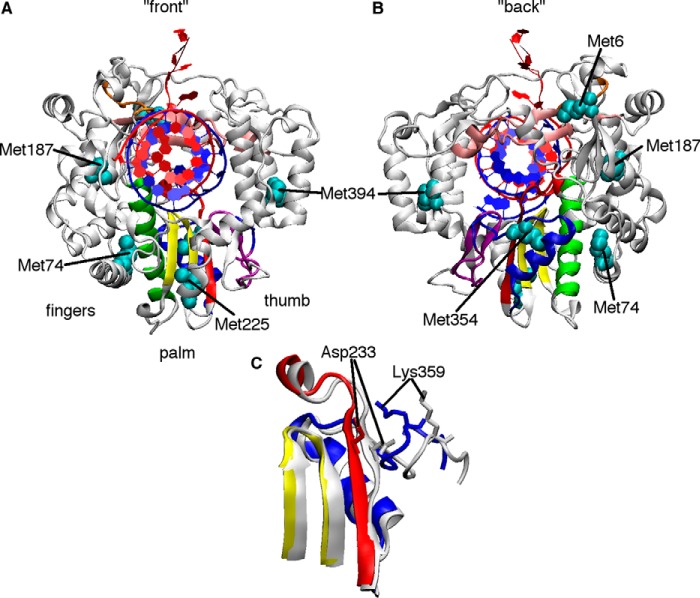
Figure 1.
Figure 1.
Structural changes in PV RdRp necessary for nucleotide selection and incorporation. A and B, the X-ray crystal structure of PV RdRp (PDB code 3OL7) (21) with the conserved structural motifs colored (A, red; B, green; C, yellow; D, blue; E, purple; F, pink) and the locations of Met probes indicated (cyan). C, close-up of motifs A, C, and D, showing structural changes before NTP binding (white, PDB code 3OL6) (21) and after NTP binding and incorporation (colored, PDB code 3OL7). The white and colored structures represent the open and closed conformations according to X-ray crystallography. These and other structural changes may be monitored by solution-state NMR analysis of [methyl-13C]Met probes.
Figure 2.
Figure 2.
Incorporation of 2′-C-Me-AMP by PV RdRp terminates RNA synthesis and inhibits virus replication. A, chemical structure of 2′-C-Me-adenosine. B, sequence and base-pairing within the ssAU RNA used in many of the described studies. C, incorporation of 2′-C-Me-AMP terminates RNA synthesis. In brief, PV RdRp (1 μm) was incubated with 20 μm ssAU RNA (i.e. 10 μm duplex RNA) and appropriate NTPs (500 μm). RNA reaction products were resolved by denaturing PAGE and visualized by phosphorimaging. When 2′-C-Me-ATP and UTP were incubated with ssAU RNA, there was no band corresponding to two nucleotide addition events (i.e. +2 position) for over 5 h (i.e. under the time necessary for the NMR experiments). D, the second-order rate constants for single-nucleotide incorporation based on the ssAU RNA as determined previously (33, 51). The kinetic parameters kpol and Kd are the maximum polymerase rate constant and the apparent dissociation constant for the incoming NTP, respectively. For the kinetics studies with mispaired termini, studies were conducted using the RNA sequence 5′-GCAUGGGCCCG-3′ so that the RNA terminus contained a G:U mismatch and the next correct incoming NTP was UTP (27). E, 2′-C-Me-adenosine has antiviral activity. HeLa S3 cells were incubated with 2′-C-methyladenosine for 1 h at the concentrations shown and subsequently infected with 106 pfu of PV. Fifteen minutes after the infection, fresh medium containing 2′-C-methyladenosine at the appropriate concentration was added, and the infection progressed for 6 h. Cell-associated virus was titered with plaque assays.
Figure 3.
Figure 3.
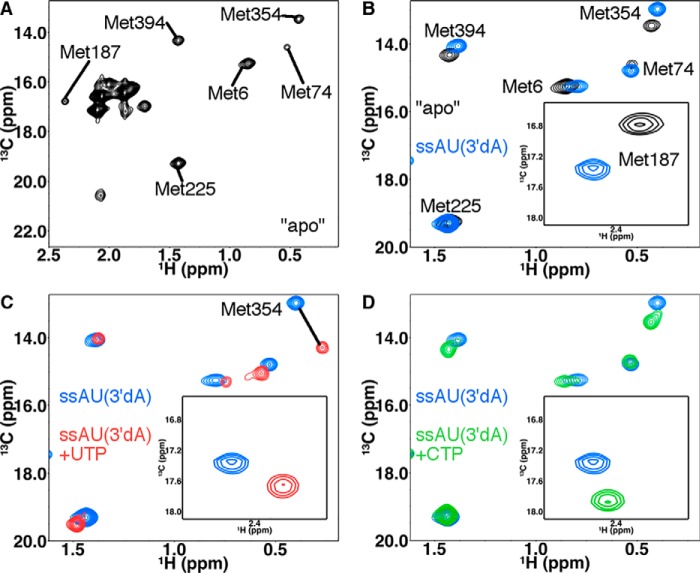
[Methyl-13C]Met chemical shift perturbations provide insight into structure and dynamic changes in PV RdRp upon binding RNA and nucleotide. A, 1H-13C HSQC of PV RdRp in the absence of RNA and nucleotide. Important Met resonances are labeled. Other Met resonances do not show chemical shift changes upon RNA and/or nucleotide addition and so were not considered further. B–D, 1H-13C HSQC comparisons between PV RdRp in the absence of RNA and nucleotide (black), PV RdRp bound to ssAU(3′dA) RNA (blue), PV RdRp bound to ssAU(3′dA) RNA and UTP (red), and PV RdRp bound to ssAU(3′dA) RNA and CTP (green). The resonances for Met-187 are indicated in the insets. For these experiments, PV RdRp (250 μm) is first incubated with 500 μm duplex RNA (ssAU (Fig. 2)) and 4 mm 3′-dATP so that 3′-dAMP is incorporated but lack of the 3′-hydroxyl prevents further nucleotide addition. Excess 3′-dATP is removed through a desalting column before addition of the second NTP (4–12 mm) to generate the ternary RdRp–RNA–NTP complexes. The D2O-based buffer consisted of 10 mm HEPES (pH 8.0), 200 mm NaCl, 0.02% NaN3, 5 mm MgCl2, and 10 μm ZnCl2. NMR spectra were collected at 293 K using a Bruker Avance III 600 MHz spectrometer. Aspects of these NMR experiments have been reported previously (27, 35, 36).
Figure 4.
Figure 4.
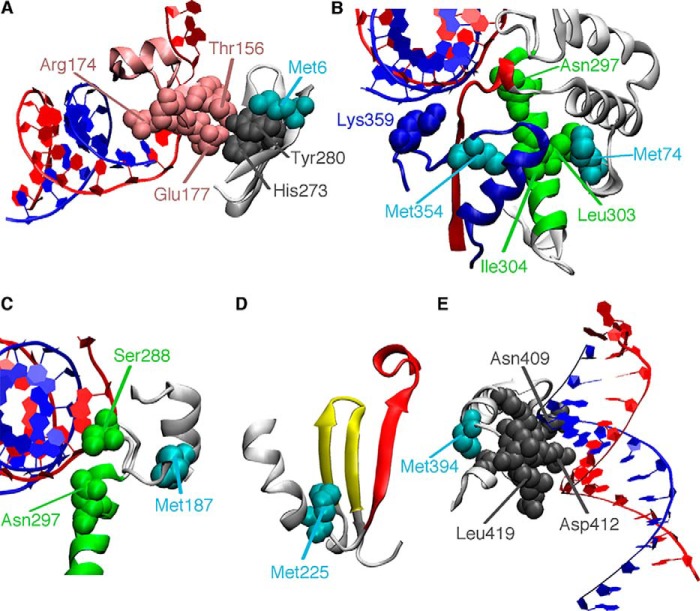
Methionine probes report on ligand binding and conformational changes throughout the RdRp structure. The template and primer RNA strands are colored red and blue, respectively. A, Met-6 is part of the three-stranded β-sheet that makes interactions with residues in motif F (pink). B, Met-74 is in the fingers subdomain and makes van der Waals contact with residues on the motif B helix (green). Met-354 is in motif D (blue). Other important residues include the proposed general acid Lys-359 and Asn-297, which makes hydrogen-bonding interactions with the 2′-hydroxyl of the incoming NTP. C, Met-187 is near motif B, including Ser-288 and Asn-297, and so likely reports on RNA and NTP binding. D, Met-225 is near motifs A and C (red and yellow, respectively) and likely reports on the realignment of motif A to form the three-stranded β-sheet important in active-site closure. E, Met-394 is near residues important for RNA binding.
Figure 5.
Figure 5.
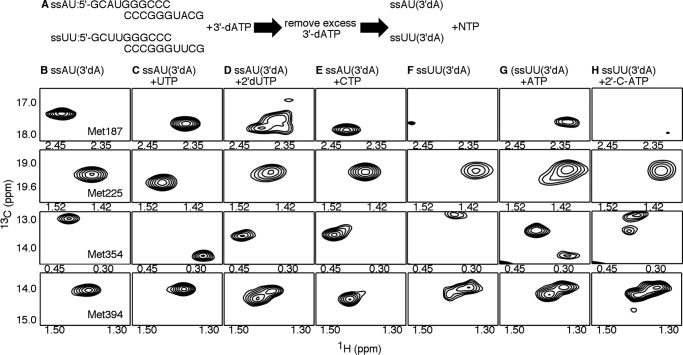
The RdRp–RNA ternary complex with 2′-C-Me-ATP does not achieve the closed conformation. A, experimental design. PV RdRp (250 μm) is first incubated with 500 μm duplex RNA (ssAU or ssUU) and 4 mm 3′-dATP so that 3′-dAMP is incorporated, but lack of the 3′-hydroxyl prevents further nucleotide addition. Excess 3′-dATP is removed through a desalting column before addition of the second NTP (4–12 mm) to generate the ternary RdRp–RNA–NTP complexes. The D2O-based buffer consisted of 10 mm HEPES (pH 8.0), 200 mm NaCl, 0.02% NaN3, 5 mm MgCl2, and 10 μm ZnCl2. B–H, [13C-methyl]Met 1H-13C HSQC NMR spectra of different RdRp–RNA binary and RdRp–RNA–NTP ternary complexes, including the RdRp–ssAU(3′dA) (i.e. ssAU RNA with incorporated 3′-dAMP) (B), RdRp–ssAU(3′dA)–UTP (C), RdRp–ssAU(3′dA)–2′-dUTP (D), RdRp:ssAU(3′dA)–CTP (E), RdRp–ssUU(3′dA) (i.e. ssUU RNA with incorporated 3′-dAMP) (F), RdRp–ssUU(3′dA)–ATP (G), and RdRp–ssUU(3′dA)–2′-C-Me-ATP (H) complexes. Resonances belonging to the ϵ-13CH3 groups of Met-187, Met-225, Met-354, and Met-394 are highlighted. NMR spectra were collected at 293 K using a Bruker Avance III 600 MHz spectrometer.
Figure 6.
Figure 6.
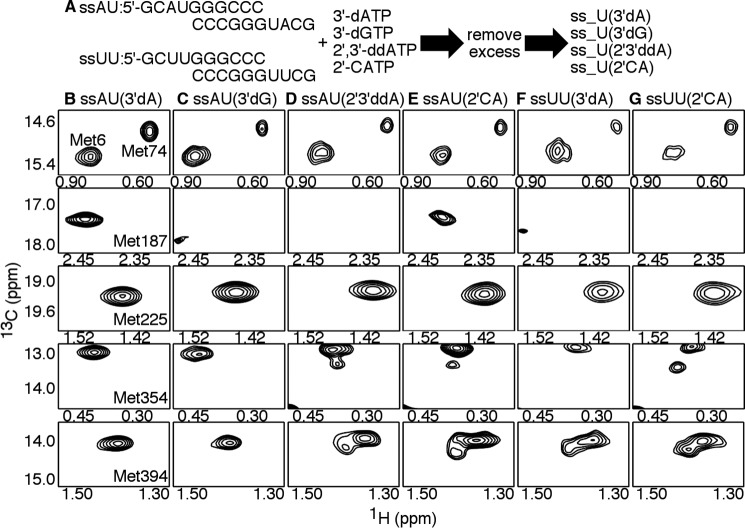
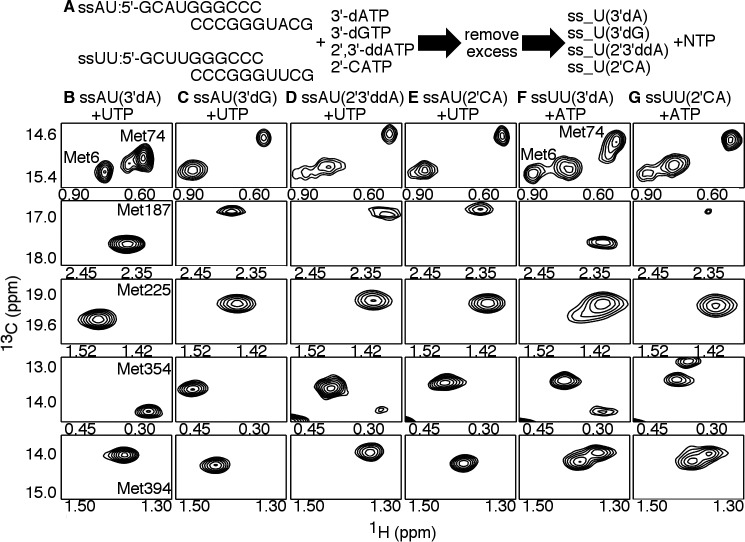
Incorporation of 2′-C-Me-AMP does not substantially affect the structure and/or dynamics of the RdRp–RNA binary complex. A, experimental design. PV RdRp (250 μm) is first incubated with 500 μm duplex RNA (ssAU or ssUU) and 4 mm nucleotide analogs, which, when incorporated, terminate RNA synthesis. The nucleotide analogs include the obligate chain terminators 3′-dATP, 3′-dGTP, and 2′,3′-ddATP and the nonobligate chain terminator 2′-C-Me-ATP (2-CATP). Excess nucleotide analog was later removed through a desalting column to generate the RdRp–RNA binary complexes. The D2O-based buffer consisted of 10 mm HEPES (pH 8.0), 200 mm NaCl, 0.02% NaN3, 5 mm MgCl2, and 10 μm ZnCl2. B–G, [13C-methyl]Met 1H-13C HSQC NMR spectra of different RdRp–RNA binary complexes, including RdRp–ssAU(3′dA) (i.e. ssAU RNA with incorporated 3′-dAMP) (B), RdRp–ssAU(3′dG) (i.e. ssAU RNA with incorporated 3′-dGMP) (C), RdRp–ssAU(2′3′ddA) (i.e. ssAU RNA with incorporated 2′,3′-ddAMP) (D), RdRp–ssAU(2′CA) (i.e. ssAU RNA with incorporated 2′-C-Me-AMP) (E), RdRp–ssUU(3′dA) (i.e. ssUU RNA with incorporated 3′-dAMP) (F), and RdRp–ssUU(2′CA) (i.e. ssUU RNA with incorporated 2′-C-Me-AMP) (G). Resonances belonging to the ϵ-13CH3 groups of Met-6, Met-74, Met-187, Met-225, Met-354, and Met-394 are highlighted. NMR spectra were collected at 293 K using a Bruker Avance III 600 MHz spectrometer.
Figure 7.
Figure 7.
Incorporation of 2′-C-Me-AMP prevents active-site closure upon binding the next incoming nucleotide. A, experimental design. PV RdRp (250 μm) is first incubated with 500 μm duplex RNA (ssAU or ssUU) and 4 mm nucleotide analogs, which, when incorporated, terminate RNA synthesis. The nucleotide analogs include the obligate chain terminators 3′-dATP, 3′-dGTP, and 2′,3′-ddATP and the nonobligate chain terminator 2′-C-Me-ATP (2-CATP). Excess nucleotide analog was later removed through a desalting column, followed by addition of the second NTP (4–12 mm) to generate the RdRp–RNA–NTP ternary complexes. The D2O-based buffer consisted of 10 mm HEPES (pH 8.0), 200 mm NaCl, 0.02% NaN3, 5 mm MgCl2, and 10 μm ZnCl2. B–G, [13C-methyl]Met 1H-13C HSQC NMR spectra of different RdRp–RNA–NTP ternary complexes, including the RdRp–ssAU(3′dA)–UTP (B), RdRp–ssAU(3′dG)–UTP (C), RdRp–ssAU(2′3′ddA)–UTP (D), RdRp–ssAU(2′CA)–UTP (E), RdRp–ssUU(3′dA)–ATP (F), and RdRp–ssUU(2′CA)–ATP (G) complexes. Designations for the chain-terminated RNA can be found in the legend for Fig. 6, including the ssAU(2′CA) and ssUU(2′CA) RNA, which are ssAU and ssUU RNA with incorporated 2′-C-Me-AMP. Resonances belonging to the ϵ-13CH3 groups of Met-6, Met-74, Met-187, Met-225, Met-354, and Met-394 are highlighted. NMR spectra were collected at 293 K using a Bruker Avance III 600 MHz spectrometer.
Figure 8.
Figure 8.
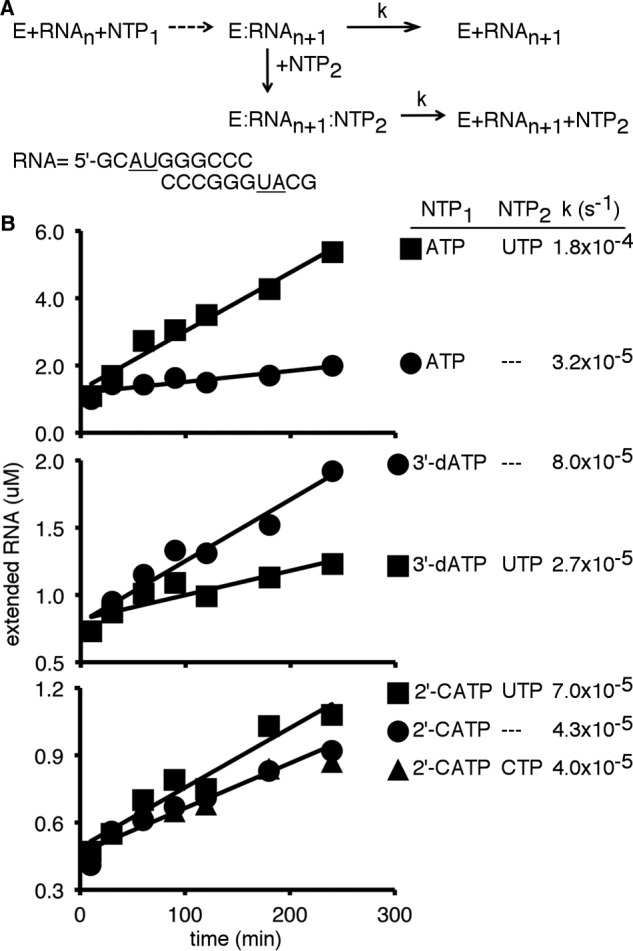
Incorporation of 2′-C-Me-AMP does not prevent the next nucleotide from binding. A, experimental design. The rate-determining step in steady-state nucleotide incorporation is dissociation of the RdRp–RNAn+1 complex (42), in which RNAn is the ssAU RNA, and RNAn+1 is the ssAU RNA following a single-nucleotide incorporation event. Addition of a second NTP may affect RdRp–RNA complex dissociation to affect the steady-state rate constant. B, steady-state incorporation of nucleotides. Reactions contained 20 μm ssAU RNA (i.e. 10 μm duplex), 5 mm MgCl2, 1 μm PV RdRp, and 500 μm NTPs. Reactions were initiated by addition of NTP(s), incubated at 30 °C, and quenched by addition of EDTA to a final concentration of 50 mm at the indicated times. The steady-state rate constants (k) were determined by dividing the slope by the y-intercept of the line indicated. Addition of UTP (i.e. the next correct incoming NTP) increased the rate of dissociation between the RdRp and RNA with incorporated 2′-C-Me-AMP (2-CATP, 2′-C-Me-ATP). This result suggests that UTP is still able to bind to form the RdRp–ssAU(2′CA)–UTP ternary complex.

References

    1. Wang L. S., D'Souza L. S., and Jacobson I. M. (2016) Hepatitis C: a clinical review. J. Med. Virol. 88, 1844–1855 10.1002/jmv.24554 - DOI - PubMed
    1. Sun J., Hu X. Y., and Yu X. F. (2019) Current understanding of human enterovirus D68. Viruses 11, E490 - PMC - PubMed
    1. Racaniello V. R. (2006) One hundred years of poliovirus pathogenesis. Virology 344, 9–16 10.1016/j.virol.2005.09.015 - DOI - PubMed
    1. Bandyopadhyay A. S., Garon J., Seib K., and Orenstein W. A. (2015) Polio vaccination: past, present and future. Future Microbiol. 10, 791–808 10.2217/fmb.15.19 - DOI - PubMed
    1. Collins M. H., and Metz S. W. (2017) Progress and works in progress: update on flavivirus vaccine development. Clin. Ther. 39, 1519–1536 10.1016/j.clinthera.2017.07.001 - DOI - PubMed

Publication types