


Utilising Genetically-Informed Research Designs to Better Understand Family Processes and Child Development: Implications for Adoption and Foster Care Focused Interventions
- PMID: 31576061
- PMCID: PMC6771282
- DOI: 10.1177/0308575919866526
Utilising Genetically-Informed Research Designs to Better Understand Family Processes and Child Development: Implications for Adoption and Foster Care Focused Interventions
Abstract
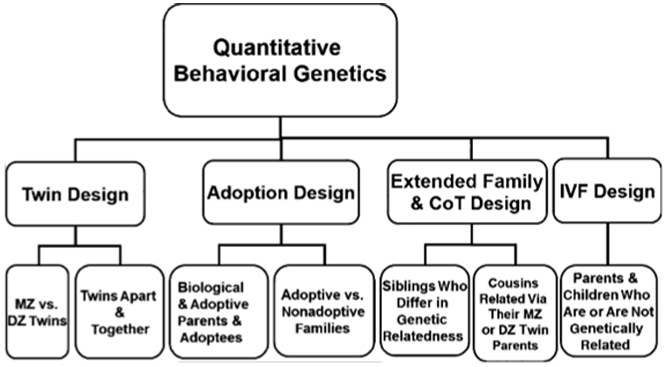
Understanding the interplay between genetic factors and family environmental processes (e.g., inter-parental relationship quality, positive versus negative parenting practices) and children's mental health (e.g., anxiety, depression, conduct problems, ADHD) in the contexts of adoption and foster-care research and practice is critical for effective prevention and intervention programme development. Whilst evidence highlights the importance of family environmental processes for the mental health and well-being of children in adoption and foster care, there is relatively limited evidence of effective interventions specifically for these families. Additionally, family-based interventions not specific to the context of adoption and foster-care typically show small to medium effects, and even where interventions are efficacious, not all children benefit. One explanation for why interventions may not work well for some is that responses to intervention may be influenced by an individual's genetic make-up. This paper summarises how genetically-informed research designs can help disentangle genetic from environmental processes underlying psychopathology outcomes for children, and how this evidence can provide improved insights into the development of more effective preventative intervention targets for adoption and foster-care families. We discuss current difficulties in translating behavioural genetics research to prevention science, and provide recommendations to bridge the gap between behavioural genetics research and prevention science, with lessons for adoption and foster-care research and practice.
Keywords: adoption; child; family; foster-care; genetically-informed research designs; intervention; mental health; prevention science; quantitative genetics.
Conflict of interest statement
The authors declared no conflicts of interest with respect to the authorship or the publication of this article
Figures
References
-
- Arseneault L, Moffitt TE, Caspi A, Taylor A, Rijsdijk FV, Jaffee SR, … & Measelle JR (2003). Strong genetic effects on cross‐situational antisocial behaviour among 5‐year‐old children according to mothers, teachers, examiner‐observers, and twins’ self‐reports. Journal of Child Psychology and Psychiatry, 44(6), 832–848. - PubMed
-
- Bornovalova MA, Cummings JR, Hunt E, Blazei R, Malone S, & Iacono WG (2014). Understanding the relative contributions of direct environmental effects and passive genotype-environment correlations in the association between familial risk factors and child disruptive behavior disorders. Psychological Medicine, 44(4), 831–844. - PMC - PubMed
-
- Bouchard TJ, Lykken DT, McGue M, Segal NL, & Tellegen A (1990). Sources of human psychological differences: The Minnesota study of twins reared apart. Science, 250, 223–228. - PubMed
Grants and funding
LinkOut - more resources
Full Text Sources
Miscellaneous