From habitat use to social behavior: natural history of a voiceless poison frog, Dendrobates tinctorius
- PMID: 31576237
- PMCID: PMC6753930
- DOI: 10.7717/peerj.7648
From habitat use to social behavior: natural history of a voiceless poison frog, Dendrobates tinctorius
Abstract
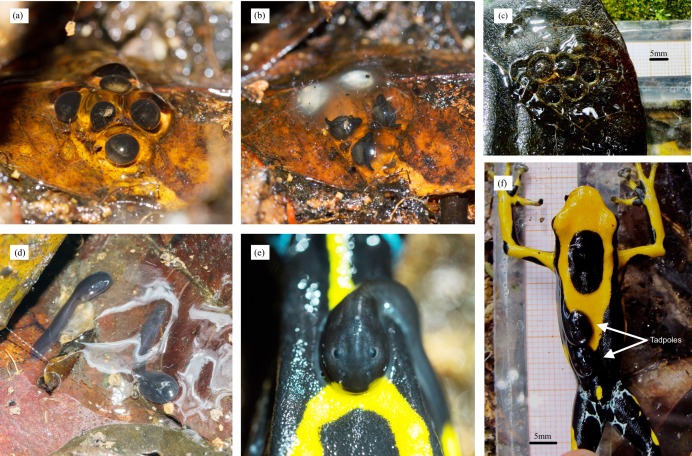
Descriptive studies of natural history have always been a source of knowledge on which experimental work and scientific progress rely. Poison frogs are a well-studied group of small Neotropical frogs with diverse parental behaviors, distinct calls, and bright colors that warn predators about their toxicity; and a showcase of advances in fundamental biology through natural history observations. The dyeing poison frog, Dendrobates tinctorius, is emblematic of the Guianas region, widespread in the pet trade, and increasingly popular in research. This species shows several unusual behaviors, such as the lack of advertisement calls and the aggregation around tree-fall gaps, which remain poorly described and understood. Here, we summarize our observations from a natural population of D. tinctorius in French Guiana collected over various field trips between 2009 and 2017; our aim is to provide groundwork for future fundamental and applied research spanning parental care, animal dispersal, disease spread, habitat use in relation to color patterns, and intra-specific communication, to name a few. We report sex differences in habitat use and the striking invasion of tree-fall gaps; describe their courtship and aggressive behaviors; document egg development and tadpole transport; and discuss how the knowledge generated by this study could set the grounds for further research on the behavior, ecology, and conservation of this species.
Keywords: Agonistic behavior; Amazon; Courtship; Habitat use; Parental care; Tadpole transport; Treefall.
© 2019 Rojas and Pašukonis.
Conflict of interest statement
The authors declare that they have no competing interests.
Figures




References
-
- Alvarez-Berríos NL, Aide TM. Global demand for gold is another threat for tropical forests. Environmental Research Letters. 2015;10(1):014006. doi: 10.1088/1748-9326/10/1/014006. - DOI
-
- Amézquita A, Flechas SV, Lima AP, Gasser H, Hödl W. Acoustic interference and recognition space within a complex assemblage of dendrobatid frogs. Proceedings of the National Academy of Sciences of the United States of America. 2011;108(41):17058–17063. doi: 10.1073/pnas.1104773108. - DOI - PMC - PubMed
-
- Anderson JGT. Why ecology needs natural history. American Scientist. 2017;105(5):290. doi: 10.1511/2017.105.5.290. - DOI
Associated data
LinkOut - more resources
Full Text Sources