


Association Between Active Commuting and Incident Cardiovascular Diseases in Chinese: A Prospective Cohort Study
- PMID: 31576770
- PMCID: PMC6818036
- DOI: 10.1161/JAHA.119.012556
Association Between Active Commuting and Incident Cardiovascular Diseases in Chinese: A Prospective Cohort Study
Abstract
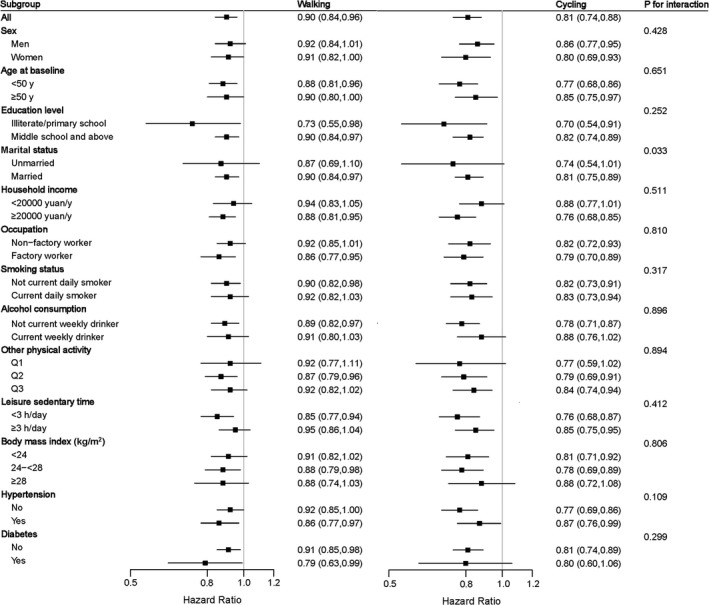
Background Active commuting is related to a higher level of physical activity but more exposure to ambient air pollutants. With the rather serious air pollution in urban China, we aimed to examine the association between active commuting and risk of incident cardiovascular disease in the Chinese population. Methods and Results A total of 104 170 urban commuters without major chronic diseases at baseline were included from China Kadoorie Biobank. Self-reported commuting mode was defined as nonactive commuting, work at home or near home, walking, and cycling. Multivariable Cox regression was used to examine associations between commuting mode and cardiovascular disease. Overall, 47.2% of the participants reported nonactive commuting, 13.4% reported work at home or work near home, 20.1% reported walking, and 19.4% reported cycling. During a median follow-up of 10 years, we identified 5374 incidents of ischemic heart disease, 664 events of hemorrhagic stroke, and 4834 events of ischemic stroke. After adjusting for sex, socioeconomic status, lifestyle factors, sedentary time, body mass index, comorbidities, household air pollution, passive smoking, and other domain physical activity, walking (hazard ratio, 0.90; 95% CI, 0.84-0.96) and cycling (hazard ratio, 0.81; 95% CI, 0.74-0.88) were associated with a lower risk of ischemic heart disease than nonactive commuting. Cycling was associated with a lower risk of ischemic stroke (hazard ratio, 0.92; 95% CI, 0.84-1.00). No significant association was found of walking or cycling with hemorrhagic stroke. The associations of commuting mode with major cardiovascular disease were consistent among men and women and across different levels of other domain physical activity. Conclusions In urban China, cycling was associated with a lower risk of ischemic heart disease and ischemic stroke. Walking was associated with a lower risk of ischemic heart disease.
Keywords: cardiovascular disease; commuting; cycling; physical activity; walking.
Figures
References
-
- Cepeda M, Schoufour J, Freak‐Poli R, Koolhaas CM, Dhana K, Bramer WM, Franco OH. Levels of ambient air pollution according to mode of transport: a systematic review. Lancet Public Health. 2017;2:e23–e34. - PubMed
-
- Hamer M, Chida Y. Active commuting and cardiovascular risk: a meta‐analytic review. Prev Med. 2008;46:9–13. - PubMed
-
- Autenrieth CS, Baumert J, Baumeister SE, Fischer B, Peters A, Doring A, Thorand B. Association between domains of physical activity and all‐cause, cardiovascular and cancer mortality. Eur J Epidemiol. 2011;26:91–99. - PubMed
-
- Wanner M, Tarnutzer S, Martin BW, Braun J, Rohrmann S, Bopp M, Faeh D, Cohort SN. Impact of different domains of physical activity on cause‐specific mortality: a longitudinal study. Prev Med. 2014;62:89–95. - PubMed
-
- Blond K, Jensen MK, Rasmussen MG, Overvad K, Tjonneland A, Ostergaard L, Grontved A. Prospective study of bicycling and risk of coronary heart disease in Danish men and women. Circulation. 2016;134:1409–1411. - PubMed
Publication types
MeSH terms
Grants and funding
- 212946/Z/18/Z/WT_/Wellcome Trust/United Kingdom
- R01 DK115679/DK/NIDDK NIH HHS/United States
- R01 DK091718/DK/NIDDK NIH HHS/United States
- MC_UU_12026/2/MRC_/Medical Research Council/United Kingdom
- R21 HL126024/HL/NHLBI NIH HHS/United States
- R01 HL034594/HL/NHLBI NIH HHS/United States
- R01 HL071981/HL/NHLBI NIH HHS/United States
- UM1 DK078616/DK/NIDDK NIH HHS/United States
- R01 DK078616/DK/NIDDK NIH HHS/United States
- MC_U137686851/MRC_/Medical Research Council/United Kingdom
- MC_UU_00017/1/MRC_/Medical Research Council/United Kingdom
- U01 DK078616/DK/NIDDK NIH HHS/United States
- R01 DK100383/DK/NIDDK NIH HHS/United States
LinkOut - more resources
Full Text Sources
Medical
