


Association of Total Daily Physical Activity and Fragmented Physical Activity With Mortality in Older Adults
- PMID: 31577355
- PMCID: PMC6777397
- DOI: 10.1001/jamanetworkopen.2019.12352
Association of Total Daily Physical Activity and Fragmented Physical Activity With Mortality in Older Adults
Abstract
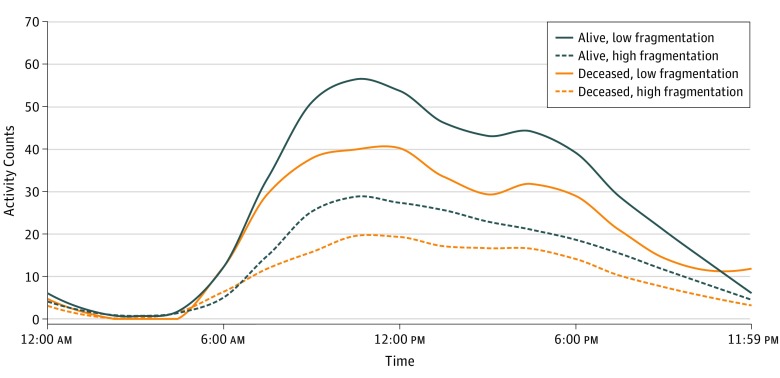
Importance: Fragmented daily physical activity may be a sign of physiological decline that provides more powerful insight into impending mortality than total daily activity.
Objective: To compare and contrast the association between total daily activity and activity fragmentation, which encompasses activity bouts and duration, and mortality risk.
Design, setting, and participants: In this cohort study, accelerometer data from 2007 through 2015 and mortality data from 2007 through 2017 were collected from 548 adults aged 65 years and older participating in the Baltimore Longitudinal Study of Aging. The dates of analysis were November 2016 to June 2019, with data collected through December 31, 2017. Using Cox proportional hazards regression, the association between accelerometer-derived patterns of physical activity and mortality was estimated after adjusting for demographic characteristics, lifestyle factors, and comorbidities.
Exposures: Minute-by-minute physical activity data were collected over a 24-hour, 7-day period (excluding times between 11:00 pm and 4:59 am) using an accelerometer. Each minute was labeled either active or sedentary, and 5 features of accelerometer data were extracted: total daily activity (defined as any activity performed throughout the day), activity fragmentation (defined as an active-to-sedentary transition probability), and 3 measures of activity bouts (<5, 5-10, and ≥10 active minutes).
Main outcomes and measures: All-cause mortality.
Results: Among 548 well-functioning older adults (mean [SD] age, 75.8 [7.2] years; 262 [47.8%] women), 61 participants (11.1%) died. Total daily physical activity was not associated with mortality risk (hazard ratio [HR], 0.90 [95% CI, 0.75-1.08]; P = .28). However, more fragmented physical activity patterns were associated with greater mortality risk (HR, 1.49 [95% CI, 1.02-2.19]; P = .04) after adjusting for age, sex, race/ethnicity, body mass index, smoking history, employment, self-reported health, grip strength, usual gait speed, comorbidities, and device wear time. In addition, more frequently engaging in activity bouts lasting less than 5 minutes was associated with greater mortality risk (HR, 1.28 [95% CI, 1.01-1.61]; P = .04), whereas activity bouts of 5 to 10 minutes (HR, 0.99 [95% CI, 0.58-1.69]; P = .97) and 10 minutes or longer (HR, 0.81 [95% CI, 0.65-1.01]; P = .06) were not associated with mortality risk.
Conclusions and relevance: In this cohort study of well-functioning adults aged 65 years and older, fragmented daily physical activity, particularly activity bouts lasting less than 5 minutes, was associated with greater mortality risk. These findings suggest that activity fragmentation in older adults may precede declines in functional capability and overall physical activity that typically indicate impending mortality.
Conflict of interest statement
Figures
References
-
- Lobelo F, Rohm Young D, Sallis R, et al. ; American Heart Association Physical Activity Committee of the Council on Lifestyle and Cardiometabolic Health; Council on Epidemiology and Prevention; Council on Clinical Cardiology; Council on Genomic and Precision Medicine; Council on Cardiovascular Surgery and Anesthesia; Stroke Council . Routine assessment and promotion of physical activity in healthcare settings: a scientific statement from the American Heart Association. Circulation. 2018;137(18):e495-e522. doi:10.1161/CIR.0000000000000559 - DOI - PubMed
