


Electrocatheter-mediated High-voltage Pulsed Radiofrequency of the Dorsal Root Ganglion in the Treatment of Chronic Lumbosacral Neuropathic Pain: A Randomized Controlled Study
- PMID: 31577546
- PMCID: PMC6903354
- DOI: 10.1097/AJP.0000000000000766
Electrocatheter-mediated High-voltage Pulsed Radiofrequency of the Dorsal Root Ganglion in the Treatment of Chronic Lumbosacral Neuropathic Pain: A Randomized Controlled Study
Abstract
Objectives: Despite the interest in scientific community, there is still poor evidence about pulsed radiofrequency (PRF) efficacy in the treatment of neuropathic pain. In order to determine whether high-voltage PRF and epidural adhesiolysis (PRF-EA) showed better results than epidural adhesiolysis alone (EA), a randomized, double-blind, comparative-effectiveness study was conducted in patients with chronic lumbosacral radiating pain and neuropathic features.
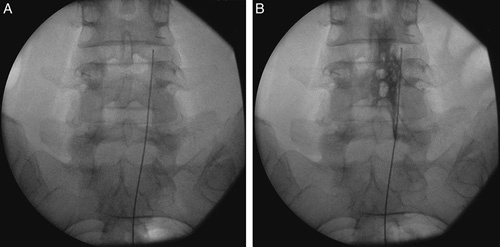
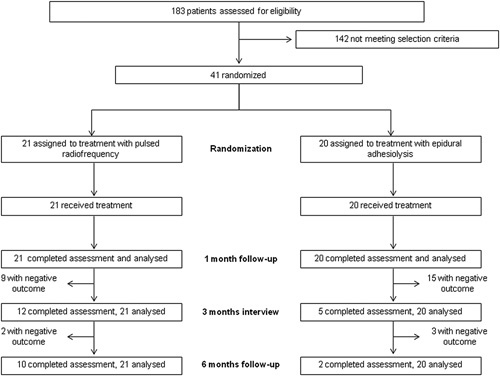
Materials and methods: A total of 41 patients were randomly allocated to 2 groups. Twenty-one patients were randomized to receive 2 cycles of 240 seconds high-voltage PRF followed by the injection of local anesthetics, hyaluronidase, and betamethasone, whereas 20 patients underwent sham stimulation followed by adhesiolysis. The treatment was delivered at the affected lumbosacral roots and patients, treating physicians and assessors were blinded to intervention.
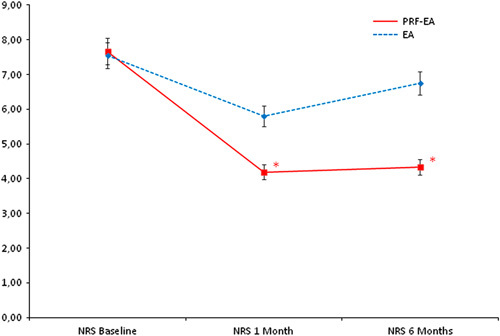
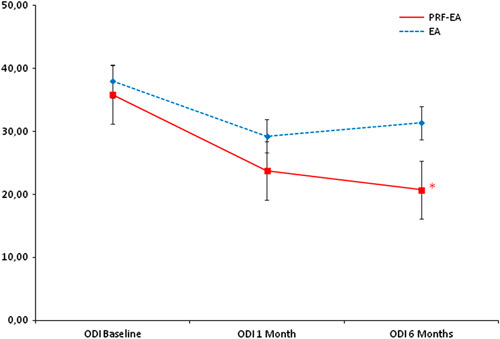
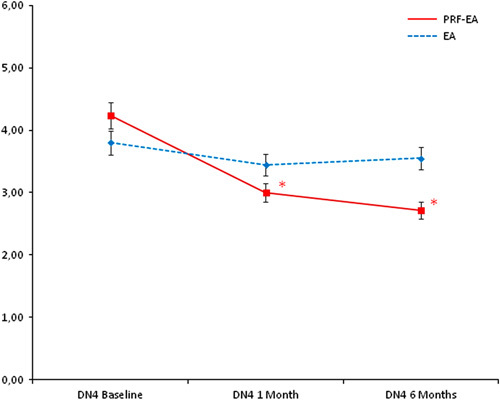
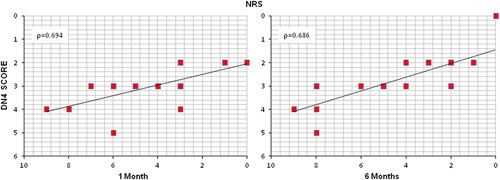
Results: A significant reduction of radiating pain was observed in mean Numeric Rating Scale score at follow-up. A change of -3.43 versus -1.75 (P=0.031) after 1 month and -3.34 versus -0.80 (P=0.005) after 6 months was reported in patients undergoing PRF-EA in comparison with EA, respectively. After 1 month, 57% of patients in the PRF-EA group experienced a pain reduction of ≥50% versus only 25% of patients allocated to EA (P=0.037). Improvement decreased to 48% in the PRF-EA group whereas only 10% of EA reported significant pain relief after 6 months (P=0.008).
Discussion: High-voltage PRF of dorsal root ganglion delivered through multifunctional electrode provided significant pain relief and may be considered a valuable treatment in chronic lumbosacral radicular pain with neuropathic features.
Conflict of interest statement
The authors declare no conflict of interest.
Figures
Comment in
-
Efficacy of High-Voltage Pulsed Radiofrequency in Chronic Lumbosacral Radicular Pain: A Response.Neuromodulation. 2024 Jan;27(1):218. doi: 10.1016/j.neurom.2023.01.002. Neuromodulation. 2024. PMID: 38184339 No abstract available.
References
-
- Uematsu S, Udrarhelyi GB, Benson DW, et al. Percutaneous radiofrequency rhizotomy. Surg Neurol. 1974;2:319–325. - PubMed
-
- Vigneri S, Sindaco G, Gallo G, et al. Effectiveness of pulsed radiofrequency with multifunctional epidural electrode in chronic lumbosacral radicular pain with neuropathic features. Pain Physician. 2014;17:477–486. - PubMed
-
- Martin DC, Willis ML, Mullinax LA, et al. Pulsed radiofrequency application in the treatment of chronic pain. Pain Pract. 2007;7:31–35. - PubMed
