Evaluating Whether Sight Is the Most Valued Sense
- PMID: 31580383
- PMCID: PMC6777262
- DOI: 10.1001/jamaophthalmol.2019.3537
Evaluating Whether Sight Is the Most Valued Sense
Abstract
Importance: Sight is often considered to be the sense most valued by the general public, but there are limited empirical data to support this. This study provides empirical evidence for frequent assertions made by practitioners, researchers, and funding agencies that sight is the most valued sense.
Objective: To determine which senses are rated most valuable by the general public and quantify attitudes toward sight and hearing loss in particular.
Design, setting, and participants: This cross-sectional web-based survey was conducted from March to April 2016 through a market research platform and captured a heterogeneous sample of 250 UK adults ages 22 to 80 years recruited in March 2016. The data were analyzed from October to December 2018.
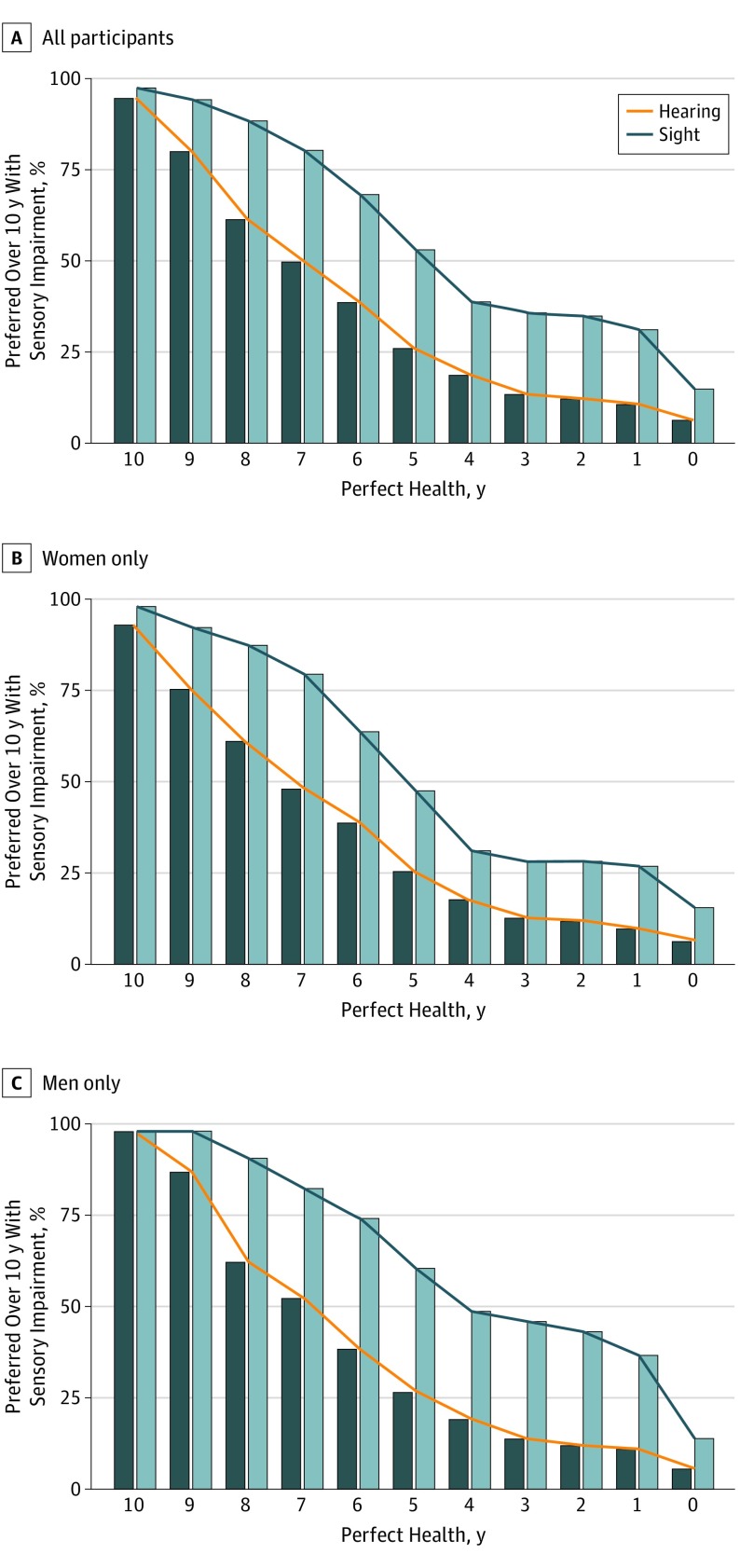
Main outcomes and measures: Participants were first asked to rank the 5 traditional senses (sight, hearing, touch, smell, and taste) plus 3 other senses (balance, temperature, and pain) in order of most valuable (8) to least valuable (1). Next, the fear of losing sight and hearing was investigated using a time tradeoff exercise. Participants chose between 10 years without sight/hearing vs varying amounts of perfect health (from 0-10 years).
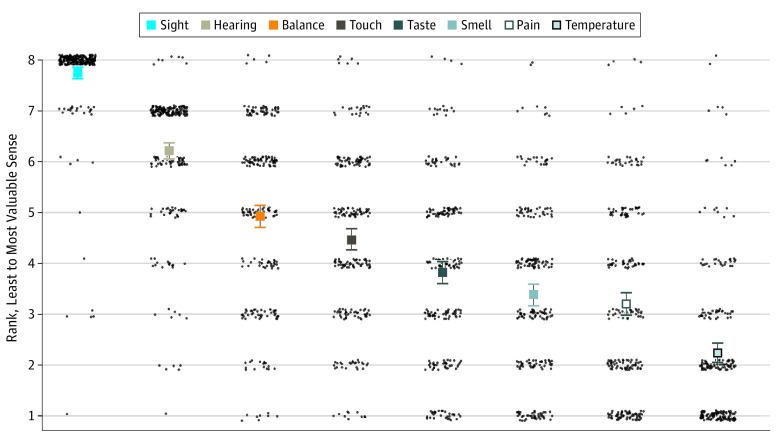
Results: Of 250 participants, 141 (56.4%) were women and the mean (SD) age was 49.5 (14.6) years. Two hundred twenty participants (88%) ranked sight as their most valuable sense (mean [SD] rating, 7.8 [0.9]; 95% CI, 7.6-7.9). Hearing was ranked second (mean [SD] rating, 6.2 [1.3]; 95% CI 6.1-6.4) and balance third (mean [SD] rating, 4.9 [1.7]; 95% CI, 4.7-5.1). All 3 were ranked above the traditional senses of touch, taste, and smell (F7 = 928.4; P < .001). The time tradeoff exercise indicated that, on average, participants preferred 4.6 years (95% CI, 4.2-5.0) of perfect health over 10 years without sight and 6.8 years (95% CI, 6.5-7.2) of perfect health over 10 years without hearing (mean difference between sight and hearing, 2.2 years; P < .001).
Conclusions and relevance: In a cross-sectional survey of UK adults from the general public, sight was the most valued sense, followed by hearing. These results suggest that people would on average choose 4.6 years of perfect health over 10 years of life with complete sight loss, although how this generalizes to other parts of the world is unknown.
Conflict of interest statement
Figures
References
-
- Brown GC, Brown MM, Sharma S. The five senses: a patient preference-based comparative analysis. Clin. Res. Ophthalmol. 2018;1(1):1-8. https://asclepiusopen.com/clinical-research-in-ophthalmology/volume-1-is.... Accessed January 8, 2019.
LinkOut - more resources
Full Text Sources
Miscellaneous