


Causes of hospital admission and mortality among 6683 people who use heroin: A cohort study comparing relative and absolute risks
- PMID: 31581023
- PMCID: PMC6891224
- DOI: 10.1016/j.drugalcdep.2019.06.027
Causes of hospital admission and mortality among 6683 people who use heroin: A cohort study comparing relative and absolute risks
Abstract
Background: Mortality in high-risk groups such as people who use illicit drugs is often expressed in relative terms such as standardised ratios. These measures are highest for diseases that are rare in the general population, such as hepatitis C, and may understate the importance of common long-term conditions.
Population: 6683 people in community-based treatment for heroin dependence between 2006 and 2017 in London, England, linked to national hospital and mortality databases with 55,683 years of follow-up.
Method: Age- and sex-specific mortality and hospital admission rates in the general population of London were used to calculate the number of expected events. We compared standardised ratios (relative risk) to excess deaths and admissions (absolute risk) across ICD-10 chapters and subcategories.
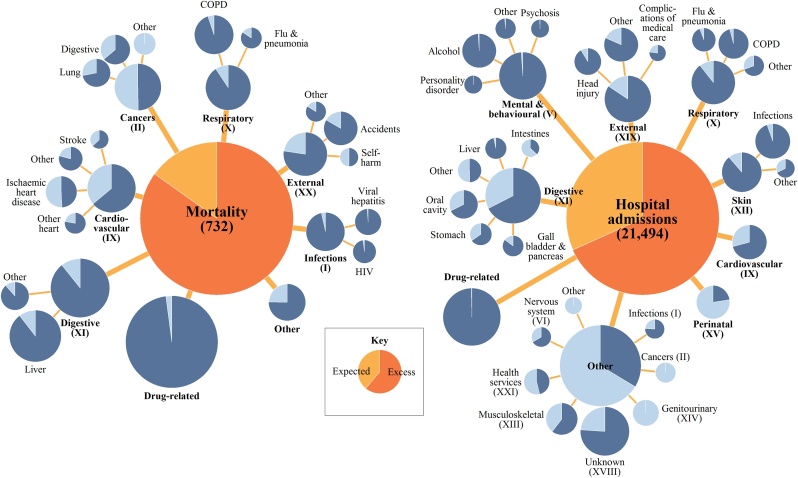
Results: Drug-related diseases had the highest relative risks, with a standardised mortality ratio (SMR) of 48 (95% CI 42-54) and standardised admission ratio (SAR) of 293 (95% CI 282-304). By contrast, other diseases had an SMR of 4.4 (95% CI 4.0-4.9) and an SAR of 3.15 (95% CI 3.11-3.19). However, the majority of the 621 excess deaths (95% CI 569-676) were not drug-related (361; 58%). The largest groups were liver disease (75 excess deaths) and COPD (45). Similarly, 80% (11,790) of the 14,668 excess admissions (95% CI 14,382-14,957) were not drug-related. The largest groups were skin infections (1073 excess admissions), alcohol (1060), COPD (812) and head injury (612).
Conclusions: Although relative risks of drug-related diseases are very high, most excess morbidity and mortality in this cohort was caused by common long-term conditions.
Keywords: Crack cocaine; Epidemiology; Heroin; Public health; Substance-related disorders.
Copyright © 2019 The Authors. Published by Elsevier B.V. All rights reserved.
Conflict of interest statement
None.
Figures
References
-
- Aldridge R.W., Story A., Hwang S.W., Nordentoft M., Luchenski S.A., Hartwell G., Tweed E.J., Lewer D., Vittal Katikireddi S., Hayward A.C. Morbidity and mortality in homeless individuals, prisoners, sex workers, and individuals with substance use disorders in high-income countries: a systematic review and meta-analysis. Lancet. 2018;391:241–250. - PMC - PubMed
-
- Amato L., Davoli M., Aperucci C., Ferri M., Faggiano F., Pmattick R. An overview of systematic reviews of the effectiveness of opiate maintenance therapies: available evidence to inform clinical practice and research. J. Subst. Abuse Treat. 2005;28:321–329. - PubMed
-
- Degenhardt L., Bucello C., Mathers B., Briegleb C., Ali H., Hickman M., McLaren J. Mortality among regular or dependent users of heroin and other opioids: a systematic review and meta-analysis of cohort studies: mortality among opioid users. Addiction. 2011;106:32–51. - PubMed
-
- Degenhardt L., Larney S., Randall D., Burns L., Hall W. Causes of death in a cohort treated for opioid dependence between 1985 and 2005: mortality among opioid-dependent people. Addiction. 2014;109:90–99. - PubMed
-
- European Monitoring Centre for, Drugs and Drug Addiction . 2015. Preventing Fatal Overdoses: a Systematic Review of the Effectiveness of Take-home Naloxone.
Publication types
MeSH terms
Grants and funding
LinkOut - more resources
Full Text Sources
Medical
Miscellaneous
