


Flavored Tobacco Product Use Among Middle and High School Students - United States, 2014-2018
- PMID: 31581163
- PMCID: PMC6776376
- DOI: 10.15585/mmwr.mm6839a2
Flavored Tobacco Product Use Among Middle and High School Students - United States, 2014-2018
Abstract
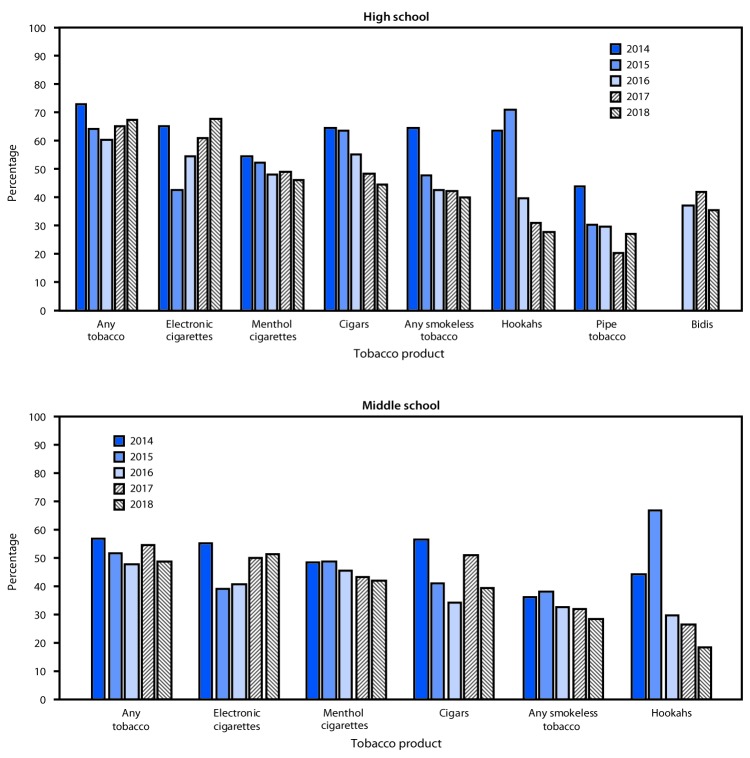
The 2009 Family Smoking Prevention and Tobacco Control Act prohibits the inclusion of characterizing flavors (e.g., candy or fruit) other than tobacco and menthol in cigarettes; however, characterizing flavors are not currently prohibited in other tobacco products at the federal level.* Flavored tobacco products can appeal to youths and young adults and influence initiation and establishment of tobacco-use patterns (1). The Food and Drug Administration (FDA) and CDC analyzed data from the 2014-2018 National Youth Tobacco Surveys (NYTS) to determine prevalence of current (past 30-day) use of flavored tobacco products, including electronic cigarettes (e-cigarettes), hookah tobacco, cigars, pipe tobacco, smokeless tobacco, bidis, and menthol cigarettes among U.S. middle school (grades 6-8) and high school (grades 9-12) students. In 2018, an estimated 3.15 million (64.1%) youth tobacco product users currently used one or more flavored tobacco products, compared with 3.26 million (70.0%) in 2014. Despite this overall decrease in use of flavored tobacco products, current use of flavored e-cigarettes increased among high school students during 2014-2018; among middle school students, current use of flavored e-cigarettes increased during 2015-2018, following a decrease during 2014-2015. During 2014-2018, current use of flavored hookah tobacco decreased among middle and high school students; current use of flavored smokeless tobacco, cigars, pipe tobacco, and menthol cigarettes decreased among high school students. Full implementation of comprehensive tobacco prevention and control strategies, coupled with regulation of tobacco products by FDA, can help prevent and reduce use of tobacco products, including flavored tobacco products, among U.S. youths (2,3).
Conflict of interest statement
All authors have completed and submitted the International Committee of Medical Journal Editors form for disclosure of potential conflicts of interest. No potential conflicts of interest were disclosed.
Figures
References
-
- US Department of Health and Human Services. Preventing tobacco use among youth and young adults: a report of the Surgeon General. Atlanta, GA: US Department of Health and Human Services, CDC; 2012. https://www.ncbi.nlm.nih.gov/books/NBK45031/
-
- CDC. Best practices for comprehensive tobacco control programs–2014. Atlanta, GA: US Department of Health and Human Services, CDC; 2014. https://www.cdc.gov/tobacco/stateandcommunity/best_practices/index.htm
-
- US Department of Health and Human Services. E-cigarette use among youth and young adults. a report of the Surgeon General. Atlanta, GA: US Department of Health and Human Services, CDC; 2016. https://e-cigarettes.surgeongeneral.gov/documents/2016_sgr_full_report_n...
-
- National Academies of Sciences, Engineering, and Medicine. Public health consequences of e-cigarettes. Washington, DC: The National Academies Press; 2018. https://www.nap.edu/catalog/24952/public-health-consequences-of-e-cigare... - PubMed
MeSH terms
Substances
LinkOut - more resources
Full Text Sources
Other Literature Sources
Miscellaneous
