


Iron Deficiency in Acute Decompensated Heart Failure
- PMID: 31581494
- PMCID: PMC6832529
- DOI: 10.3390/jcm8101569
Iron Deficiency in Acute Decompensated Heart Failure
Abstract
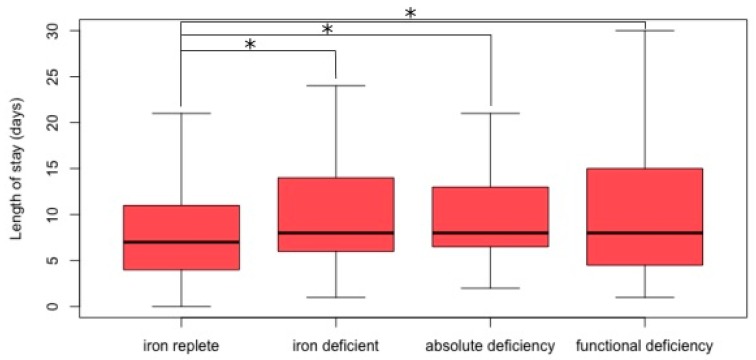
The aim of this study was to characterize iron deficiency (ID) in acutely decompensated heart failure (ADHF) and identify whether ID is associated with dyspnea class, length of stay (LOS), biomarker levels, and echocardiographic indices of diastolic function in patients with reduced ejection fraction (HFrEF) and with preserved ejection fraction (HFpEF). Consecutive patients admitted with ADHF at a single tertiary center were included. Demographic information, pathology investigations, and metrics regarding hospital stay and readmission were recorded. Patients were classified as having 'absolute' ID if they had a ferritin level <100 ng/mL; or 'functional' ID if they had a ferritin 100-200 ng/mL and a transferrin saturation <20%. Of 503 patients that were recruited, 270 (55%) had HFpEF, 160 (33%) had HFREF, and 57 (12%) had heart failure with mid-range ejection fraction. ID was present in 54% of patients with HFrEF and 56% of patients with HFpEF. In the HFpEF group, ID was associated with a LOS of 11 ± 7.7 vs. 9 ± 6 days in iron replete patients, p = 0.036, and remained an independent predictor of increased LOS in a multivariate linear regression incorporating comorbidities, age, and ID status. This study corroborates a high prevalence of ID in both HFrEF and HFpEF, and further shows that in patients with HFpEF there is a prolongation of LOS not seen in HFrEF which may indicate a more prominent role for ID in HFpEF.
Keywords: heart failure; heart failure with preserved ejection fraction; iron deficiency; length of stay.
Conflict of interest statement
The authors declare no conflict of interest.
Figures
References
LinkOut - more resources
Full Text Sources
