. 2019 Oct 1;8(10):392.
doi: 10.3390/plants8100392.

De Novo Assembly Discovered Novel Structures in Genome of Plastids and Revealed Divergent Inverted Repeats in Mammillaria (Cactaceae, Caryophyllales)

Affiliations

De Novo Assembly Discovered Novel Structures in Genome of Plastids and Revealed Divergent Inverted Repeats in Mammillaria (Cactaceae, Caryophyllales)

Sofía Solórzano et al. Plants (Basel). .

Abstract

The complete sequence of chloroplast genome (cpDNA) has been documented for single large columnar species of Cactaceae, lacking inverted repeats (IRs). We sequenced cpDNA for seven species of the short-globose cacti of Mammillaria and de novo assembly revealed three novel structures in land plants. These structures have a large single copy (LSC) that is 2.5 to 10 times larger than the small single copy (SSC), and two IRs that contain strong differences in length and gene composition. Structure 1 is distinguished by short IRs of <1 kb composed by rpl23-trnI-CAU-ycf2; with a total length of 110,189 bp and 113 genes. In structure 2, each IR is approximately 7.2 kb and is composed of 11 genes and one Intergenic Spacer-(psbK-trnQ)-trnQ-UUG-rps16-trnK-UUU-matK-trnK-UUU-psbA-trnH-GUG-rpl2-rpl23-trnI-CAU-ycf2; with a total size of 116,175 bp and 120 genes. Structure 3 has divergent IRs of approximately 14.1 kb, where IRA is composed of 20 genes: psbA-trnH-GUG-rpl23-trnI-CAU-ycf2-ndhB-rps7-rps12-trnV-GAC-rrn16-ycf68-trnI-GAU-trnA-AGC-rrn23-rrn4.5-rrn5-trnR-ACG-trnN-GUU-ndhF-rpl32; and IRB is identical to the IRA, but lacks rpl23. This structure has 131 genes and, by pseudogenization, it is shown to have the shortest cpDNA, of just 107,343 bp. Our findings show that Mammillaria bears an unusual structural diversity of cpDNA, which supports the elucidation of the evolutionary processes involved in cacti lineages.

Keywords: divergent inverted repeats; novel gene rearrangements; pseudogenization; short-globose cacti.


Conflict of interest statement

The authors declare that the research was conducted in the absence of any commercial or financial relationships that could be construed as a potential conflict of interest.

Figures
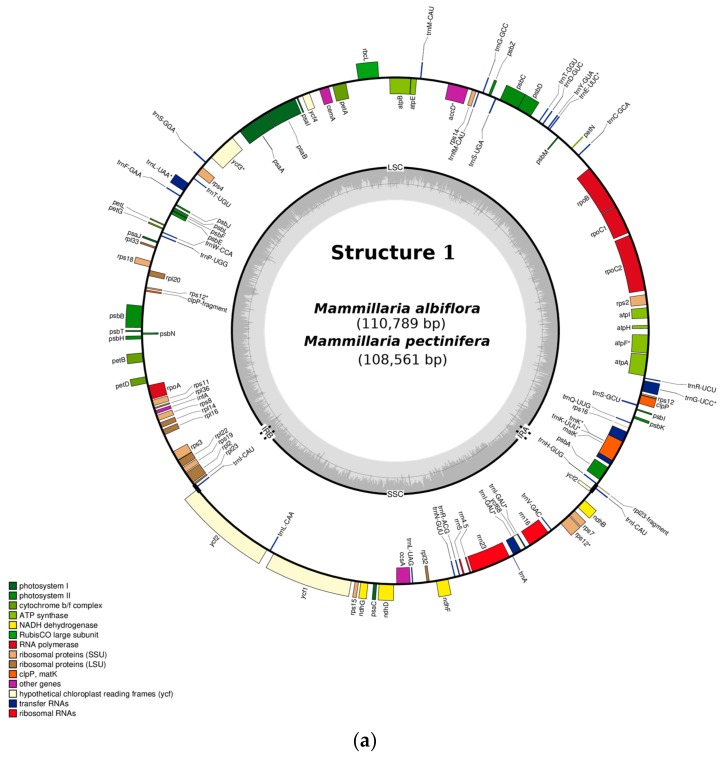
Figure 1
Figure 1
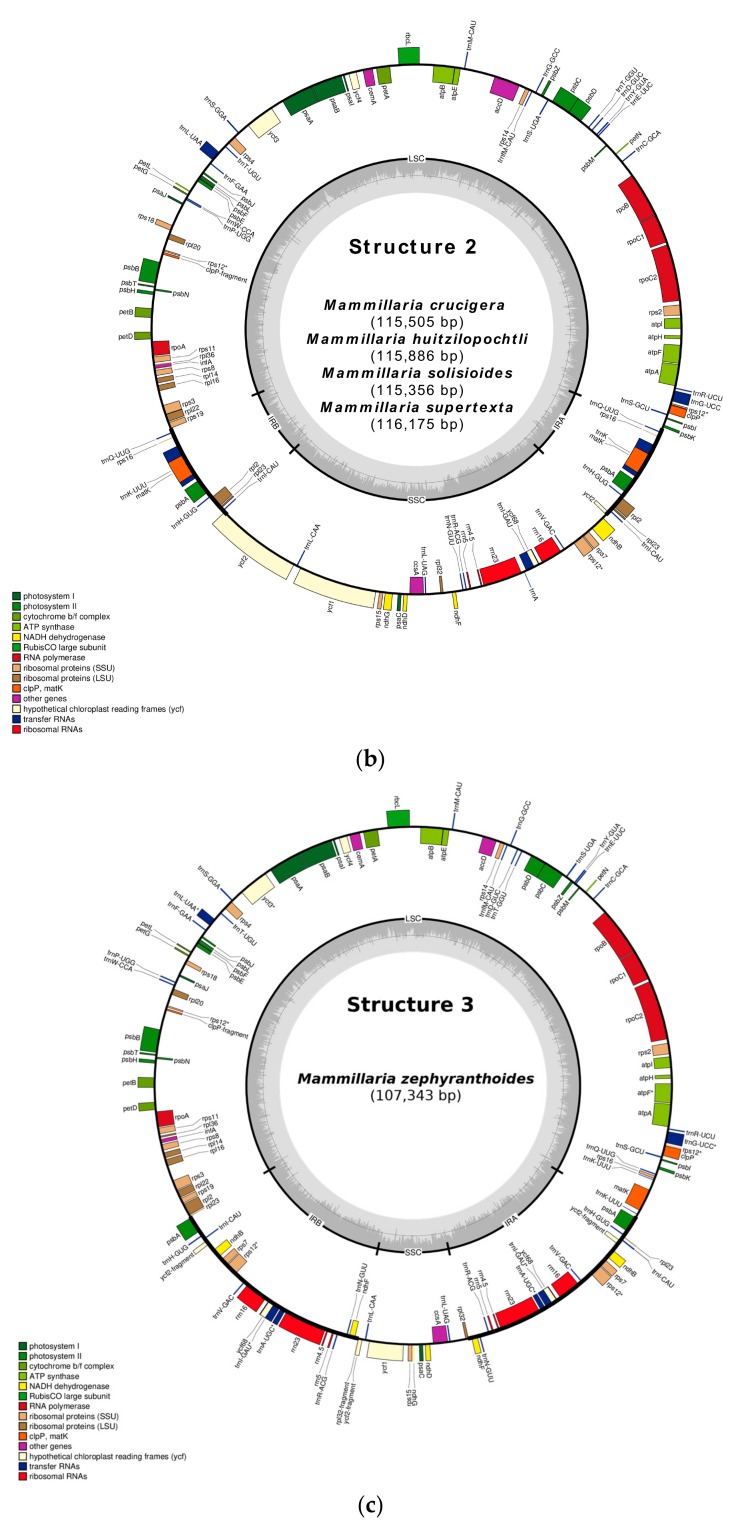
Three different structures found in the complete chloroplast genome of Mammillaria: (a) structure 1, (b) structure 2, and (c) structure 3. In structure 1, the rpl2 gene is flanking IRB in M. albiflora and IRA in M. pectinifera. Gene rpl33 was lost in M. supertexta of structure 2 and in M. zephyranthoides of structure 3. The genomes are displayed circularly, and IRA and IRB correspond to duplicated blocks of regions; starting from the top of the circle, the IRA is the one that appears first in clockwise.
Figure 1
Figure 1
Three different structures found in the complete chloroplast genome of Mammillaria: (a) structure 1, (b) structure 2, and (c) structure 3. In structure 1, the rpl2 gene is flanking IRB in M. albiflora and IRA in M. pectinifera. Gene rpl33 was lost in M. supertexta of structure 2 and in M. zephyranthoides of structure 3. The genomes are displayed circularly, and IRA and IRB correspond to duplicated blocks of regions; starting from the top of the circle, the IRA is the one that appears first in clockwise.
Figure 2
Figure 2
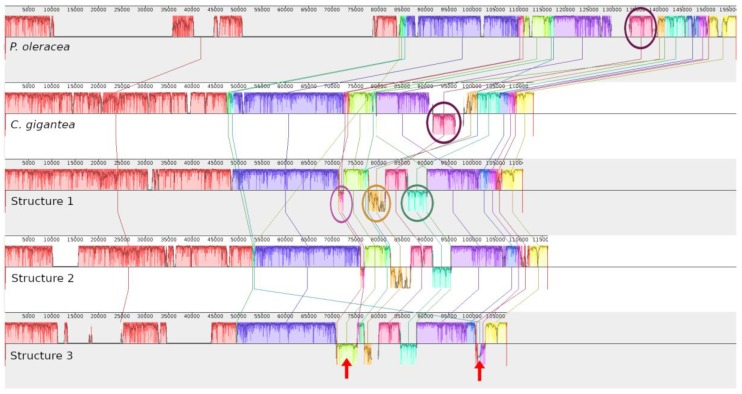
MAUVE graphic of five structural alignments of complete chloroplast genomes. The upper graph corresponds to caryophyllid P. oleracea (Portulacaceae); below that, the large giant columnar cactus, C. gigantea; and the last three graphs are the three structures documented in Mammillaria. Relative inverted DNA sequences are drawn above/below of the horizontal line; identical genes are in the same color. P. oleracea has a larger genome than any species of Cactaceae. Discarding the IRs that are recorded in Mammillaria and P. oleracea, but not in C. gigantea, the cpDNA structure of P. oleracea is more similar in structure to C. gigantea than to Mammillaria. Between C. gigantea and P. oleracea, a single large block of inverted genes (encircled) corresponding to atpB and atpE is shown. This block of genes in Mammillaria has identical orientation to P. oleracea. In Mammillaria, many other novel gene rearrangements, which are absent in the other two-caryophyllid taxa, were documented. Additionally, structure 3 has two blocks of inverted genes (described in detail in Figure 3b), with respect to structures 1 and 2. These two blocks of genes are indicated with arrows and have identical orientation in C. gigantea, P. oleracea, and structures 1 and 2 of Mammillaria.
Figure 3
Figure 3
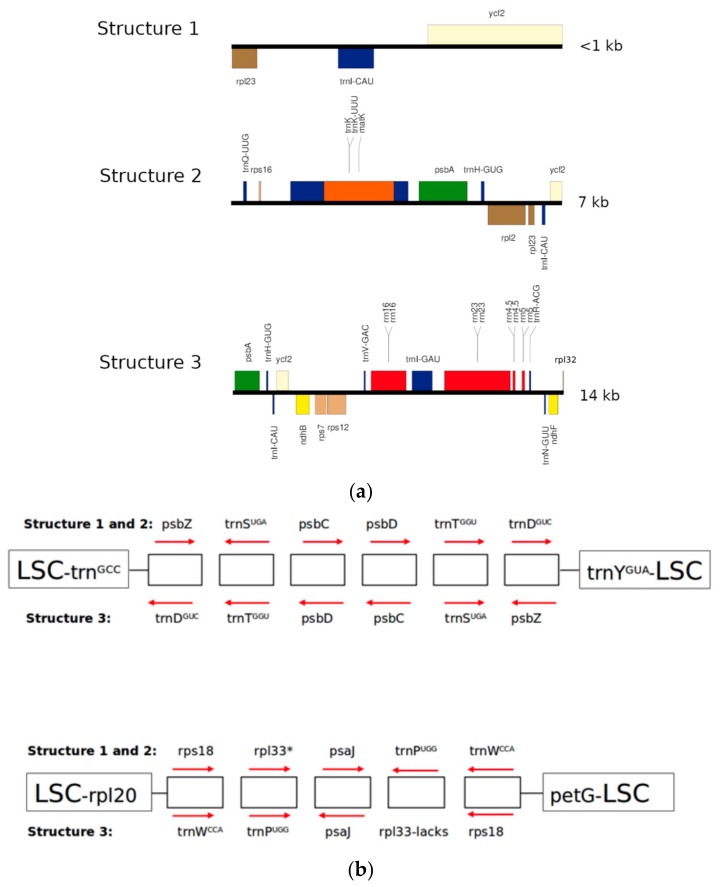
(a) Comparison of length and gene composition of IRs in the three structures documented for the complete chloroplast genomes of Mammillaria. The two IRs of structure 3 diverge in rpl23; its location in IRA is denoted with an asterisk. (b) Blocks of genes rearranged at the LSC. These genes are inverted and reoriented in structures 1 and 2, with respect to structure 3. The direction of the row indicates the orientation of transcription, to the left in sense of clockwise and to the right, counter-clockwise. The large squares indicate the genes of LSC that flank these two rearrangements. The asterisk in rpl33 (bottom figure) indicates that, in M. supertexta of structure 2 and in species of structure 3, this gene was lost.
Figure 4
Figure 4
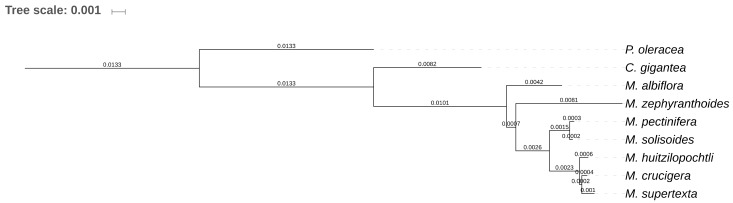
Phylogenetic ML tree obtained for the seven species of Mammillaria. The analysis is based on 42 coding regions shared to the two species used as outgroups (C. gigantea and P. oleraceae).

References

    1. Daniell H., Lin C.S., Yu M., Chang W.J. Chloroplast genomes: Diversity, evolution, and applications in genetic engineering. Genome Biol. 2016;17:134. doi: 10.1186/s13059-016-1004-2. - DOI - PMC - PubMed
    1. Morden C., Delwiche C., Kuhsel M., Palmer D. Gene phylogenies and the endosymbiotic origin of plastids. Biosystems. 1992;28:75–90. doi: 10.1016/0303-2647(92)90010-V. - DOI - PubMed
    1. Cavalier-Smith T. The origins of plastids. Biol. J. Linn. Soc. 1982;17:289–306. doi: 10.1111/j.1095-8312.1982.tb02023.x. - DOI
    1. Lemieux C., Otis C., Turnel M. Ancestral chloroplast genome in Mesostigma viride reveals an early branch of green plant evolution. Nature. 2000;403:649–652. doi: 10.1038/35001059. - DOI - PubMed
    1. Xiao-Ming Z., Junrui W., Li F., Sha L., Hongbo P., Lan Q., Jing L., Yan S., Weihua Q., Lifang Z., et al. Inferring the evolutionary mechanism of the chloroplast genome size by comparing whole-chloroplast genome sequences in seed plants. Sci. Rep. 2017;7:1555. doi: 10.1038/s41598-017-01518-5. - DOI - PMC - PubMed

LinkOut - more resources