. 2020 Jun;105(6):1667-1676.
doi: 10.3324/haematol.2019.225516. Epub 2019 Oct 3.

Coactosin-like 1 integrates signaling critical for shear-dependent thrombus formation in mouse platelets

Affiliations

Coactosin-like 1 integrates signaling critical for shear-dependent thrombus formation in mouse platelets

Inga Scheller et al. Haematologica. 2020 Jun.

Abstract

Platelet aggregate formation is a multistep process involving receptor-mediated, as well as biomechanical, signaling cascades, which are highly dependent on actin dynamics. We have previously shown that actin depolymerizing factor (ADF)/n-cofilin and Twinfilin 2a, members of the ADF homology (ADF-H) protein family, have distinct roles in platelet formation and function. Coactosin-like 1 (Cotl1) is another ADF-H protein that binds actin and was also shown to enhance biosynthesis of pro-inflammatory leukotrienes (LT) in granulocytes. Here, we generated mice lacking Cotl1 in the megakaryocyte lineage (Cotl1-/- ) to investigate its role in platelet production and function. Absence of Cotl1 had no impact on platelet counts, platelet activation or cytoskeletal reorganization under static conditions in vitro In contrast, Cotl1 deficiency markedly affected platelet aggregate formation on collagen and adhesion to immobilized von Willebrand factor at high shear rates in vitro, pointing to an impaired function of the platelet mechanoreceptor glycoprotein (GP) Ib. Furthermore, Cotl1 -/-platelets exhibited increased deformability at high shear rates, indicating that the GPIb defect may be linked to altered biomechanical properties of the deficient cells. In addition, we found that Cotl1 deficiency markedly affected platelet LT biosynthesis. Strikingly, exogenous LT addition restored defective aggregate formation of Cotl1-/- platelets at high shear in vitro, indicating a critical role of platelet-derived LT in thrombus formation. In vivo, Cotl1 deficiency translated into prolonged tail bleeding times and protection from occlusive arterial thrombus formation. Together, our results show that Cotl1 in platelets is an integrator of biomechanical and LT signaling in hemostasis and thrombosis.


Figures

Figure 1.
Figure 1.
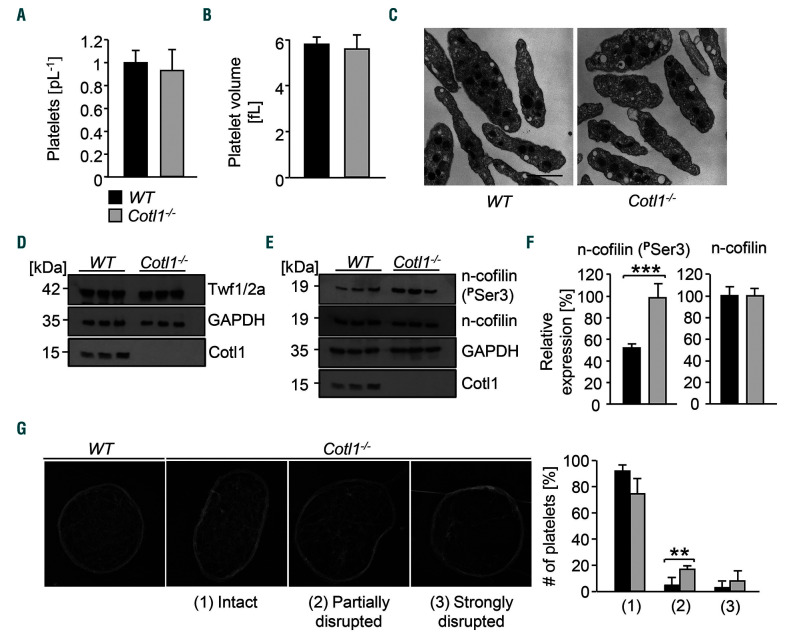
Cotl1 is not essential for platelet formation and function under static conditions in vitro. (A and B) Platelet count (A) and size (B) were determined with an automated cell analyzer (ScilVet). (C) Visualization of platelet size and structure using transmission electron microscopy (n=4). Scale bar, 2 μm. (D–F) Platelets were left untreated, lysed, and processed for immunoblotting. Total twinfilin (D), phosphorylated n-cofilin and total n-cofilin (E) were probed with the respective antibodies and analyzed by densitometry (F). GAPDH served as loading control. Values are mean±standard deviation (SD) (n=3). (G) Images of the platelet cytoskeleton ultrastructure on poly-L-lysine. (Left) WT sample. (Right) Cotl1−/− sample. 0: intact, 1: partially disrupted, 2: strongly disrupted F-actin structures. Scale bar, 1 μm. At least 158 platelets per genotype were analyzed.
Figure 2.
Figure 2.
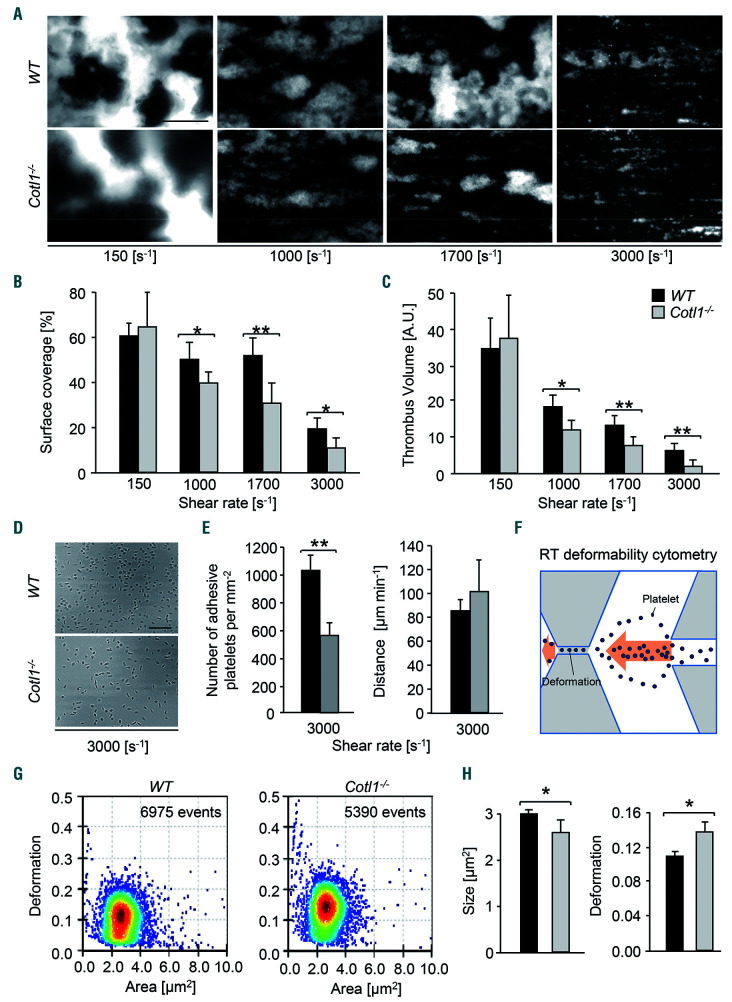
Cotl1 is required for thrombus formation and stability at high shear. (A–C) Assessment of platelet adhesion (A and B) and aggregate formation (A and C) on Horm collagen (70 μg mL−1) under flow (150-3 000 s−1) in heparinized whole blood of WT and Cotl1−/− mice. Values are mean±standard deviation (SD) (n=12). Scale bar, 50 μm. (D and E) Heparinized whole blood of WT and Cotl1−/− mice was perfused over a von Willebrand factor (vWF)-coated cover slip for 4 minutes (min) at a shear rate of 3,000 s−1. (D) Representative phase contrast images taken at the end of the perfusion time and (E) analysis of the number of adherent platelets per mm2 ±SD (left), as well as the rolling velocity calculated from the distance a platelet covered per minute in μm ±SD (right) was performed. Images were acquired with a Zeiss Axiovert 200 inverted microscope (40x/0.6 oil objective). Images are representative of at least 12 animals per group. Scale bar, 50 μm. Unpaired Student t-test: **P<0.01; *P<0.05. (F–H) Real-time deformability cytometry (RT-DC), a method for continuous mechanical characterization of cells which are deformed by deceleration at the stagnation point of fast extensional flow. (F) Scheme depicting the principle of real-time deformability cytometry (RT-DC.) (G) Representative dot plots showing the relative deformation, as well as the (H) the size of washed WT and Cotl1−/− platelets. Values are mean±SD (n=3). *P<0.1; **P<0.01. A.U. : arbitrary units.
Figure 3.
Figure 3.
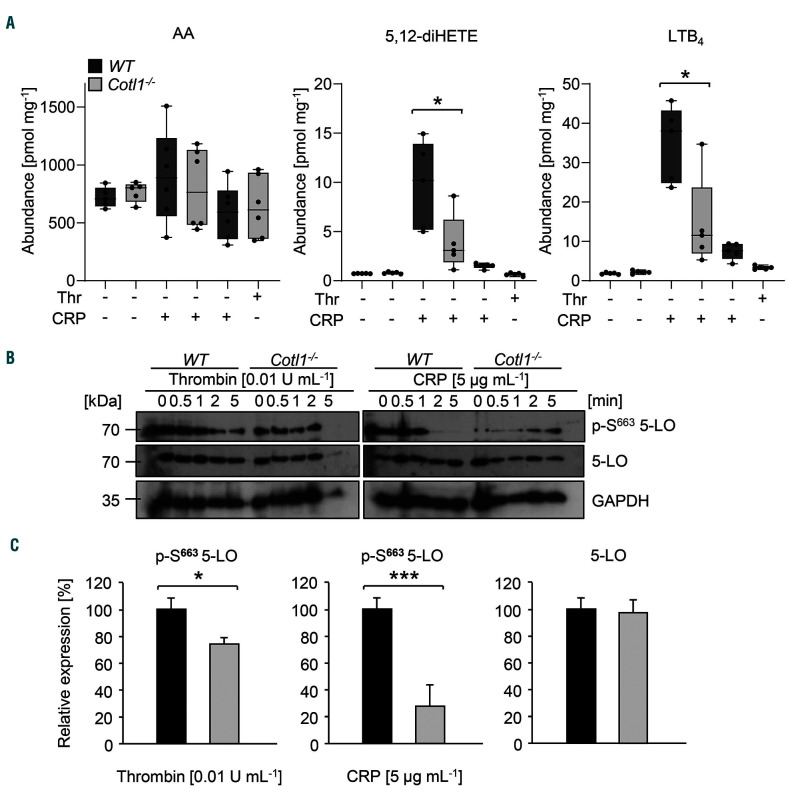
Cotl1 is a regulator of leukotriene biosynthesis in platelets. (A) For lipid mediator analysis platelets were either left untreated or stimulated with CRP [5 μg mL−1] or thrombin [0.01 U mL−1] for 5 minutes (min). Subsequently, samples were spun down, pellet and supernatant were separately shock-frozen in liquid nitrogen. Lipid abundance was assessed using liquid crystal mass spectrometry. Values are mean±standard deviation (SD) (n=15). (B and C) Platelets were either left untreated or stimulated with CRP [5 μg mL−1] or thrombin [0.01 U mL−1] for 5 min, lysed, and processed for immunoblotting. Total 5-LO, phospho-5-LO (S663) and GAPDH (B) were probed with the respective antibodies and analyzed by densitometry (C). Values are mean±SD (n=4).
Figure 4.
Figure 4.
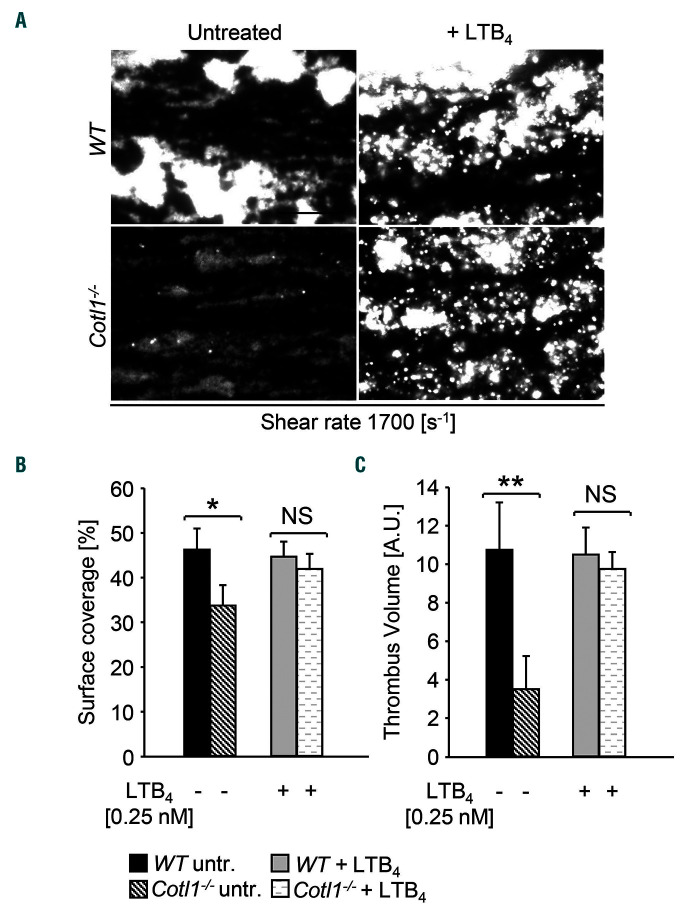
Defective shear-dependent thrombus formation in Cotl1-deficient mice can be rescued by exogenous addition of leukotriene B4. (A–C) Assessment of platelet adhesion (A and B) and aggregate formation in heparinized blood (A and C) on Horm collagen (70 μg mL−1) under flow (1700 s−1). WT and Cotl1−/− samples were either left untreated or were pre-incubated for 5 minutes (min) with LTB4 [0.25 nM]. Images are representatives of at least 12 mice per group. Values are mean±standard deviation. Scale bar, 50 μm. *P<0.1; **P<0.01.
Figure 5.
Figure 5.
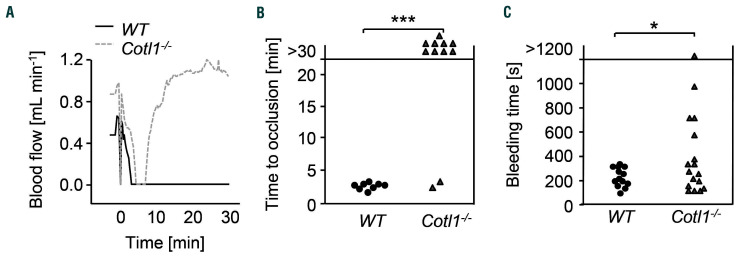
Cotl1 modulates thrombosis and hemostasis. (A and B) Intravital thrombosis model. (A) Representative graph of blood flow of one WT and one Cotl1−/−mouse after mechanical injury of the abdominal aorta. (B) Occlusion times after mechanical injury of the abdominal aorta. Data are mean±standard deviation of at least eight mice per group. (C) Tail bleeding times in WT and Cotl1−/− mice (filter paper method). Each symbol represents one individual. Unpaired Student t-test: ***P<0.001; *P<0.05.

References

    1. Ruggeri ZM. Platelets in atherothrombosis. Nat Med. 2002;8(11):1227–1234. - PubMed
    1. Jackson SP, Nesbitt WS, Kulkarni S. Signaling events underlying thrombus formation. J Thromb Haemost. 2003;1(7):1602–1612. - PubMed
    1. Zhang W, Deng W, Zhou L, et al. Identification of a juxtamembrane mechanosensitive domain in the platelet mechanosensor glycoprotein Ib-IX complex. Blood. 2015;125(3):562–569. - PMC - PubMed
    1. Stritt S, Nurden P, Turro E, et al. A gain-of-function variant in <em>DIAPH1</em> causes dominant macrothrombocytopenia and hearing loss. Blood. 2016;127(23):2903–2914. - PubMed
    1. Nurden P, Debili N, Coupry I, et al. Thrombocytopenia resulting from mutations in filamin A can be expressed as an isolated syndrome. Blood. 2011;118(22):5928–5937. - PubMed

Publication types

Substances