


Social media, body image and food choices in healthy young adults: A mixed methods systematic review
- PMID: 31583837
- PMCID: PMC7384161
- DOI: 10.1111/1747-0080.12581
Social media, body image and food choices in healthy young adults: A mixed methods systematic review
Abstract
Aim: Negative body image increases the risk of engaging in unhealthy dieting and disordered eating patterns. This review evaluated the impact of habitual social media engagement or exposure to image-related content on body image and food choices in healthy young adults (18-30 years).
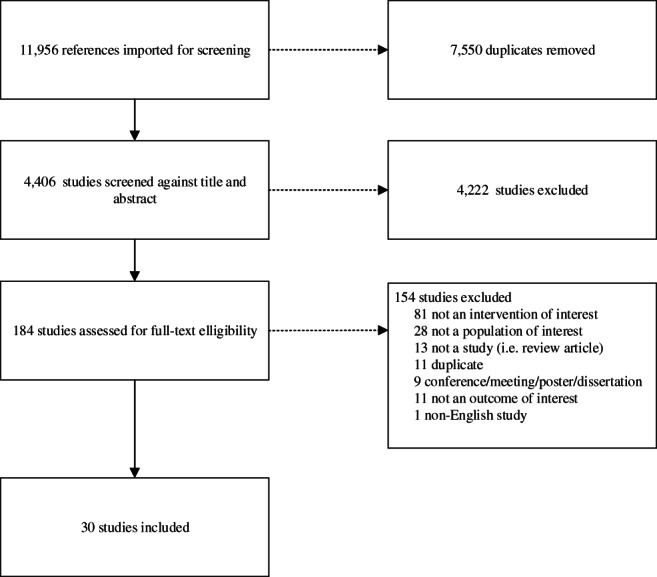
Methods: A systematic search of six databases of observational literature published 2005-2019, was conducted (PROSPERO Registration No. CRD42016036588). Inclusion criteria were: studies reporting social media engagement (posting, liking, commenting) or exposure to image-related content in healthy young adults. Outcomes were: body image (satisfaction or dissatisfaction) and food choices (healthy eating, dieting/restricting, overeating/binging). Two authors independently screened, coded and evaluated studies for methodological quality.
Results: Thirty studies were identified (n = 11 125 participants). Quantitative analysis (n = 26) identified social media engagement or exposure to image-related content was associated with higher body dissatisfaction, dieting/restricting food, overeating, and choosing healthy foods. Qualitative analysis (n = 4) identified five themes: (i) social media encourages comparison between users, (ii) comparisons heighten feelings about the body, (iii) young adults modify their appearance to portray a perceived ideal image, (iv) young adults are aware of social media's impact on body image and food choices, however, (v) external validation via social media is pursued. Most studies (n = 17) controlled for some confounding variables (age, gender, BMI, ethnicity).
Conclusions: Social media engagement or exposure to image-related content may negatively impact body image and food choice in some healthy young adults. Health professionals designing social media campaigns for young adults should consider image-related content, to not heighten body dissatisfaction.
Keywords: body image; disordered eating; self-objectification; social comparison; social media; social networking sites.
© 2019 Dietitians Association of Australia.
Conflict of interest statement
Authors have no conflicts of interest to declare for this review.
References
-
- Arnett J. Emerging adulthood: what is it, and what is it good for? Child Dev Perspect. 2007;1:68‐73.
-
- Wood D, Crapnell T, Lau L, et al. Emerging adulthood as a critical stage in the life course In: Halfon N, Forrest C, Lerner R, Faustman E, eds. Handbook of Life Course Health Development. Cham, Switzerland: Springer, 2018:123‐143. - PubMed
-
- Australian Bureau of Statistics . Consumption of sweetened beverages. Updated 2015. http://www.abs.gov.au/ausstats/abs@.nsf/lookup/4364.0.55.007main+feature.... Accessed January 7, 2019.
-
- National Health Service Digital . Fruit and vegetables. Updated 2017. http://healthsurvey.hscic.gov.uk/data-visualisation/data-visualisation/e.... Accessed July 10, 2019.
Publication types
MeSH terms
LinkOut - more resources
Full Text Sources
