


The Impact of an mHealth Voice Message Service (mMitra) on Infant Care Knowledge, and Practices Among Low-Income Women in India: Findings from a Pseudo-Randomized Controlled Trial
- PMID: 31584144
- PMCID: PMC6823296
- DOI: 10.1007/s10995-019-02805-5
The Impact of an mHealth Voice Message Service (mMitra) on Infant Care Knowledge, and Practices Among Low-Income Women in India: Findings from a Pseudo-Randomized Controlled Trial
Abstract
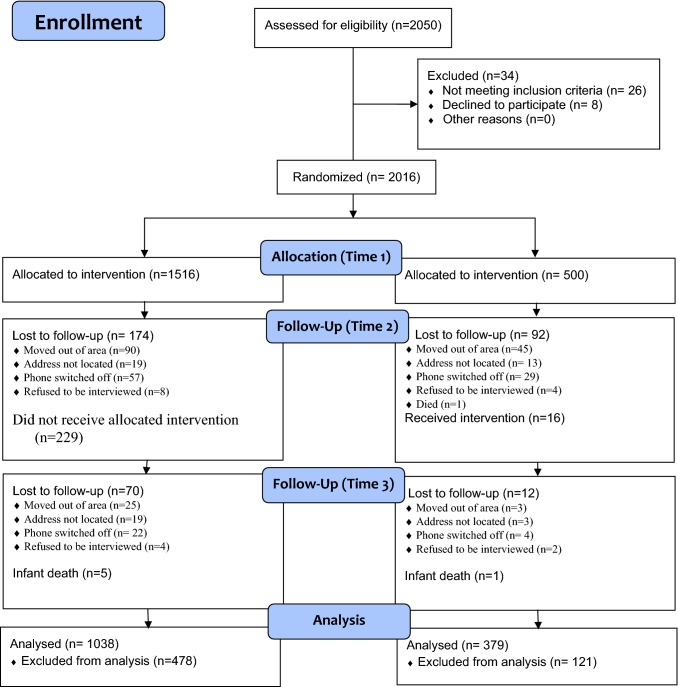
Objectives mHealth interventions for MNCH have been shown to improve uptake of antenatal and neonatal services in low- and middle-income countries (LMICs). However, little systematic analysis is available about their impact on infant health outcomes, such as reducing low birth weight or malnutrition among children under the age of five. The objective of this study is to determine if an age- and stage-based mobile phone voice messaging initiative for women, during pregnancy and up to 1 year after delivery, can reduce low birth weight and child malnutrition and improve women's infant care knowledge and practices. Methods We conducted a pseudo-randomized controlled trial among pregnant women from urban slums and low-income areas in Mumbai, India. Pregnant women, 18 years and older, speaking Hindi or Marathi were enrolled and assigned to receive mMitra messages (intervention group N = 1516) or not (Control group N = 500). Women in the intervention group received mMitra voice messages two times per week throughout their pregnancy and until their infant turned 1 year of age. Infant's birth weight, anthropometric data at 1 year of age, and status of immunization were obtained from Maternal Child Health (MCH) cards to assess impact on primary infant health outcomes. Women's infant health care practices and knowledge were assessed through interviews administered immediately after women enrolled in the study (Time 1), after they delivered their babies (Time 2), and after their babies turned 1 year old (Time 3). 15 infant care practices self-reported by women (Time 3) and knowledge on ten infant care topics (Time 2) were also compared between intervention and control arms. Results We observed a trend for increased odds of a baby being born at or above the ideal birth weight of 2.5 kg in the intervention group compared to controls (odds ratio (OR) 1.334, 95% confidence interval (CI) 0.983-1.839, p = 0.064). The intervention group performed significantly better on two infant care practice indicators: giving the infant supplementary feeding at 6 months of age (OR 1.4, 95% CI 1.08-1.82, p = 0.009) and fully immunizing the infant as prescribed under the Government of India's child immunization program (OR 1.531, 95% CI 1.141-2.055, p = 0.005). Women in the intervention group had increased odds of knowing that the baby should be given solid food by 6 months (OR 1.89, 95% CI 1.371-2.605, p < 0.01), that the baby needs to be given vaccines (OR 1.567, 95% CI 1.047-2.345, p = 0.028), and that the ideal birth weight is > 2.5 kg (OR 2.279, 95% CI 1.617-3.213, p < 0.01). Conclusions for Practice This study provides robust evidence that tailored mobile voice messages can significantly improve infant care practices and maternal knowledge that can positively impact infant child health. Furthermore, this is the first prospective study of a voice-based mHealth intervention to demonstrate a positive impact on infant birth weight, a health outcome of public health importance in many LMICs.
Keywords: Digital health; Immunization; India; Infant health; Mobile messaging; Nutrition; Voice messaging; mHealth.
Figures
References
-
- ARMMAN. (n.d.). mMitra. Retrieved January, 2015 from https://armman.org/mmitra/.
-
- BabyCenter. (n.d.). Expert info for pregnancy & parenting. Retrieved January, 2015 from https://www.babycenter.com/.
MeSH terms
LinkOut - more resources
Full Text Sources
Medical
