


Nomenclature of Genetically Determined Myoclonus Syndromes: Recommendations of the International Parkinson and Movement Disorder Society Task Force
- PMID: 31584223
- PMCID: PMC6899848
- DOI: 10.1002/mds.27828
Nomenclature of Genetically Determined Myoclonus Syndromes: Recommendations of the International Parkinson and Movement Disorder Society Task Force
Abstract
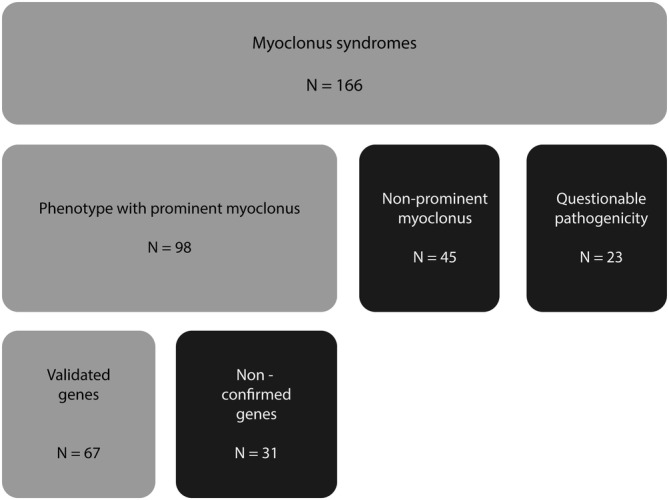
Genetically determined myoclonus disorders are a result of a large number of genes. They have wide clinical variation and no systematic nomenclature. With next-generation sequencing, genetic diagnostics require stringent criteria to associate genes and phenotype. To improve (future) classification and recognition of genetically determined movement disorders, the Movement Disorder Society Task Force for Nomenclature of Genetic Movement Disorders (2012) advocates and renews the naming system of locus symbols. Here, we propose a nomenclature for myoclonus syndromes and related disorders with myoclonic jerks (hyperekplexia and myoclonic epileptic encephalopathies) to guide clinicians in their diagnostic approach to patients with these disorders. Sixty-seven genes were included in the nomenclature. They were divided into 3 subgroups: prominent myoclonus syndromes, 35 genes; prominent myoclonus syndromes combined with another prominent movement disorder, 9 genes; disorders that present usually with other phenotypes but can manifest as a prominent myoclonus syndrome, 23 genes. An additional movement disorder is seen in nearly all myoclonus syndromes: ataxia (n = 41), ataxia and dystonia (n = 6), and dystonia (n = 5). However, no additional movement disorders were seen in related disorders. Cognitive decline and epilepsy are present in the vast majority. The anatomical origin of myoclonus is known in 64% of genetic disorders: cortical (n = 34), noncortical areas (n = 8), and both (n = 1). Cortical myoclonus is commonly seen in association with ataxia, and noncortical myoclonus is often seen with myoclonus-dystonia. This new nomenclature of myoclonus will guide diagnostic testing and phenotype classification. © 2019 The Authors. Movement Disorders published by Wiley Periodicals, Inc. on behalf of International Parkinson and Movement Disorder Society.
Keywords: genetics; hyperekplexia; myoclonic epilepsy; myoclonus; nomenclature.
© 2019 The Authors. Movement Disorders published by Wiley Periodicals, Inc. on behalf of International Parkinson and Movement Disorder Society.
Figures
References
-
- Marras C, Lang A, van de Warrenburg BP, et al. Nomenclature of genetic movement disorders: Recommendations of the international Parkinson and movement disorder society task force. Mov Disord 2016;31:436–457. - PubMed
-
- Rossi M, Anheim M, Durr A, et al. The genetic nomenclature of recessive cerebellar ataxias. Mov Disord 2018;33:1056–1076. - PubMed
-
- Caviness JN. Myoclonus. Mayo Clin Proc 1996;71:679–688. - PubMed
-
- Shibasaki H, Hallet M. The Neurological Examination: Scientific Basis for Clinical Diagnosis. New York: Oxford University Press; 2016.
-
- Van Egmond ME, Elting JWJ, Kuiper A, et al. Myoclonus in childhood‐onset neurogenetic disorders: The importance of early identification and treatment. Eur J Paediatr Neurol 2015;19:726–729. - PubMed
Publication types
MeSH terms
Supplementary concepts
LinkOut - more resources
Full Text Sources
Medical
