. 2020 Mar 16;21(6):793-796.
doi: 10.1002/cbic.201900514. Epub 2019 Nov 27.

A Fast and Easy Method for Specific Detection of Circular RNA by Rolling-Circle Amplification

Affiliations

A Fast and Easy Method for Specific Detection of Circular RNA by Rolling-Circle Amplification

Marcel Boss et al. Chembiochem. .

Abstract

Circular RNAs (circRNAs) represent a new class of usually noncoding transcripts with largely unknown functions. Their research is hampered not least by the inapplicability of traditional analytical methods. Herein we describe a rapid and easy assay for the detection of natural circRNA, based on rolling-circle amplification (RCA). This technique does not require the use of fluorescently labeled RNA or DNA and can specifically detect circular RNA in the presence of a 1000-fold excess of the same linear RNA. Only standard devices such as (quantitative) PCR cyclers and gel electrophoresis are used.

Keywords: RNA analysis; circRNA; polymerase chain reaction; quantitative PCR; rolling-circle amplification.


Conflict of interest statement

The authors declare no conflict of interest.

Figures

Figure 1
Figure 1
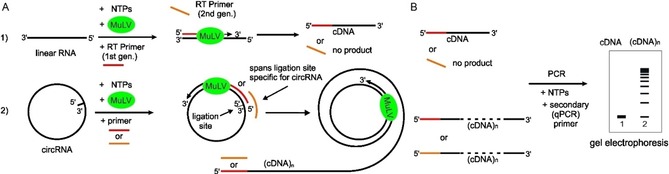
Schematic illustration of the rolling‐circle amplification assay with circular RNA in comparison with linear RNA. A) Reverse transcription of circRNA amplifies a multimeric cDNA by rolling‐circle mechanism but only a monomeric cDNA with linear RNA template by normal amplification, if first‐generation primers (red) are used. The second‐generation RT primer (orange) spans the ligation site of circRNA and is specific to circRNA. B) Gel electrophoresis shows multimeric cDNA (concatemer) only for the circRNA template, confirming RCA mechanism. MuLV (green)=reverse transcriptase.
Figure 2
Figure 2
PCR analysis of the RT rolling‐circle amplification assay. A) Control without RNA template (blue), circCRKL (green) and linear CRKL (red) 17 fmol each. B) Dose dependence circCRKL (20: blue, 10: orange, 3: grey, 1 fmol: yellow). C) Analysis of real‐time PCR samples by 1.5 % agarose gel electrophoresis: 1) DNA ladder, 2) control, 3) linear CRKL, 4) circular CRKL.
Figure 3
Figure 3
A) RCA assay with redesigned (second‐generation primer) circular CRKL (green), linear CRKL (red) 4 fmol each. Control without RNA template (blue). B) 1.5 % agarorse gel of qPCR: 1) 50 bp DNA ladder, 2) negative control, 3) linear CRKL, 4) circular CRKL.
Figure 4
Figure 4
A) qPCR with 250 fmol linear CRKL (grey) and 250 amol circular CRKL (orange) and negative control (blue). B) 1.5 % agarose gel of qPCR: 1) DNA ladder, 2) linear CRKL. C) qPCR: control (blue), linear CRKL (orange), linear CRKL+RNaseR (grey), circCRKL (green), circCRKL+RNaseR (dark blue).
Figure 5
Figure 5
Agarose gel (1 %) of RCA assay with total RNAs from cell lysates after RNAseR treatment. A) 1) Ladder, 2) circCRKL, 3) linear CRKL, 4) HEK293, 5) HeLa, 6) A549, 7) CHO. B) 1 % agarose gel: 1) 10 kb DNA ladder, 2) circCRKL, 3) RNase R treated total RNA from HEK293 with random DNA primers.

References

    1. Sanger H. L., Klotz G., Riesner D., Gross H. J., Kleinschmidt A. K., Proc. Natl. Acad. Sci. USA 1976, 73, 3852–3856. - PMC - PubMed
    1. None
    1. Jeck W. R., Sorrentino J. A., Wang K., Slevin M. K., Burd C. E., Liu J., Marzluff W. F., Sharpless N. E., RNA 2013, 19, 141–157; - PMC - PubMed
    1. Nigro J. M., Cho K. R., Fearon E. R., Kern S. E., Ruppert J. M., Oliner J. D., Kinzler K. W., Vogelstein B., Cell 1991, 64, 607–613; - PubMed
    1. Salzman J., Gawad C., Wang P. L., Lacayo N., Brown P. O., PLoS One 2012, 7, e30733. - PMC - PubMed

MeSH terms

LinkOut - more resources