Ocular findings in Fabry disease in Colombian patients
- PMID: 31584758
- PMCID: PMC7357367
- DOI: 10.7705/biomedica.3841
Ocular findings in Fabry disease in Colombian patients
Abstract
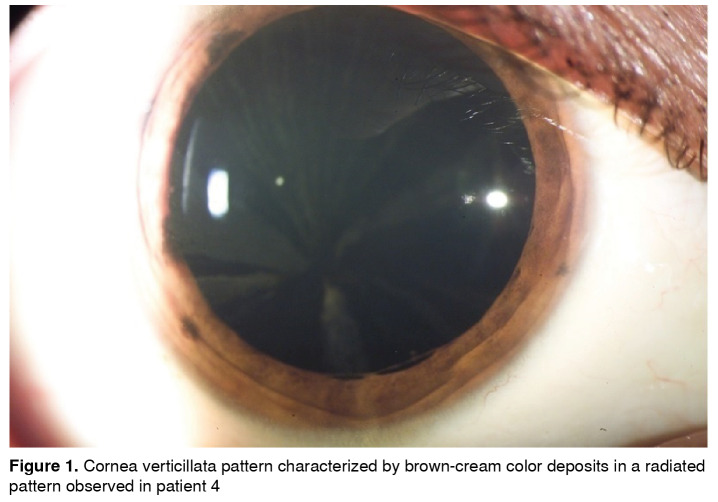
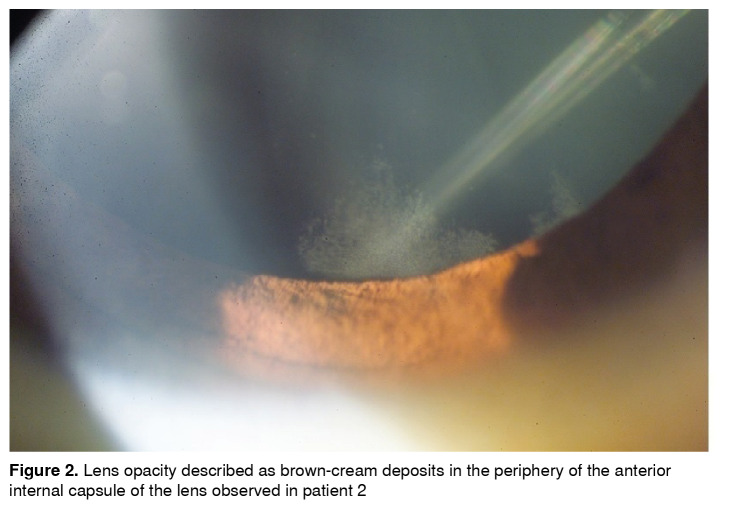
Fabry disease is a rare X-linked disorder caused by an alpha-galactosidase enzyme deficiency, which leads to a progressive lysosomal glycosphingolipids accumulation, mainly globotriaosylceramide, in multiple organism tissues including the eye. This case series describes the first ophthalmological Colombian report of Fabry disease highlighting the importance of ocular signs as markers of the disease, useful in diagnosis and treatment to avoid long-term complications that lead to a morbi-mortality increment. We describe five cases of Fabry disease from Bogotá, Colombia, including a complete clinical history, ophthalmologic, optometric examination, and photographs. We found that all patients had refractive defects and that in all cases corneal verticillata pattern was found. Four patients presented with posterior capsule lens brown-beige deposits and four patients had conjunctival and retinal tortuous vessels. A complete ophthalmologic examination is important for prompt diagnosis, which is key to starting a multidisciplinary treatment and reducing morbi-mortality.
La enfermedad de Fabry es un raro trastorno ligado al cromosoma X causado por deficiencia de la enzima alfa-galactosidasa y la consiguiente y progresiva acumulación lisosómica de glucoesfingolípidos, especialmente la globotriaosilceramida, en múltiples tejidos del organismo, incluido el ojo. En este reporte se presenta la primera serie de casos de manifestaciones oculares de la enfermedad de Fabry en Colombia, resaltando la importancia de los signos oculares como ayuda para el diagnóstico temprano. Se presentan cinco casos de la enfermedad en Bogotá y se da cuenta de las historias clínicas y los exámenes oftalmológicos y de optometría, y se incluyen fotografías. En todos los pacientes se hallaron errores de refracción y se evidenció el patrón de córnea verticillata. Cuatro pacientes presentaban depósitos de color café y castaño claro en la cápsula posterior del cristalino, y cuatro tenían tortuosidad vascular conjuntival y retiniana. El examen oftalmológico completo es importante para hacer un diagnóstico oportuno con el fin de iniciar el tratamiento multidisciplinario y reducir la morbimortalidad.
La enfermedad de Fabry es un raro trastorno ligado al cromosoma X causado por deficiencia de la enzima alfa-galactosidasa y la consiguiente y progresiva acumulación lisosómica de glucoesfingolípidos, especialmente la globotriaosilceramida, en múltiples tejidos del organismo, incluido el ojo. En este reporte se presenta la primera serie de casos de manifestaciones oculares de la enfermedad de Fabry en Colombia, resaltando la importancia de los signos oculares como ayuda para el diagnóstico temprano. Se presentan cinco casos de la enfermedad en Bogotá y se da cuenta de las historias clínicas y los exámenes oftalmológicos y de optometría, y se incluyen fotografías. En todos los pacientes se hallaron errores de refracción y se evidenció el patrón de córnea verticillata. Cuatro pacientes presentaban depósitos de color café y castaño claro en la cápsula posterior del cristalino, y cuatro tenían tortuosidad vascular conjuntival y retiniana. El examen oftalmológico completo es importante para hacer un diagnóstico oportuno con el fin de iniciar el tratamiento multidisciplinario y reducir la morbimortalidad.
Keywords: Fabry disease; alpha-Galactosidase; lysosomal storage diseases; corneal opacity; retinal vessels; lens capsule; crystalline.
Conflict of interest statement
Figures