Review
. 2019 Oct:58:175-180.
doi: 10.1016/j.conb.2019.09.008. Epub 2019 Oct 1.

Functional flexibility in cortical circuits

Affiliations
Review

Functional flexibility in cortical circuits

Jessica A Cardin. Curr Opin Neurobiol. 2019 Oct.

Abstract

Cortical networks receive a highly variable stream of inputs from internal and external influences, and must flexibly adapt their operations on a short timescale. Recent work has highlighted this state-dependent functional flexibility of cortical circuits and provided initial insights into underlying circuit-level mechanisms. Transitions from quiescent to aroused or task-engaged behavioral states are associated with common motifs of network activity, including changes in correlations and enhanced sensory encoding. Evidence points to a key role for selective activation of specific GABAergic interneuron populations in mediating mode-switching in cortical networks. Finally, inhibitory interneurons may function as a critical target for convergent state-dependent neuromodulatory sculpting of cortical circuits.


Conflict of interest statement

Conflict of interest

The author declares no conflict of interest.

Figures
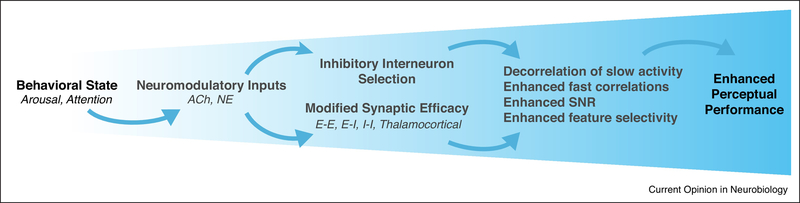
Figure 1.
Figure 1.
Cortical function is flexibly modulated by behavioral state. Changes in behavioral state during wakefulness, such as increased arousal or attention, are associated with increased release of acetylcholine (ACh) and norepinephrine (NE). These neuromodulators have many effects in the cortex, including depolarization of inhibitory interneurons, such as the VIP and SST cells, and regulation of cortico-cortical synapses among excitatory (E) and inhibitory (I) cells as well as thalamocortical synapses. These cellular effects lead to altered circuit activity, including modulation of pairwise temporal correlations between neurons and enhancement of sensory encoding. Together, state-dependent modulation of cellular and circuit interactions leads to enhanced performance of perceptual and cognitive tasks.
Figure 2.
Figure 2.
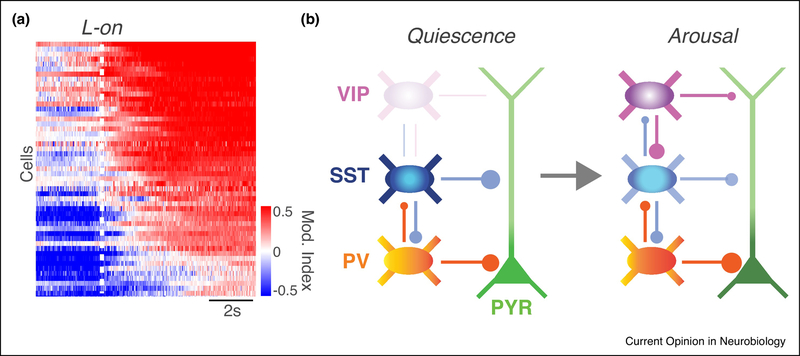
Online sculpting of the functional cortical circuit. A. Activity of GCamp6-expressing VIP interneurons in primary visual cortex of an awake behaving mouse around the time of locomotion onset (L-on) as compared to a preceding quiescent period, quantified as a modulation index. The majority of VIP cells exhibit increased activity during locomotion, and some cells also show anticipatory activity preceding motor output. Adapted from [50]. B. Schematic of a local cortical circuit with PV (orange), SST (blue), and VIP (purple) -expressing interneurons and a pyramidal neuron (green). Under quiescent conditions, VIP interneurons may be minimally participatory in the local circuit. Upon arousal, VIP cells are robustly recruited into the functional local circuit, potentially altering the balance of dendrite- and soma-targeting inhibition and increasing pyramidal neuron output.

References

    1. Marder E: Modifiability of pattern generation. Curr Opin Neurobiol 1991, 1:571–576. - PubMed
    1. Engel TA, Steinmetz NA, Gieselmann MA, Thiele A, Moore T, Boahen K: Selective modulation of cortical state during spatial attention. Science 2016, 354:1140–1144. - PubMed
    1. Reimer J, Froudarakis E, Cadwell CR, Yatsenko D, Denfield GH, Tolias AS: Pupil fluctuations track fast switching of cortical states during quiet wakefulness. Neuron 2014, 84:355–362. - PMC - PubMed
    1. Vinck M, Batista-Brito R, Knoblich U, Cardin JA: Arousal and locomotion make distinct contributions to cortical activity patterns and visual encoding. Neuron 2015, 86:740–754. - PMC - PubMed
    1. Musall S, Kaufman MT, Juavinett AL, Gluf S, Churchland AK: Single-trial neural dynamics are dominated by richly varied movements. bioRxiv 2019. - PMC - PubMed

Publication types