


Genomics of LGL leukemia and select other rare leukemia/lymphomas
- PMID: 31585620
- PMCID: PMC6779335
- DOI: 10.1016/j.beha.2019.06.003
Genomics of LGL leukemia and select other rare leukemia/lymphomas
Abstract
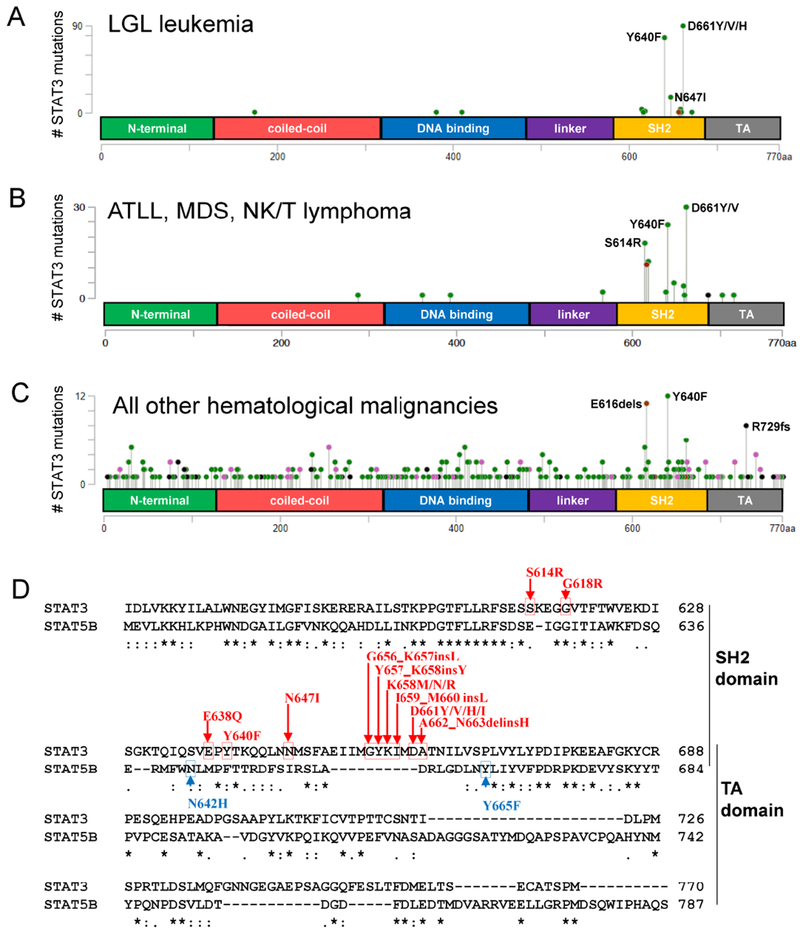
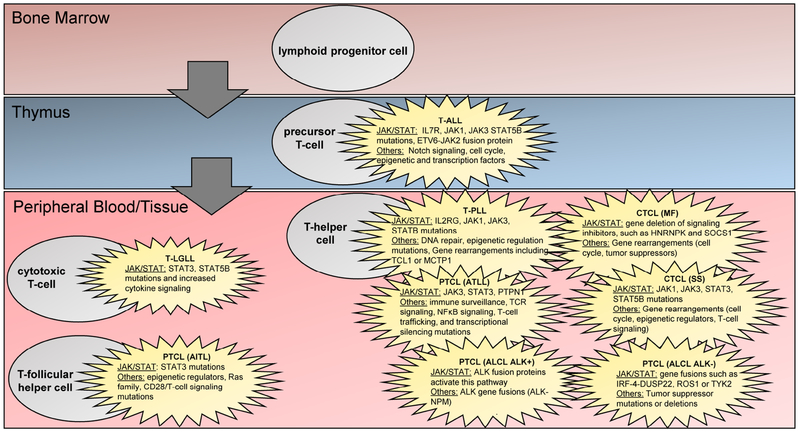
Genomic analysis of cancer offers the hope of identifying new treatments or aiding in the selection of existing treatments. Rare leukemias pose additional challenges in this regard as samples may be hard to acquire and when found the underlying pathway may not be attractive to drug development since so few individuals are affected. In this case, it can be useful to identify common mutational overlap among subsets of rare leukemias to increase the number of individuals that may benefit from a targeted therapy. This chapter examines the current mutational landscape of large granular lymphocyte (LGL) leukemia with a focus on STAT3 mutations, the most common mutation in LGL leukemia to date. We examined the linkage between these mutations and autoimmune symptoms and disorders, in cases of obvious and suspected LGL leukemia. We then summarized and compared mutations in a set of other rare leukemias that also have JAK/STAT signaling pathway activation brought about by genomic changes. These include T-cell acute lymphoblastic leukemia (T-ALL), T-cell prolymphocytic leukemia (T-PLL), cutaneous T-cell lymphoma (CTCL), select peripheral T-cell lymphoma (PTCL), and adult T-cell leukemia/lymphoma (ATLL). Though STAT3 activation is common in these leukemias, the way in which it is achieved, such as the activating cytokine pathway and/or the co-mutational background, is quite diverse.
Keywords: ATLL; CTCL; JAK/STAT; LGL; PTCL; STAT3; T-ALL; T-PLL.
Copyright © 2019 Elsevier Ltd. All rights reserved.
Conflict of interest statement
Conflict of Interest
Thomas P. Loughran, Jr. is on the Scientific Advisory Board and has stock options for both Keystone Nano and Bioniz Therapeutics. There are no conflicts of interest with the work presented in this manuscript.
Figures
References
-
- Melenhorst JJ, Eniafe R, Follmann D, Molldrem J, Kirby M, El Ouriaghli F, et al. T-cell large granular lymphocyte leukemia is characterized by massive TCRBV-restricted clonal CD8 expansion and a generalized overexpression of the effector cell marker CD57. Hematol J. 2003;4(1):18–25. - PubMed
-
- Loughran TP. Clonal diseases of large granular lymphocytes. Blood. 1993. July 1;82(1): 1–14. - PubMed
-
- Lamy T, Moignet A, Loughran TP. LGL leukemia: from pathogenesis to treatment. Blood. 2017. March 2;129(9):1082–1094. - PubMed
Publication types
MeSH terms
Substances
Grants and funding
LinkOut - more resources
Full Text Sources
Medical
Miscellaneous
